

E1C12 09/14/2010
13:54:20 Page 559
PROBLEMS
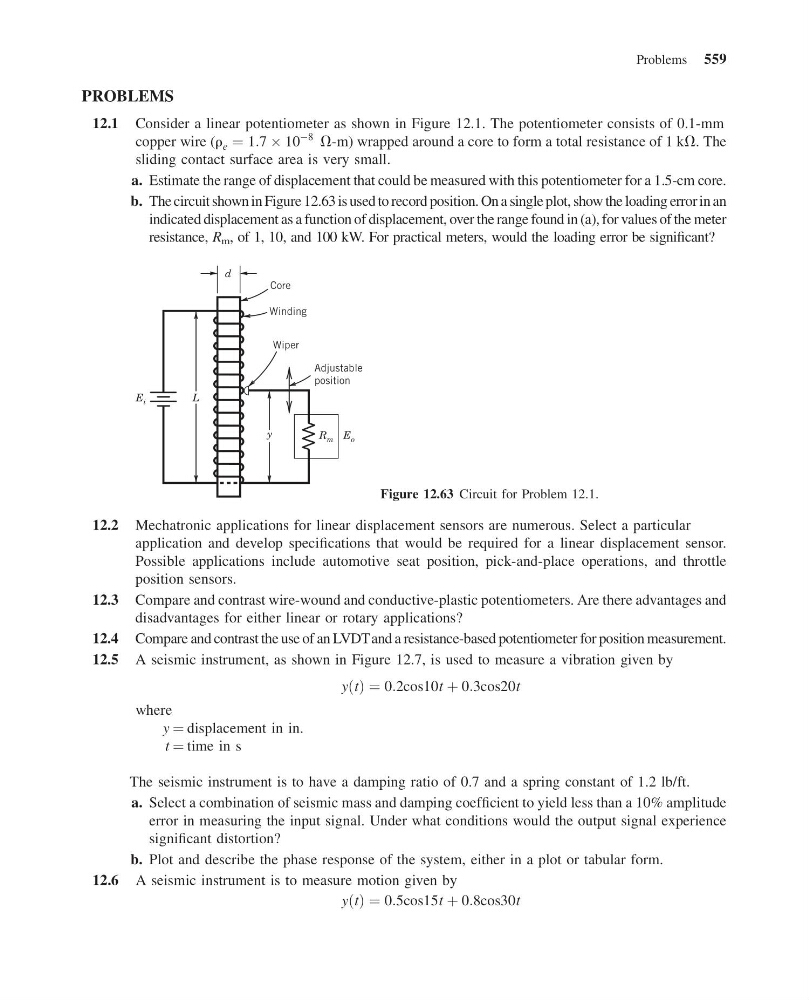
12.1 Consider a linear potentiometer as shown in Figure 12.1. The potentiometer consists of 0.1-mm
copper wire (r e ¼ 1:7 Â 10
À8
V-m) wrapped around a core to form a total resistance of 1 kV. The
sliding contact surface area is very small.
a. Estimate the range of displacement that could be measured with this potentiometer for a 1.5-cm core.
b. The circuit shown in Figure 12.63 is used to record position. On a single plot, show the loading error in an
indicated displacement as a function of displacement, over the range found in (a), for values of the meter
resistance, R m , of 1, 10, and 100 kW. For practical meters, would the loading error be significant?
12.2 Mechatronic applications for linear displacement sensors are numerous. Select a particular
application and develop specifications that would be required for a linear displacement sensor.
Possible applications include automotive seat position, pick-and-place operations, and throttle
position sensors.
12.3 Compare and contrast wire-wound and conductive-plastic potentiometers. Are there advantages and
disadvantages for either linear or rotary applications?
12.4 Compare and contrast the use of an LVDTand a resistance-based potentiometer for position measurement.
12.5 A seismic instrument, as shown in Figure 12.7, is used to measure a vibration given by
y t
ð Þ ¼ 0:2cos10t þ 0:3cos20t
where
y ¼ displacement in in.
t ¼ time in s
The seismic instrument is to have a damping ratio of 0.7 and a spring constant of 1.2 lb/ft.
a. Select a combination of seismic mass and damping coefficient to yield less than a 10% amplitude
error in measuring the input signal. Under what conditions would the output signal experience
significant distortion?
b. Plot and describe the phase response of the system, either in a plot or tabular form.
12.6 A seismic instrument is to measure motion given by
y t
ð Þ ¼ 0:5cos15t þ 0:8cos30t
d
Core
Winding
Wiper
Adjustable
position
E i
L
R m E o
y
Figure 12.63 Circuit for Problem 12.1.
Problems 559
13:54:20 Page 559
PROBLEMS
12.1 Consider a linear potentiometer as shown in Figure 12.1. The potentiometer consists of 0.1-mm
copper wire (r e ¼ 1:7 Â 10
À8
V-m) wrapped around a core to form a total resistance of 1 kV. The
sliding contact surface area is very small.
a. Estimate the range of displacement that could be measured with this potentiometer for a 1.5-cm core.
b. The circuit shown in Figure 12.63 is used to record position. On a single plot, show the loading error in an
indicated displacement as a function of displacement, over the range found in (a), for values of the meter
resistance, R m , of 1, 10, and 100 kW. For practical meters, would the loading error be significant?
12.2 Mechatronic applications for linear displacement sensors are numerous. Select a particular
application and develop specifications that would be required for a linear displacement sensor.
Possible applications include automotive seat position, pick-and-place operations, and throttle
position sensors.
12.3 Compare and contrast wire-wound and conductive-plastic potentiometers. Are there advantages and
disadvantages for either linear or rotary applications?
12.4 Compare and contrast the use of an LVDTand a resistance-based potentiometer for position measurement.
12.5 A seismic instrument, as shown in Figure 12.7, is used to measure a vibration given by
y t
ð Þ ¼ 0:2cos10t þ 0:3cos20t
where
y ¼ displacement in in.
t ¼ time in s
The seismic instrument is to have a damping ratio of 0.7 and a spring constant of 1.2 lb/ft.
a. Select a combination of seismic mass and damping coefficient to yield less than a 10% amplitude
error in measuring the input signal. Under what conditions would the output signal experience
significant distortion?
b. Plot and describe the phase response of the system, either in a plot or tabular form.
12.6 A seismic instrument is to measure motion given by
y t
ð Þ ¼ 0:5cos15t þ 0:8cos30t
d
Core
Winding
Wiper
Adjustable
position
E i
L
R m E o
y
Figure 12.63 Circuit for Problem 12.1.
Problems 559