

E1C12 09/14/2010
13:54:11 Page 529
where
dy ¼ deflection along the applied force
F n ¼ applied force
D ¼ diameter
E ¼ modulus of elasticity
I ¼ moment of inertia
The application of the proving ring involves measuring the deflection of the proving ring in
the direction of the applied force. Typical methods for this displacement measurement include
displacement transducers, which measure overall displacement, and strain gauges. These methods
are illustrated in Figure 12.25.
Torque Measurements
Torque and mechanical power measurements are often associated with the energy conversion
processes that serve to provide mechanical and electrical power to our industrial world. Such
energy conversion processes are largely characterized by the mechanical transmission of
power produced by prime movers such as internal combustion engines. From automobiles to
turbine-generator sets, mechanical power transmission occurs through torque acting through a
rotating shaft.
The measurement of torque is important in a variety of applications, including sizing of
load-carrying shafts. This measurement is also a crucial aspect of the measurement of shaft
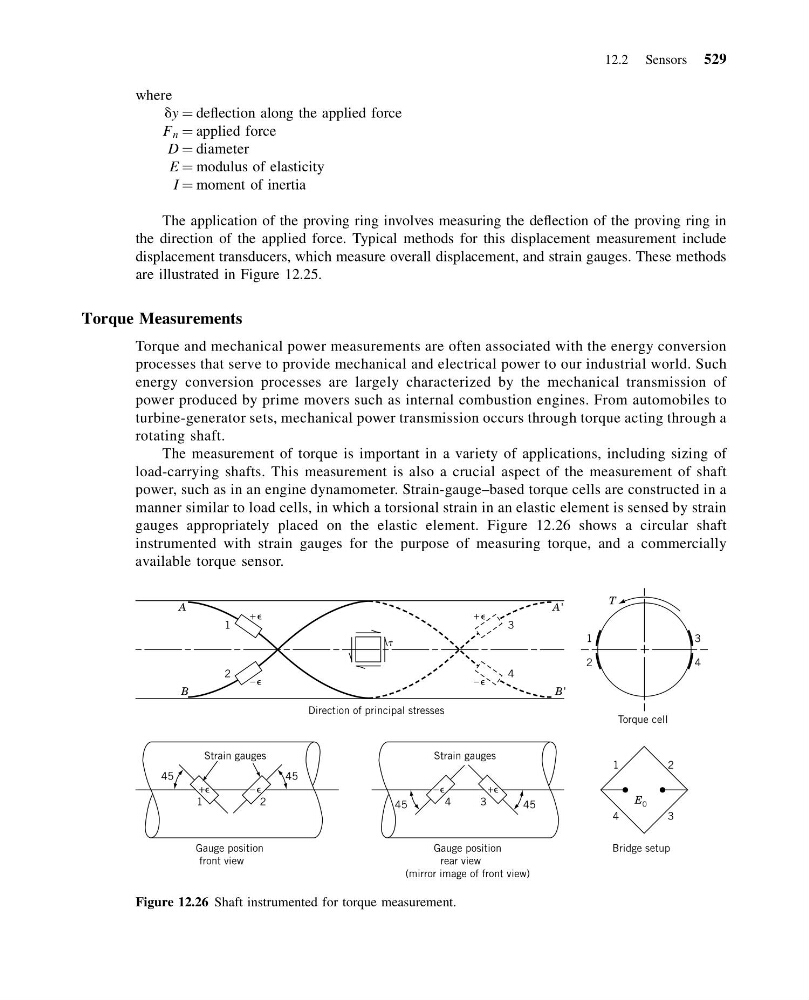
power, such as in an engine dynamometer. Strain-gauge–based torque cells are constructed in a
manner similar to load cells, in which a torsional strain in an elastic element is sensed by strain
gauges appropriately placed on the elastic element. Figure 12.26 shows a circular shaft
instrumented with strain gauges for the purpose of measuring torque, and a commercially
available torque sensor.
Gauge position
front view
Gauge position
rear view
(mirror image of front view)
Direction of principal stresses
s
e
g
u
a
g
n
i
a
r
t
S
s
e
g
u
a
g
n
i
a
r
t
S
45
5
4
5
4
45
4
1
4
B'
E 0
A'
B
A
T
4
2
3
1
3
1
2
3
2
Bridge setup
Torque cell
–
–
–
–
+
+
+
+
1
2
3
4
Figure 12.26 Shaft instrumented for torque measurement.
12.2 Sensors 529
13:54:11 Page 529
where
dy ¼ deflection along the applied force
F n ¼ applied force
D ¼ diameter
E ¼ modulus of elasticity
I ¼ moment of inertia
The application of the proving ring involves measuring the deflection of the proving ring in
the direction of the applied force. Typical methods for this displacement measurement include
displacement transducers, which measure overall displacement, and strain gauges. These methods
are illustrated in Figure 12.25.
Torque Measurements
Torque and mechanical power measurements are often associated with the energy conversion
processes that serve to provide mechanical and electrical power to our industrial world. Such
energy conversion processes are largely characterized by the mechanical transmission of
power produced by prime movers such as internal combustion engines. From automobiles to
turbine-generator sets, mechanical power transmission occurs through torque acting through a
rotating shaft.
The measurement of torque is important in a variety of applications, including sizing of
load-carrying shafts. This measurement is also a crucial aspect of the measurement of shaft
power, such as in an engine dynamometer. Strain-gauge–based torque cells are constructed in a
manner similar to load cells, in which a torsional strain in an elastic element is sensed by strain
gauges appropriately placed on the elastic element. Figure 12.26 shows a circular shaft
instrumented with strain gauges for the purpose of measuring torque, and a commercially
available torque sensor.
Gauge position
front view
Gauge position
rear view
(mirror image of front view)
Direction of principal stresses
s
e
g
u
a
g
n
i
a
r
t
S
s
e
g
u
a
g
n
i
a
r
t
S
45
5
4
5
4
45
4
1
4
B'
E 0
A'
B
A
T
4
2
3
1
3
1
2
3
2
Bridge setup
Torque cell
–
–
–
–
+
+
+
+
1
2
3
4
Figure 12.26 Shaft instrumented for torque measurement.
12.2 Sensors 529