

E1C01 09/14/2010
15:40:39 Page 39
b. Tennis strings: A new tennis string material is to be tested for durability. String failure occurs due
to breakage or due to loss of tension. String life is a function of the racquet, the player’s style, and
string tension.
c. Tennis balls: Two tennis balls are to be play tested for durability. The condition of a tennis ball can
be described by the coefficient of restitution, and the total weight (since the cover material
actually is lost during play). A player’s style and the court surface are the primary determining
factors on tennis ball wear.
1.49 The acceleration of a cart down a plane inclined at an angle a to horizontal can be determined by
measuring the change in speed of the cart at two points, separated by a distance s, along the inclined
plane. Suppose two photocells are fixed at the two points along the plane. Each photocell measures
the time for the cart, which has a length L, to pass it. Identify the important variables in this test. List
any assumptions that you feel are intrinsic to such a test. Suggest a concomitant approach. How
would you interpret the data to answer the question?
1.50 Is it more fuel efficient to drive a car in warm, humid weather with the air conditioning on and
windows closed, or with the air conditioning off and the windows open for ventilation? Develop a test
plan to address this question. Include a concomitant approach (experimental or analytical) that might
assess the validity of your test results.
1.51 Explain the potential differences in the following evaluations of an instrument’s accuracy.
Figure 1.12 will be useful, and you may refer to ASTM E177, if needed.
a. The closeness of agreement between the true value and the average of a large set of measurements.
b. The closeness of agreement between the true value and an individual measurement.
1.52 Suggest a reasonable number of significant digits for reporting the following common values and
give some indication as to your reasoning:
a. Your body weight for a passport
b. A car’s fuel usage (use liters per 100 km)
Strain
gauge
E o
Excitation
voltage
Voltmeter
Output
voltage
2.121
(Resistance, R)
Tensile
loading
Resistance,
R
R
R
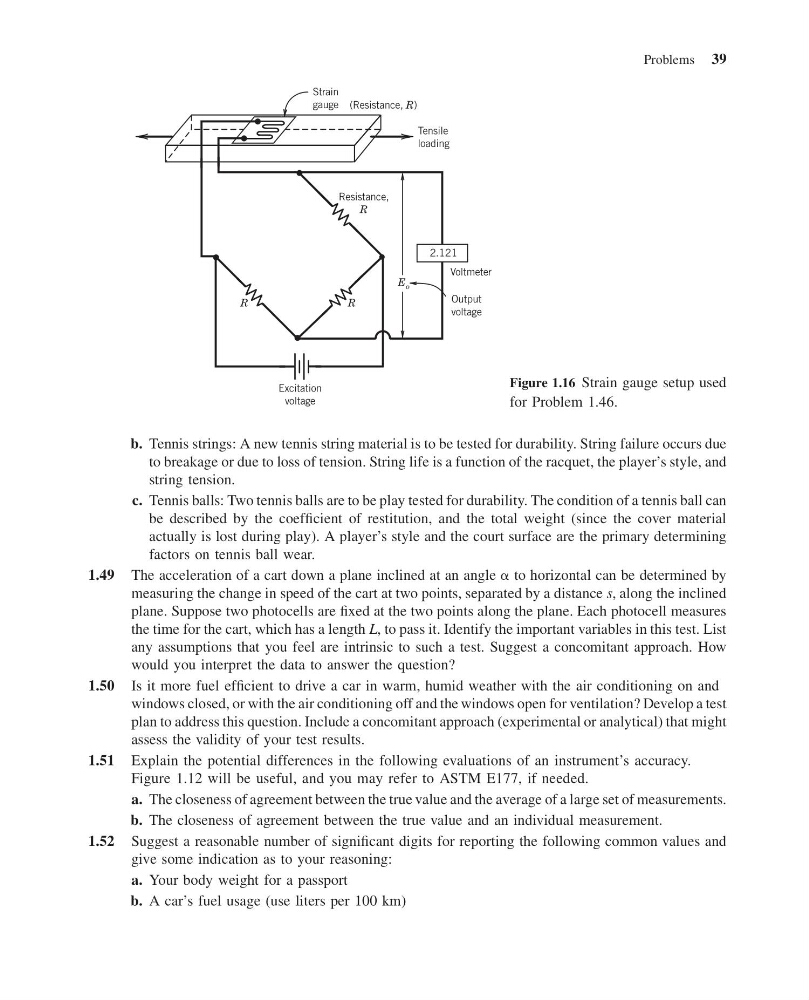
Figure 1.16 Strain gauge setup used
for Problem 1.46.
Problems 39
15:40:39 Page 39
b. Tennis strings: A new tennis string material is to be tested for durability. String failure occurs due
to breakage or due to loss of tension. String life is a function of the racquet, the player’s style, and
string tension.
c. Tennis balls: Two tennis balls are to be play tested for durability. The condition of a tennis ball can
be described by the coefficient of restitution, and the total weight (since the cover material
actually is lost during play). A player’s style and the court surface are the primary determining
factors on tennis ball wear.
1.49 The acceleration of a cart down a plane inclined at an angle a to horizontal can be determined by
measuring the change in speed of the cart at two points, separated by a distance s, along the inclined
plane. Suppose two photocells are fixed at the two points along the plane. Each photocell measures
the time for the cart, which has a length L, to pass it. Identify the important variables in this test. List
any assumptions that you feel are intrinsic to such a test. Suggest a concomitant approach. How
would you interpret the data to answer the question?
1.50 Is it more fuel efficient to drive a car in warm, humid weather with the air conditioning on and
windows closed, or with the air conditioning off and the windows open for ventilation? Develop a test
plan to address this question. Include a concomitant approach (experimental or analytical) that might
assess the validity of your test results.
1.51 Explain the potential differences in the following evaluations of an instrument’s accuracy.
Figure 1.12 will be useful, and you may refer to ASTM E177, if needed.
a. The closeness of agreement between the true value and the average of a large set of measurements.
b. The closeness of agreement between the true value and an individual measurement.
1.52 Suggest a reasonable number of significant digits for reporting the following common values and
give some indication as to your reasoning:
a. Your body weight for a passport
b. A car’s fuel usage (use liters per 100 km)
Strain
gauge
E o
Excitation
voltage
Voltmeter
Output
voltage
2.121
(Resistance, R)
Tensile
loading
Resistance,
R
R
R
Figure 1.16 Strain gauge setup used
for Problem 1.46.
Problems 39