

E1C11 09/14/2010
13:14:4 Page 489
Example 11.6
A rectangular strain gauge rosette is composed of strain gauges oriented at relative angles
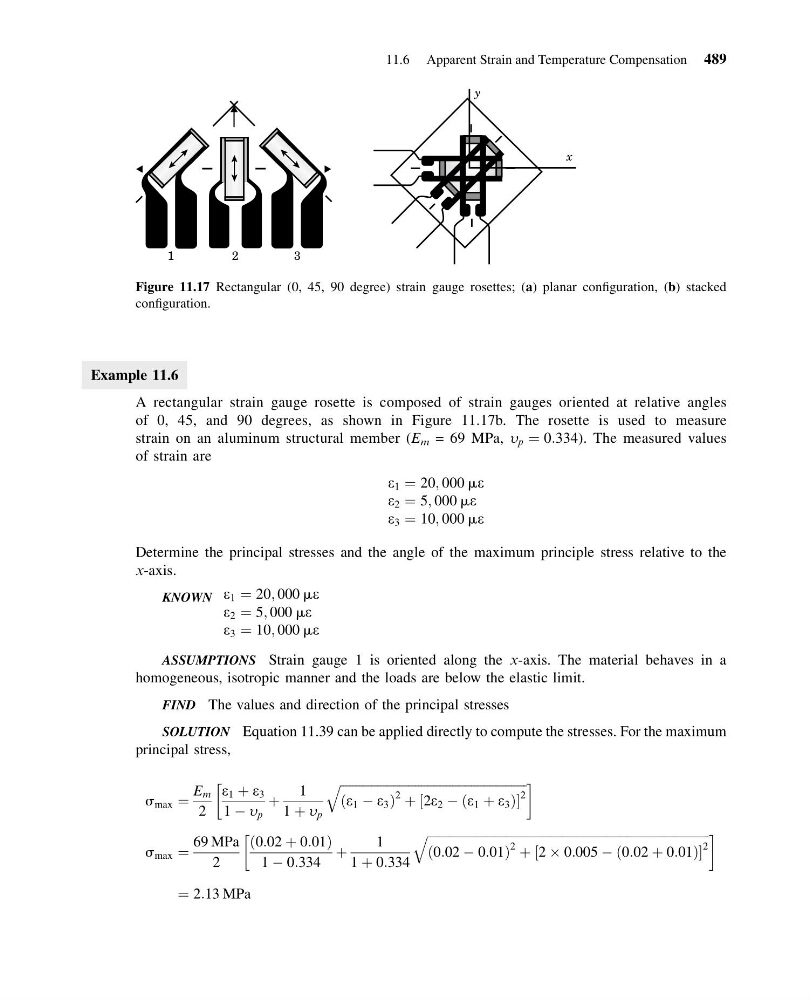
of 0, 45, and 90 degrees, as shown in Figure 11.17b. The rosette is used to measure
strain on an aluminum structural member (E m = 69 MPa, y p ¼ 0:334). The measured values
of strain are
e 1 ¼ 20; 000 me
e 2 ¼ 5; 000 me
e 3 ¼ 10; 000 me
Determine the principal stresses and the angle of the maximum principle stress relative to the
x-axis.
KNOWN e 1 ¼ 20; 000 me
e 2 ¼ 5; 000 me
e 3 ¼ 10; 000 me
ASSUMPTIONS Strain gauge 1 is oriented along the x-axis. The material behaves in a
homogeneous, isotropic manner and the loads are below the elastic limit.
FIND The values and direction of the principal stresses
SOLUTION Equation 11.39 can be applied directly to compute the stresses. For the maximum
principal stress,
s max ¼
E m
2
e 1 þ e 3
1 À y p
þ
1
1 þ y p
ffiffiffiffiffiffiffiffiffiffiffiffiffiffiffiffiffiffiffiffiffiffiffiffiffiffiffiffiffiffiffiffiffiffiffiffiffiffiffiffiffiffiffiffiffiffiffiffiffiffiffiffiffiffiffiffiffiffiffiffi
e 1 À e 3
ð
Þ
2 þ 2e 2 À e 1 þ e 3
ð
Þ
½
2
q
!
s max ¼
69 MPa
2
0:02 þ 0:01
ð
Þ
1 À 0:334
þ
1
1 þ 0:334
ffiffiffiffiffiffiffiffiffiffiffiffiffiffiffiffiffiffiffiffiffiffiffiffiffiffiffiffiffiffiffiffiffiffiffiffiffiffiffiffiffiffiffiffiffiffiffiffiffiffiffiffiffiffiffiffiffiffiffiffiffiffiffiffiffiffiffiffiffiffiffiffiffiffiffiffiffiffiffiffiffiffiffiffiffiffiffiffiffiffi ffi
0:02 À 0:01
ð
Þ
2 þ 2 Â 0:005 À 0:02 þ 0:01
ð
Þ
½
2
q
!
¼ 2:13 MPa
y
1
2
3
x
Figure 11.17 Rectangular (0, 45, 90 degree) strain gauge rosettes; (a) planar configuration, (b) stacked
configuration.
11.6 Apparent Strain and Temperature Compensation 489
13:14:4 Page 489
Example 11.6
A rectangular strain gauge rosette is composed of strain gauges oriented at relative angles
of 0, 45, and 90 degrees, as shown in Figure 11.17b. The rosette is used to measure
strain on an aluminum structural member (E m = 69 MPa, y p ¼ 0:334). The measured values
of strain are
e 1 ¼ 20; 000 me
e 2 ¼ 5; 000 me
e 3 ¼ 10; 000 me
Determine the principal stresses and the angle of the maximum principle stress relative to the
x-axis.
KNOWN e 1 ¼ 20; 000 me
e 2 ¼ 5; 000 me
e 3 ¼ 10; 000 me
ASSUMPTIONS Strain gauge 1 is oriented along the x-axis. The material behaves in a
homogeneous, isotropic manner and the loads are below the elastic limit.
FIND The values and direction of the principal stresses
SOLUTION Equation 11.39 can be applied directly to compute the stresses. For the maximum
principal stress,
s max ¼
E m
2
e 1 þ e 3
1 À y p
þ
1
1 þ y p
ffiffiffiffiffiffiffiffiffiffiffiffiffiffiffiffiffiffiffiffiffiffiffiffiffiffiffiffiffiffiffiffiffiffiffiffiffiffiffiffiffiffiffiffiffiffiffiffiffiffiffiffiffiffiffiffiffiffiffiffi
e 1 À e 3
ð
Þ
2 þ 2e 2 À e 1 þ e 3
ð
Þ
½
2
q
!
s max ¼
69 MPa
2
0:02 þ 0:01
ð
Þ
1 À 0:334
þ
1
1 þ 0:334
ffiffiffiffiffiffiffiffiffiffiffiffiffiffiffiffiffiffiffiffiffiffiffiffiffiffiffiffiffiffiffiffiffiffiffiffiffiffiffiffiffiffiffiffiffiffiffiffiffiffiffiffiffiffiffiffiffiffiffiffiffiffiffiffiffiffiffiffiffiffiffiffiffiffiffiffiffiffiffiffiffiffiffiffiffiffiffiffiffiffi ffi
0:02 À 0:01
ð
Þ
2 þ 2 Â 0:005 À 0:02 þ 0:01
ð
Þ
½
2
q
!
¼ 2:13 MPa
y
1
2
3
x
Figure 11.17 Rectangular (0, 45, 90 degree) strain gauge rosettes; (a) planar configuration, (b) stacked
configuration.
11.6 Apparent Strain and Temperature Compensation 489