

E1C01 09/14/2010
15:40:39 Page 37
1.35 The sale of motor fuel is an essential business in the global economy. Federal (US) law requires
accurate measurement of the quantity of fuel delivered at a retail establishment. Determine:
a. The federal standard for minimum accuracy of a gas pump.
b. The maximum allowable error in the delivery of 25 gallons of fuel (or 100 L of fuel).
c. An estimate of the cost of the maximum allowable error over the 10-year life of a vehicle that is
driven 15,000 miles per year at the average fuel mileage of the American passenger car fleet.
1.36 For the orifice meter calibration in Problem 1.34: Would the term ‘‘linearity error’’ have a meaning
for this system? Explain. Also, list the dependent and independent variables in the calibration.
1.37 A piston engine manufacturer uses four different subcontractors to plate the pistons for a make of
engine. Plating thickness is important in quality control (performance and part life). Devise a test
matrix to assess how well the manufacturer can control plating under its current system.
1.38 A simple thermocouple circuit is formed using two wires of different alloy: one end of the wires is
twisted together to form the measuring junction, while the other ends are connected to a voltmeter
and form the reference junction. A voltage is set up by the difference in temperature between the two
junctions. For a given pair of alloy material and reference junction temperature, the temperature of
the measuring junction is inferred from the measured voltage difference. For a measurement, what
variables need to be controlled? What are the dependent and independent variables?
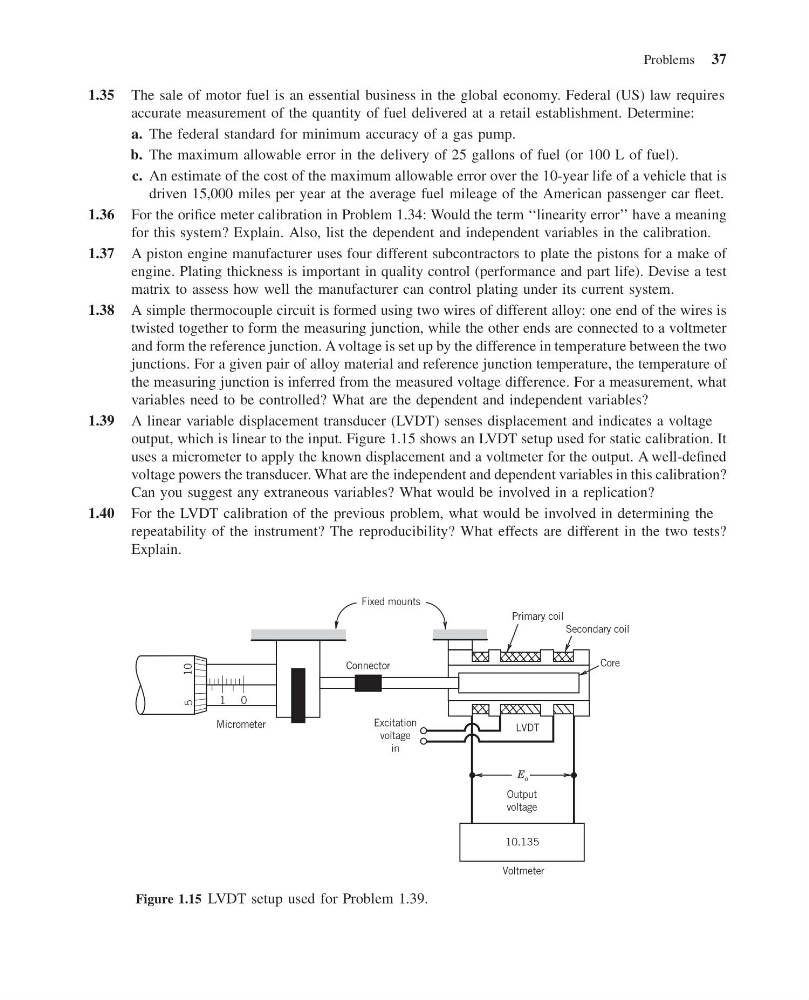
1.39 A linear variable displacement transducer (LVDT) senses displacement and indicates a voltage
output, which is linear to the input. Figure 1.15 shows an LVDT setup used for static calibration. It
uses a micrometer to apply the known displacement and a voltmeter for the output. A well-defined
voltage powers the transducer. What are the independent and dependent variables in this calibration?
Can you suggest any extraneous variables? What would be involved in a replication?
1.40 For the LVDT calibration of the previous problem, what would be involved in determining the
repeatability of the instrument? The reproducibility? What effects are different in the two tests?
Explain.
Micrometer
5
10.135
1 0
Connector
Fixed mounts
Excitation
voltage
in
Primary coil
Secondary coil
Core
LVDT
E o
Output
voltage
10
Voltmeter
Figure 1.15 LVDT setup used for Problem 1.39.
Problems 37
15:40:39 Page 37
1.35 The sale of motor fuel is an essential business in the global economy. Federal (US) law requires
accurate measurement of the quantity of fuel delivered at a retail establishment. Determine:
a. The federal standard for minimum accuracy of a gas pump.
b. The maximum allowable error in the delivery of 25 gallons of fuel (or 100 L of fuel).
c. An estimate of the cost of the maximum allowable error over the 10-year life of a vehicle that is
driven 15,000 miles per year at the average fuel mileage of the American passenger car fleet.
1.36 For the orifice meter calibration in Problem 1.34: Would the term ‘‘linearity error’’ have a meaning
for this system? Explain. Also, list the dependent and independent variables in the calibration.
1.37 A piston engine manufacturer uses four different subcontractors to plate the pistons for a make of
engine. Plating thickness is important in quality control (performance and part life). Devise a test
matrix to assess how well the manufacturer can control plating under its current system.
1.38 A simple thermocouple circuit is formed using two wires of different alloy: one end of the wires is
twisted together to form the measuring junction, while the other ends are connected to a voltmeter
and form the reference junction. A voltage is set up by the difference in temperature between the two
junctions. For a given pair of alloy material and reference junction temperature, the temperature of
the measuring junction is inferred from the measured voltage difference. For a measurement, what
variables need to be controlled? What are the dependent and independent variables?
1.39 A linear variable displacement transducer (LVDT) senses displacement and indicates a voltage
output, which is linear to the input. Figure 1.15 shows an LVDT setup used for static calibration. It
uses a micrometer to apply the known displacement and a voltmeter for the output. A well-defined
voltage powers the transducer. What are the independent and dependent variables in this calibration?
Can you suggest any extraneous variables? What would be involved in a replication?
1.40 For the LVDT calibration of the previous problem, what would be involved in determining the
repeatability of the instrument? The reproducibility? What effects are different in the two tests?
Explain.
Micrometer
5
10.135
1 0
Connector
Fixed mounts
Excitation
voltage
in
Primary coil
Secondary coil
Core
LVDT
E o
Output
voltage
10
Voltmeter
Figure 1.15 LVDT setup used for Problem 1.39.
Problems 37