

E1C09 09/14/2010
15:4:53 Page 387
over its operating range. When this is a consideration, a voltage follower (see Chapter 6) can be
inserted at the output of the transducer to isolate transducer load.
Bourdon Tube
The Bourdon tube is a curved metal tube having an elliptical cross section that mechanically
deforms under pressure. In practice, one end of the tube is held fixed and the input pressure applied
internally. A pressure difference between the outside of the tube and the inside of the tube brings
about tube deformation and a deflection of the tube free end. This action of the tube under pressure
can be likened to the action of a deflated balloon that is subsequently inflated. The magnitude of the
deflection of the tube end is proportional to the magnitude of the pressure difference. Several
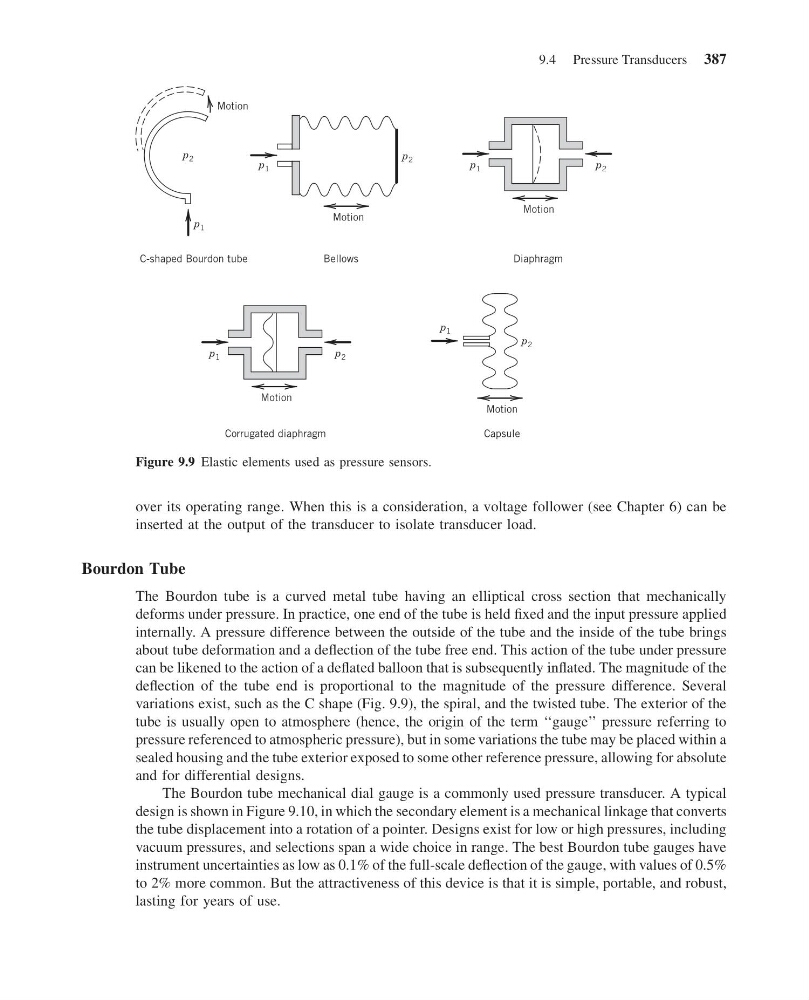
variations exist, such as the C shape (Fig. 9.9), the spiral, and the twisted tube. The exterior of the
tube is usually open to atmosphere (hence, the origin of the term ‘‘gauge’’ pressure referring to
pressure referenced to atmospheric pressure), but in some variations the tube may be placed within a
sealed housing and the tube exterior exposed to some other reference pressure, allowing for absolute
and for differential designs.
The Bourdon tube mechanical dial gauge is a commonly used pressure transducer. A typical
design is shown in Figure 9.10, in which the secondary element is a mechanical linkage that converts
the tube displacement into a rotation of a pointer. Designs exist for low or high pressures, including
vacuum pressures, and selections span a wide choice in range. The best Bourdon tube gauges have
instrument uncertainties as low as 0.1% of the full-scale deflection of the gauge, with values of 0.5%
to 2% more common. But the attractiveness of this device is that it is simple, portable, and robust,
lasting for years of use.
p 2
p 2
p 1
p 2
p 1
p 1
p 2
Motion
Motion
Motion
m
g
a
r
h
p
a
i
D
s
w
o
l
l
e
B
C-shaped Bourdon tube
Motion
Capsule
Corrugated diaphragm
p 1
p 1
p 2
Motion
Figure 9.9 Elastic elements used as pressure sensors.
9.4 Pressure Transducers 387
15:4:53 Page 387
over its operating range. When this is a consideration, a voltage follower (see Chapter 6) can be
inserted at the output of the transducer to isolate transducer load.
Bourdon Tube
The Bourdon tube is a curved metal tube having an elliptical cross section that mechanically
deforms under pressure. In practice, one end of the tube is held fixed and the input pressure applied
internally. A pressure difference between the outside of the tube and the inside of the tube brings
about tube deformation and a deflection of the tube free end. This action of the tube under pressure
can be likened to the action of a deflated balloon that is subsequently inflated. The magnitude of the
deflection of the tube end is proportional to the magnitude of the pressure difference. Several
variations exist, such as the C shape (Fig. 9.9), the spiral, and the twisted tube. The exterior of the
tube is usually open to atmosphere (hence, the origin of the term ‘‘gauge’’ pressure referring to
pressure referenced to atmospheric pressure), but in some variations the tube may be placed within a
sealed housing and the tube exterior exposed to some other reference pressure, allowing for absolute
and for differential designs.
The Bourdon tube mechanical dial gauge is a commonly used pressure transducer. A typical
design is shown in Figure 9.10, in which the secondary element is a mechanical linkage that converts
the tube displacement into a rotation of a pointer. Designs exist for low or high pressures, including
vacuum pressures, and selections span a wide choice in range. The best Bourdon tube gauges have
instrument uncertainties as low as 0.1% of the full-scale deflection of the gauge, with values of 0.5%
to 2% more common. But the attractiveness of this device is that it is simple, portable, and robust,
lasting for years of use.
p 2
p 2
p 1
p 2
p 1
p 1
p 2
Motion
Motion
Motion
m
g
a
r
h
p
a
i
D
s
w
o
l
l
e
B
C-shaped Bourdon tube
Motion
Capsule
Corrugated diaphragm
p 1
p 1
p 2
Motion
Figure 9.9 Elastic elements used as pressure sensors.
9.4 Pressure Transducers 387