

E1C09 09/14/2010
15:4:53 Page 385
common laboratory standard for the calibration of pressure-measuring devices over the
pressure range from 70 to 7 Â 10
7 N/m
2 (0.01 to 10,000 psi). A deadweight tester, such as
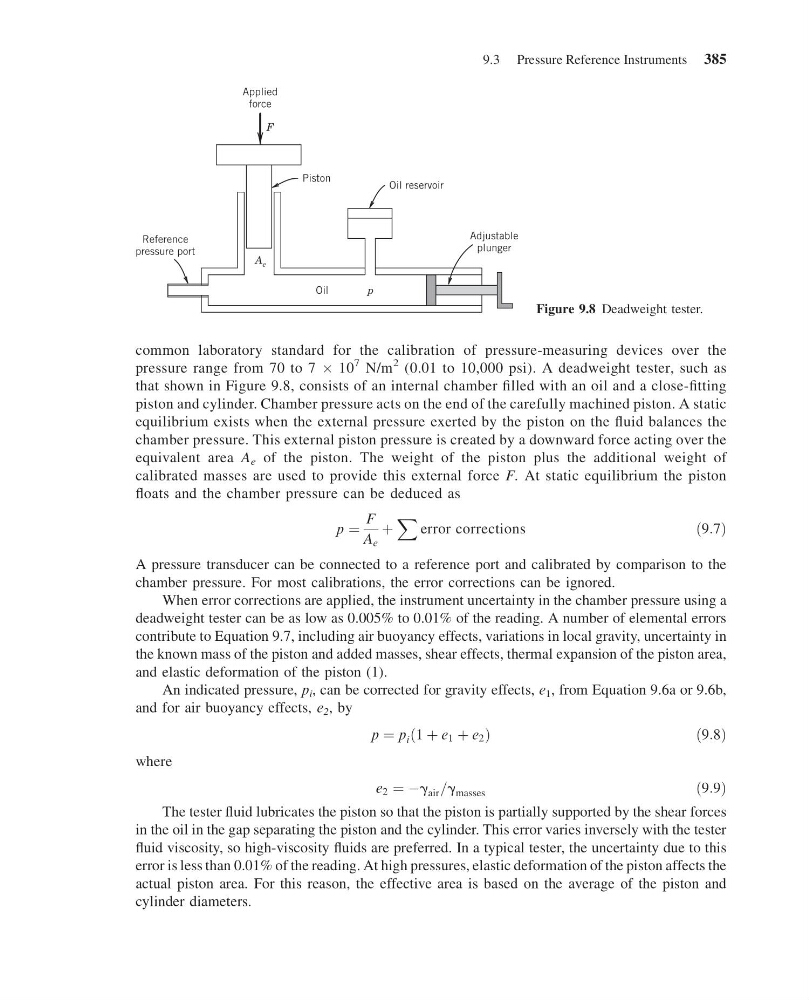
that shown in Figure 9.8, consists of an internal chamber filled with an oil and a close-fitting
piston and cylinder. Chamber pressure acts on the end of the carefully machined piston. A static
equilibrium exists when the external pressure exerted by the piston on the fluid balances the
chamber pressure. This external piston pressure is created by a downward force acting over the
equivalent area A e of the piston. The weight of the piston plus the additional weight of
calibrated masses are used to provide this external force F. At static equilibrium the piston
floats and the chamber pressure can be deduced as
p ¼
F
A e
þ
X
error corrections
ð9:7Þ
A pressure transducer can be connected to a reference port and calibrated by comparison to the
chamber pressure. For most calibrations, the error corrections can be ignored.
When error corrections are applied, the instrument uncertainty in the chamber pressure using a
deadweight tester can be as low as 0.005% to 0.01% of the reading. A number of elemental errors
contribute to Equation 9.7, including air buoyancy effects, variations in local gravity, uncertainty in
the known mass of the piston and added masses, shear effects, thermal expansion of the piston area,
and elastic deformation of the piston (1).
An indicated pressure, p i , can be corrected for gravity effects, e 1 , from Equation 9.6a or 9.6b,
and for air buoyancy effects, e 2 , by
p ¼ p i 1 þ e 1 þ e 2
ð
Þ
ð 9:8Þ
where
e 2 ¼ Àg air =g masses
ð9:9Þ
The tester fluid lubricates the piston so that the piston is partially supported by the shear forces
in the oil in the gap separating the piston and the cylinder. This error varies inversely with the tester
fluid viscosity, so high-viscosity fluids are preferred. In a typical tester, the uncertainty due to this
error is less than 0.01% of the reading. At high pressures, elastic deformation of the piston affects the
actual piston area. For this reason, the effective area is based on the average of the piston and
cylinder diameters.
Reference
pressure port
Oil
p
Oil reservoir
Piston
Applied
force
Adjustable
plunger
A e
F
Figure 9.8 Deadweight tester.
9.3 Pressure Reference Instruments 385
15:4:53 Page 385
common laboratory standard for the calibration of pressure-measuring devices over the
pressure range from 70 to 7 Â 10
7 N/m
2 (0.01 to 10,000 psi). A deadweight tester, such as
that shown in Figure 9.8, consists of an internal chamber filled with an oil and a close-fitting
piston and cylinder. Chamber pressure acts on the end of the carefully machined piston. A static
equilibrium exists when the external pressure exerted by the piston on the fluid balances the
chamber pressure. This external piston pressure is created by a downward force acting over the
equivalent area A e of the piston. The weight of the piston plus the additional weight of
calibrated masses are used to provide this external force F. At static equilibrium the piston
floats and the chamber pressure can be deduced as
p ¼
F
A e
þ
X
error corrections
ð9:7Þ
A pressure transducer can be connected to a reference port and calibrated by comparison to the
chamber pressure. For most calibrations, the error corrections can be ignored.
When error corrections are applied, the instrument uncertainty in the chamber pressure using a
deadweight tester can be as low as 0.005% to 0.01% of the reading. A number of elemental errors
contribute to Equation 9.7, including air buoyancy effects, variations in local gravity, uncertainty in
the known mass of the piston and added masses, shear effects, thermal expansion of the piston area,
and elastic deformation of the piston (1).
An indicated pressure, p i , can be corrected for gravity effects, e 1 , from Equation 9.6a or 9.6b,
and for air buoyancy effects, e 2 , by
p ¼ p i 1 þ e 1 þ e 2
ð
Þ
ð 9:8Þ
where
e 2 ¼ Àg air =g masses
ð9:9Þ
The tester fluid lubricates the piston so that the piston is partially supported by the shear forces
in the oil in the gap separating the piston and the cylinder. This error varies inversely with the tester
fluid viscosity, so high-viscosity fluids are preferred. In a typical tester, the uncertainty due to this
error is less than 0.01% of the reading. At high pressures, elastic deformation of the piston affects the
actual piston area. For this reason, the effective area is based on the average of the piston and
cylinder diameters.
Reference
pressure port
Oil
p
Oil reservoir
Piston
Applied
force
Adjustable
plunger
A e
F
Figure 9.8 Deadweight tester.
9.3 Pressure Reference Instruments 385