

E1C09 09/14/2010
15:4:52 Page 379
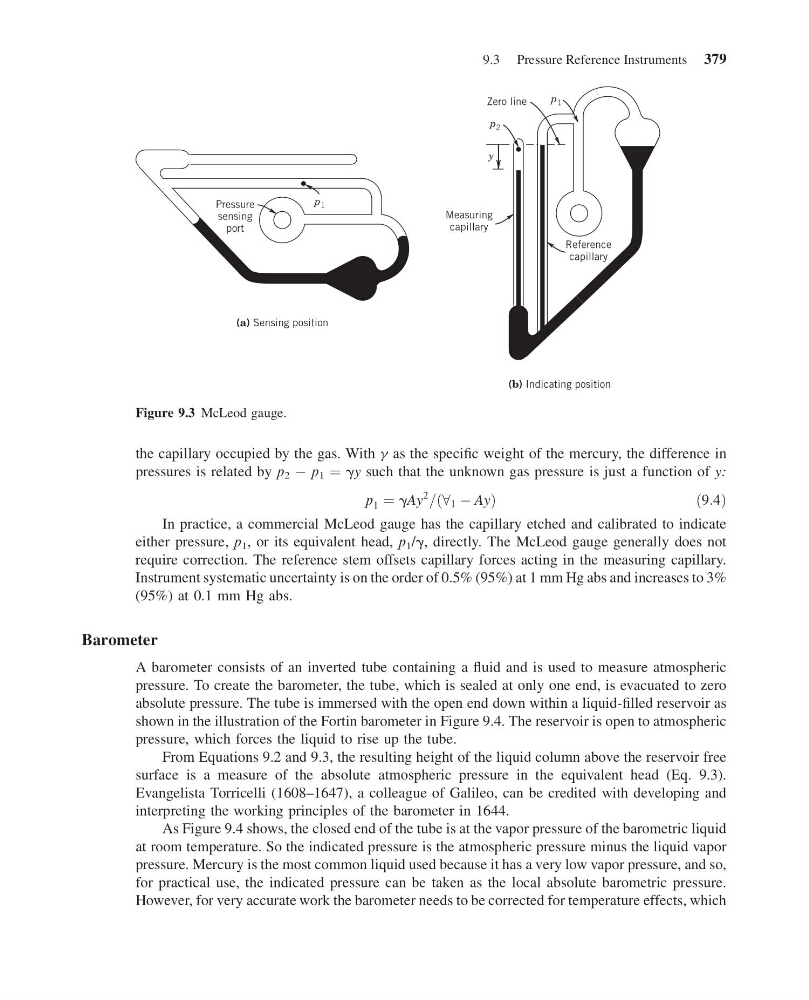
the capillary occupied by the gas. With g as the specific weight of the mercury, the difference in
pressures is related by p 2 À p 1 ¼ gy such that the unknown gas pressure is just a function of y:
p 1 ¼ gAy
2
=ð8 1 À AyÞ
ð 9:4Þ
In practice, a commercial McLeod gauge has the capillary etched and calibrated to indicate
either pressure, p 1 , or its equivalent head, p 1 /g, directly. The McLeod gauge generally does not
require correction. The reference stem offsets capillary forces acting in the measuring capillary.
Instrument systematic uncertainty is on the order of 0.5% (95%) at 1 mm Hg abs and increases to 3%
(95%) at 0.1 mm Hg abs.
Barometer
A barometer consists of an inverted tube containing a fluid and is used to measure atmospheric
pressure. To create the barometer, the tube, which is sealed at only one end, is evacuated to zero
absolute pressure. The tube is immersed with the open end down within a liquid-filled reservoir as
shown in the illustration of the Fortin barometer in Figure 9.4. The reservoir is open to atmospheric
pressure, which forces the liquid to rise up the tube.
From Equations 9.2 and 9.3, the resulting height of the liquid column above the reservoir free
surface is a measure of the absolute atmospheric pressure in the equivalent head (Eq. 9.3).
Evangelista Torricelli (1608–1647), a colleague of Galileo, can be credited with developing and
interpreting the working principles of the barometer in 1644.
As Figure 9.4 shows, the closed end of the tube is at the vapor pressure of the barometric liquid
at room temperature. So the indicated pressure is the atmospheric pressure minus the liquid vapor
pressure. Mercury is the most common liquid used because it has a very low vapor pressure, and so,
for practical use, the indicated pressure can be taken as the local absolute barometric pressure.
However, for very accurate work the barometer needs to be corrected for temperature effects, which
p 1
(a) Sensing position
Pressure
sensing
port
(b) Indicating position
Reference
capillary
Zero line
Measuring
capillary
p 1
p 2
y
Figure 9.3 McLeod gauge.
9.3 Pressure Reference Instruments 379
15:4:52 Page 379
the capillary occupied by the gas. With g as the specific weight of the mercury, the difference in
pressures is related by p 2 À p 1 ¼ gy such that the unknown gas pressure is just a function of y:
p 1 ¼ gAy
2
=ð8 1 À AyÞ
ð 9:4Þ
In practice, a commercial McLeod gauge has the capillary etched and calibrated to indicate
either pressure, p 1 , or its equivalent head, p 1 /g, directly. The McLeod gauge generally does not
require correction. The reference stem offsets capillary forces acting in the measuring capillary.
Instrument systematic uncertainty is on the order of 0.5% (95%) at 1 mm Hg abs and increases to 3%
(95%) at 0.1 mm Hg abs.
Barometer
A barometer consists of an inverted tube containing a fluid and is used to measure atmospheric
pressure. To create the barometer, the tube, which is sealed at only one end, is evacuated to zero
absolute pressure. The tube is immersed with the open end down within a liquid-filled reservoir as
shown in the illustration of the Fortin barometer in Figure 9.4. The reservoir is open to atmospheric
pressure, which forces the liquid to rise up the tube.
From Equations 9.2 and 9.3, the resulting height of the liquid column above the reservoir free
surface is a measure of the absolute atmospheric pressure in the equivalent head (Eq. 9.3).
Evangelista Torricelli (1608–1647), a colleague of Galileo, can be credited with developing and
interpreting the working principles of the barometer in 1644.
As Figure 9.4 shows, the closed end of the tube is at the vapor pressure of the barometric liquid
at room temperature. So the indicated pressure is the atmospheric pressure minus the liquid vapor
pressure. Mercury is the most common liquid used because it has a very low vapor pressure, and so,
for practical use, the indicated pressure can be taken as the local absolute barometric pressure.
However, for very accurate work the barometer needs to be corrected for temperature effects, which
p 1
(a) Sensing position
Pressure
sensing
port
(b) Indicating position
Reference
capillary
Zero line
Measuring
capillary
p 1
p 2
y
Figure 9.3 McLeod gauge.
9.3 Pressure Reference Instruments 379