

E1C09 09/14/2010
15:4:52 Page 377
Pressure can also be described in terms of the pressure exerted on a surface that is submerged in
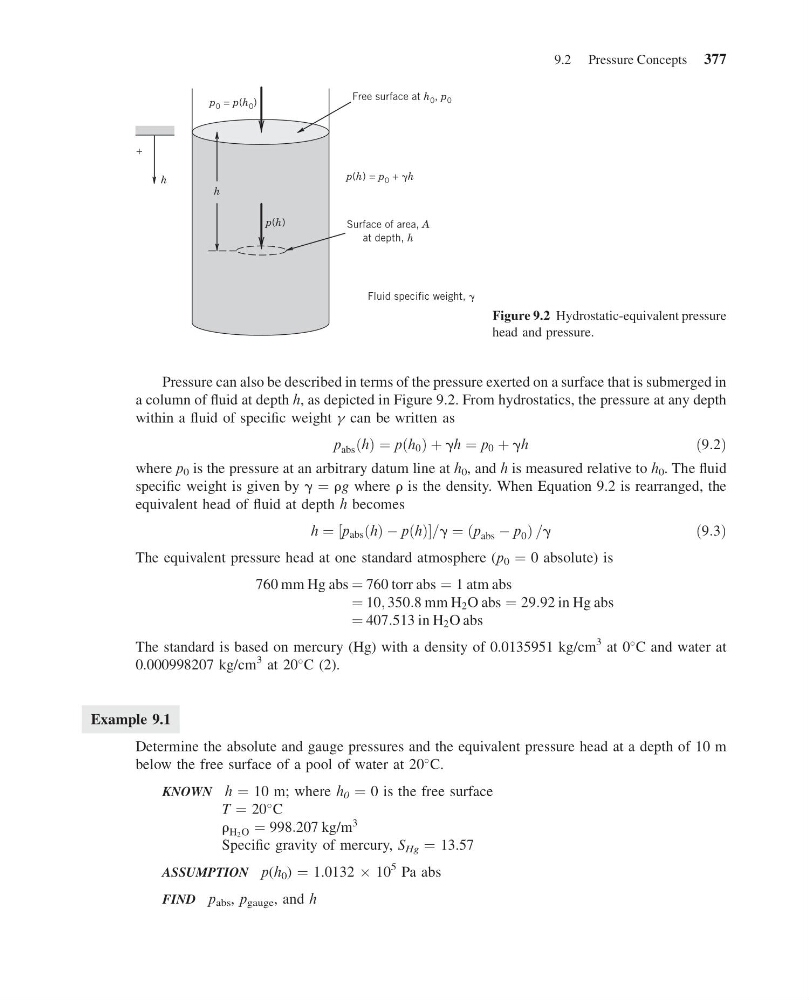
a column of fluid at depth h, as depicted in Figure 9.2. From hydrostatics, the pressure at any depth
within a fluid of specific weight g can be written as
p abs ðhÞ ¼ pðh 0 Þ þ gh ¼ p 0 þ gh
ð9:2Þ
where p 0 is the pressure at an arbitrary datum line at h 0 , and h is measured relative to h 0 . The fluid
specific weight is given by g ¼ rg where r is the density. When Equation 9.2 is rearranged, the
equivalent head of fluid at depth h becomes
h ¼ p abs ðhÞ À pðhÞ=g ¼ p abs À p 0
ð
Þ=g
½
ð 9:3Þ
The equivalent pressure head at one standard atmosphere (p 0 ¼ 0 absolute) is
760 mm Hg abs ¼ 760 torr abs ¼ 1 atm abs
¼ 10; 350:8 mm H 2 O abs ¼ 29:92 in Hg abs
¼ 407:513 in H 2 O abs
The standard is based on mercury (Hg) with a density of 0.0135951 kg/cm
3 at 0
C and water at
0.000998207 kg/cm
3 at 20
C (2).
Example 9.1
Determine the absolute and gauge pressures and the equivalent pressure head at a depth of 10 m
below the free surface of a pool of water at 20
C.
KNOWN h ¼ 10 m; where h 0 ¼ 0 is the free surface
T ¼ 20
C
r H 2 O ¼ 998:207 kg/m
3
Specific gravity of mercury, S Hg ¼ 13.57
ASSUMPTION p(h 0 ) ¼ 1.0132 Â 10
5 Pa abs
FIND p abs , p gauge , and h
h
h
p(h)
Surface of area, A
at depth, h
Fluid specific weight,
+
p(h) = p 0 + h
Free surface at h 0 , p 0
p 0 = p(h 0 )
Figure 9.2 Hydrostatic-equivalent pressure
head and pressure.
9.2 Pressure Concepts 377
15:4:52 Page 377
Pressure can also be described in terms of the pressure exerted on a surface that is submerged in
a column of fluid at depth h, as depicted in Figure 9.2. From hydrostatics, the pressure at any depth
within a fluid of specific weight g can be written as
p abs ðhÞ ¼ pðh 0 Þ þ gh ¼ p 0 þ gh
ð9:2Þ
where p 0 is the pressure at an arbitrary datum line at h 0 , and h is measured relative to h 0 . The fluid
specific weight is given by g ¼ rg where r is the density. When Equation 9.2 is rearranged, the
equivalent head of fluid at depth h becomes
h ¼ p abs ðhÞ À pðhÞ=g ¼ p abs À p 0
ð
Þ=g
½
ð 9:3Þ
The equivalent pressure head at one standard atmosphere (p 0 ¼ 0 absolute) is
760 mm Hg abs ¼ 760 torr abs ¼ 1 atm abs
¼ 10; 350:8 mm H 2 O abs ¼ 29:92 in Hg abs
¼ 407:513 in H 2 O abs
The standard is based on mercury (Hg) with a density of 0.0135951 kg/cm
3 at 0
C and water at
0.000998207 kg/cm
3 at 20
C (2).
Example 9.1
Determine the absolute and gauge pressures and the equivalent pressure head at a depth of 10 m
below the free surface of a pool of water at 20
C.
KNOWN h ¼ 10 m; where h 0 ¼ 0 is the free surface
T ¼ 20
C
r H 2 O ¼ 998:207 kg/m
3
Specific gravity of mercury, S Hg ¼ 13.57
ASSUMPTION p(h 0 ) ¼ 1.0132 Â 10
5 Pa abs
FIND p abs , p gauge , and h
h
h
p(h)
Surface of area, A
at depth, h
Fluid specific weight,
+
p(h) = p 0 + h
Free surface at h 0 , p 0
p 0 = p(h 0 )
Figure 9.2 Hydrostatic-equivalent pressure
head and pressure.
9.2 Pressure Concepts 377