

E1C08 09/14/2010
14:54:1 Page 346
temperature level sensed by the N junctions. Thus, local point measurements entail consideration of
the physical size of a thermopile, as compared to a single thermocouple. In transient measurements,
a thermopile may have a more limited frequency range than a single thermocouple, due to its
increased thermal capacitance. Thermopiles are particularly useful for reducing the uncertainty in
measuring small temperature differences between the measuring and reference junctions. The
principle has also been used to generate small amounts of power in spacecraft and to provide
thermoelectric cooling using the Peltier effect.
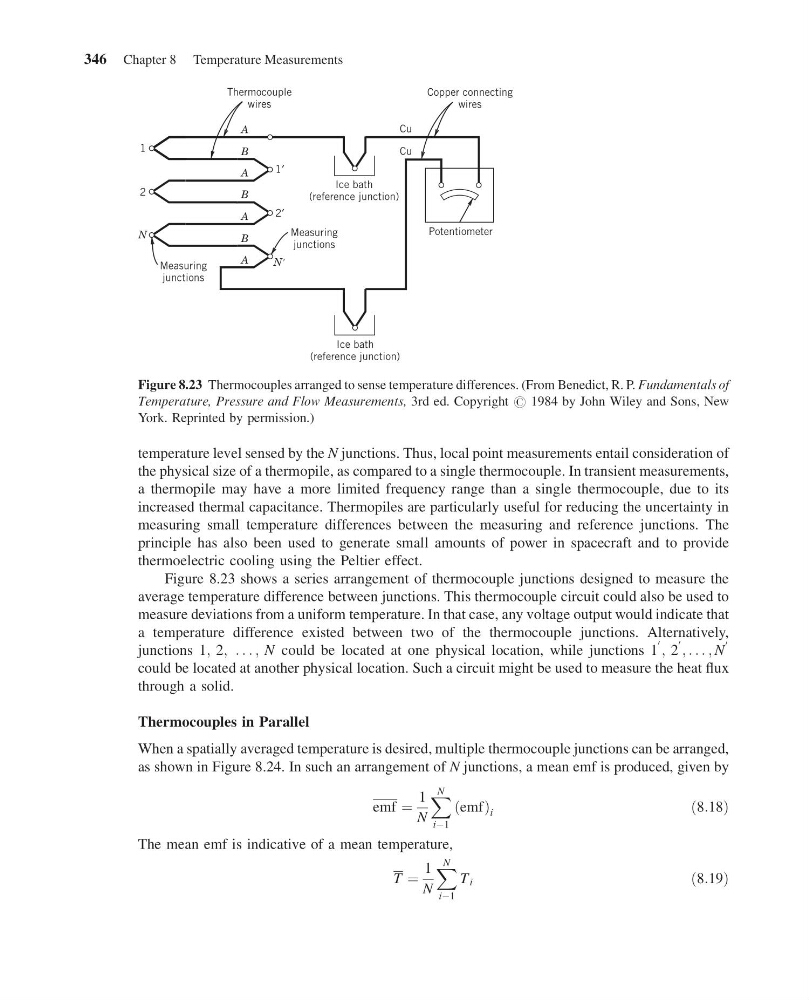
Figure 8.23 shows a series arrangement of thermocouple junctions designed to measure the
average temperature difference between junctions. This thermocouple circuit could also be used to
measure deviations from a uniform temperature. In that case, any voltage output would indicate that
a temperature difference existed between two of the thermocouple junctions. Alternatively,
junctions 1; 2; . . . ; N could be located at one physical location, while junctions 1
0 ; 2
0 ; . . . ; N
0
could be located at another physical location. Such a circuit might be used to measure the heat flux
through a solid.
Thermocouples in Parallel
When a spatially averaged temperature is desired, multiple thermocouple junctions can be arranged,
as shown in Figure 8.24. In such an arrangement of N junctions, a mean emf is produced, given by
emf ¼
1
N
X N
iÀ1
emf
ð
Þ i
ð8:18Þ
The mean emf is indicative of a mean temperature,
T ¼
1
N
X N
iÀ1
T i
ð8:19Þ
Cu
Cu
Measuring
junctions
Measuring
junctions
Ice bath
(reference junction)
Ice bath
(reference junction)
1
2
1′
2′
Potentiometer
Copper connecting
wires
Thermocouple
wires
A
B
A
B
A
A
B
N
N'
Figure 8.23 Thermocouples arranged to sense temperature differences. (From Benedict, R. P. Fundamentals of
Temperature, Pressure and Flow Measurements, 3rd ed. Copyright # 1984 by John Wiley and Sons, New
York. Reprinted by permission.)
346 Chapter 8 Temperature Measurements
14:54:1 Page 346
temperature level sensed by the N junctions. Thus, local point measurements entail consideration of
the physical size of a thermopile, as compared to a single thermocouple. In transient measurements,
a thermopile may have a more limited frequency range than a single thermocouple, due to its
increased thermal capacitance. Thermopiles are particularly useful for reducing the uncertainty in
measuring small temperature differences between the measuring and reference junctions. The
principle has also been used to generate small amounts of power in spacecraft and to provide
thermoelectric cooling using the Peltier effect.
Figure 8.23 shows a series arrangement of thermocouple junctions designed to measure the
average temperature difference between junctions. This thermocouple circuit could also be used to
measure deviations from a uniform temperature. In that case, any voltage output would indicate that
a temperature difference existed between two of the thermocouple junctions. Alternatively,
junctions 1; 2; . . . ; N could be located at one physical location, while junctions 1
0 ; 2
0 ; . . . ; N
0
could be located at another physical location. Such a circuit might be used to measure the heat flux
through a solid.
Thermocouples in Parallel
When a spatially averaged temperature is desired, multiple thermocouple junctions can be arranged,
as shown in Figure 8.24. In such an arrangement of N junctions, a mean emf is produced, given by
emf ¼
1
N
X N
iÀ1
emf
ð
Þ i
ð8:18Þ
The mean emf is indicative of a mean temperature,
T ¼
1
N
X N
iÀ1
T i
ð8:19Þ
Cu
Cu
Measuring
junctions
Measuring
junctions
Ice bath
(reference junction)
Ice bath
(reference junction)
1
2
1′
2′
Potentiometer
Copper connecting
wires
Thermocouple
wires
A
B
A
B
A
A
B
N
N'
Figure 8.23 Thermocouples arranged to sense temperature differences. (From Benedict, R. P. Fundamentals of
Temperature, Pressure and Flow Measurements, 3rd ed. Copyright # 1984 by John Wiley and Sons, New
York. Reprinted by permission.)
346 Chapter 8 Temperature Measurements