

E1C08 09/14/2010
14:54:1 Page 343
high-impedance voltmeters have been incorporated into commercially available temperature
indicators, temperature controllers, and digital data-acquisition systems (DAS).
Example 8.7
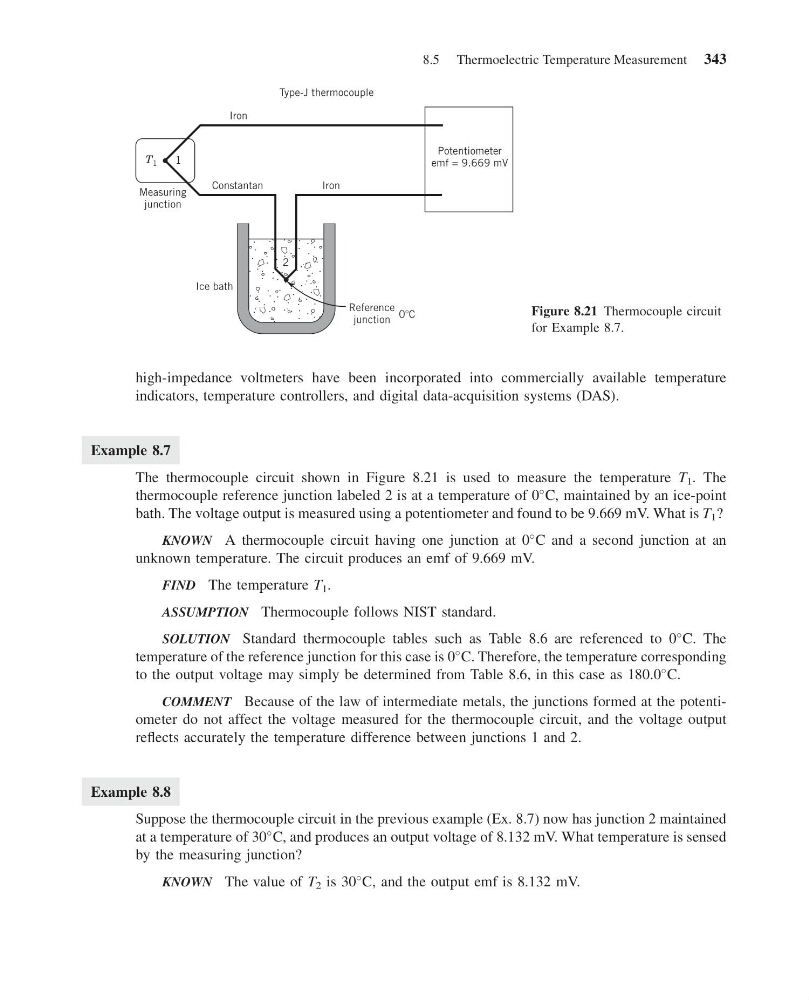
The thermocouple circuit shown in Figure 8.21 is used to measure the temperature T 1 . The
thermocouple reference junction labeled 2 is at a temperature of 0
C, maintained by an ice-point
bath. The voltage output is measured using a potentiometer and found to be 9.669 mV. What is T 1 ?
KNOWN A thermocouple circuit having one junction at 0
C and a second junction at an
unknown temperature. The circuit produces an emf of 9.669 mV.
FIND The temperature T 1 .
ASSUMPTION Thermocouple follows NIST standard.
SOLUTION Standard thermocouple tables such as Table 8.6 are referenced to 0
C. The
temperature of the reference junction for this case is 0
C. Therefore, the temperature corresponding
to the output voltage may simply be determined from Table 8.6, in this case as 180.0
C.
COMMENT Because of the law of intermediate metals, the junctions formed at the potentiometer do not affect the voltage measured for the thermocouple circuit, and the voltage output
reflects accurately the temperature difference between junctions 1 and 2.
Example 8.8
Suppose the thermocouple circuit in the previous example (Ex. 8.7) now has junction 2 maintained
at a temperature of 30
C, and produces an output voltage of 8.132 mV. What temperature is sensed
by the measuring junction?
KNOWN The value of T 2 is 30
C, and the output emf is 8.132 mV.
Potentiometer
emf = 9.669 mV
Iron
Ice bath
Iron
Type-J thermocouple
Constantan
Measuring
junction
Reference
junction
0 C
1
T 1
2
Figure 8.21 Thermocouple circuit
for Example 8.7.
8.5 Thermoelectric Temperature Measurement 343
14:54:1 Page 343
high-impedance voltmeters have been incorporated into commercially available temperature
indicators, temperature controllers, and digital data-acquisition systems (DAS).
Example 8.7
The thermocouple circuit shown in Figure 8.21 is used to measure the temperature T 1 . The
thermocouple reference junction labeled 2 is at a temperature of 0
C, maintained by an ice-point
bath. The voltage output is measured using a potentiometer and found to be 9.669 mV. What is T 1 ?
KNOWN A thermocouple circuit having one junction at 0
C and a second junction at an
unknown temperature. The circuit produces an emf of 9.669 mV.
FIND The temperature T 1 .
ASSUMPTION Thermocouple follows NIST standard.
SOLUTION Standard thermocouple tables such as Table 8.6 are referenced to 0
C. The
temperature of the reference junction for this case is 0
C. Therefore, the temperature corresponding
to the output voltage may simply be determined from Table 8.6, in this case as 180.0
C.
COMMENT Because of the law of intermediate metals, the junctions formed at the potentiometer do not affect the voltage measured for the thermocouple circuit, and the voltage output
reflects accurately the temperature difference between junctions 1 and 2.
Example 8.8
Suppose the thermocouple circuit in the previous example (Ex. 8.7) now has junction 2 maintained
at a temperature of 30
C, and produces an output voltage of 8.132 mV. What temperature is sensed
by the measuring junction?
KNOWN The value of T 2 is 30
C, and the output emf is 8.132 mV.
Potentiometer
emf = 9.669 mV
Iron
Ice bath
Iron
Type-J thermocouple
Constantan
Measuring
junction
Reference
junction
0 C
1
T 1
2
Figure 8.21 Thermocouple circuit
for Example 8.7.
8.5 Thermoelectric Temperature Measurement 343