

E1C08 09/14/2010
14:53:58 Page 336
Uncertainties for the reference junction temperature in this case are on the order of Æ0.1
C, with
Æ0.5
C as typical.
Thermocouple Standards
The National Institute of Standards and Technology (NIST) provides specifications for the materials
and construction of standard thermocouple circuits for temperature measurement (10). Many
material combinations exist for thermocouples; these material combinations are identified by a
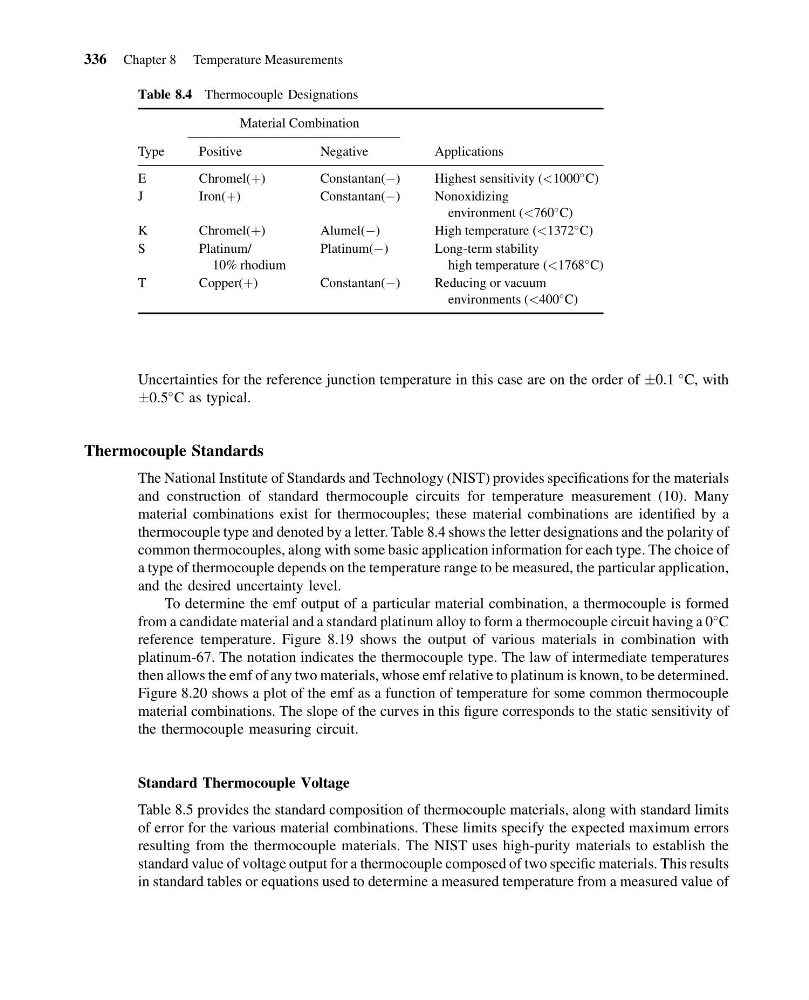
thermocouple type and denoted by a letter. Table 8.4 shows the letter designations and the polarity of
common thermocouples, along with some basic application information for each type. The choice of
a type of thermocouple depends on the temperature range to be measured, the particular application,
and the desired uncertainty level.
To determine the emf output of a particular material combination, a thermocouple is formed
from a candidate material and a standard platinum alloy to form a thermocouple circuit having a 0
C
reference temperature. Figure 8.19 shows the output of various materials in combination with
platinum-67. The notation indicates the thermocouple type. The law of intermediate temperatures
then allows the emf of any two materials, whose emf relative to platinum is known, to be determined.
Figure 8.20 shows a plot of the emf as a function of temperature for some common thermocouple
material combinations. The slope of the curves in this figure corresponds to the static sensitivity of
the thermocouple measuring circuit.
Standard Thermocouple Voltage
Table 8.5 provides the standard composition of thermocouple materials, along with standard limits
of error for the various material combinations. These limits specify the expected maximum errors
resulting from the thermocouple materials. The NIST uses high-purity materials to establish the
standard value of voltage output for a thermocouple composed of two specific materials. This results
in standard tables or equations used to determine a measured temperature from a measured value of
Table 8.4 Thermocouple Designations
Material Combination
Type
Positive
Negative
Applications
E
Chromel(þ)
Constantan(À)
Highest sensitivity (<1000
C)
J
Iron(þ)
Constantan(À)
Nonoxidizing
environment (<760
C)
K
Chromel(þ)
Alumel(À)
High temperature (<1372
C)
S
Platinum/
10% rhodium
Platinum(À)
Long-term stability
high temperature (<1768
C)
T
Copper(þ)
Constantan(À)
Reducing or vacuum
environments (<400
C)
336 Chapter 8 Temperature Measurements
14:53:58 Page 336
Uncertainties for the reference junction temperature in this case are on the order of Æ0.1
C, with
Æ0.5
C as typical.
Thermocouple Standards
The National Institute of Standards and Technology (NIST) provides specifications for the materials
and construction of standard thermocouple circuits for temperature measurement (10). Many
material combinations exist for thermocouples; these material combinations are identified by a
thermocouple type and denoted by a letter. Table 8.4 shows the letter designations and the polarity of
common thermocouples, along with some basic application information for each type. The choice of
a type of thermocouple depends on the temperature range to be measured, the particular application,
and the desired uncertainty level.
To determine the emf output of a particular material combination, a thermocouple is formed
from a candidate material and a standard platinum alloy to form a thermocouple circuit having a 0
C
reference temperature. Figure 8.19 shows the output of various materials in combination with
platinum-67. The notation indicates the thermocouple type. The law of intermediate temperatures
then allows the emf of any two materials, whose emf relative to platinum is known, to be determined.
Figure 8.20 shows a plot of the emf as a function of temperature for some common thermocouple
material combinations. The slope of the curves in this figure corresponds to the static sensitivity of
the thermocouple measuring circuit.
Standard Thermocouple Voltage
Table 8.5 provides the standard composition of thermocouple materials, along with standard limits
of error for the various material combinations. These limits specify the expected maximum errors
resulting from the thermocouple materials. The NIST uses high-purity materials to establish the
standard value of voltage output for a thermocouple composed of two specific materials. This results
in standard tables or equations used to determine a measured temperature from a measured value of
Table 8.4 Thermocouple Designations
Material Combination
Type
Positive
Negative
Applications
E
Chromel(þ)
Constantan(À)
Highest sensitivity (<1000
C)
J
Iron(þ)
Constantan(À)
Nonoxidizing
environment (<760
C)
K
Chromel(þ)
Alumel(À)
High temperature (<1372
C)
S
Platinum/
10% rhodium
Platinum(À)
Long-term stability
high temperature (<1768
C)
T
Copper(þ)
Constantan(À)
Reducing or vacuum
environments (<400
C)
336 Chapter 8 Temperature Measurements