

E1C08 09/14/2010
14:53:57 Page 322
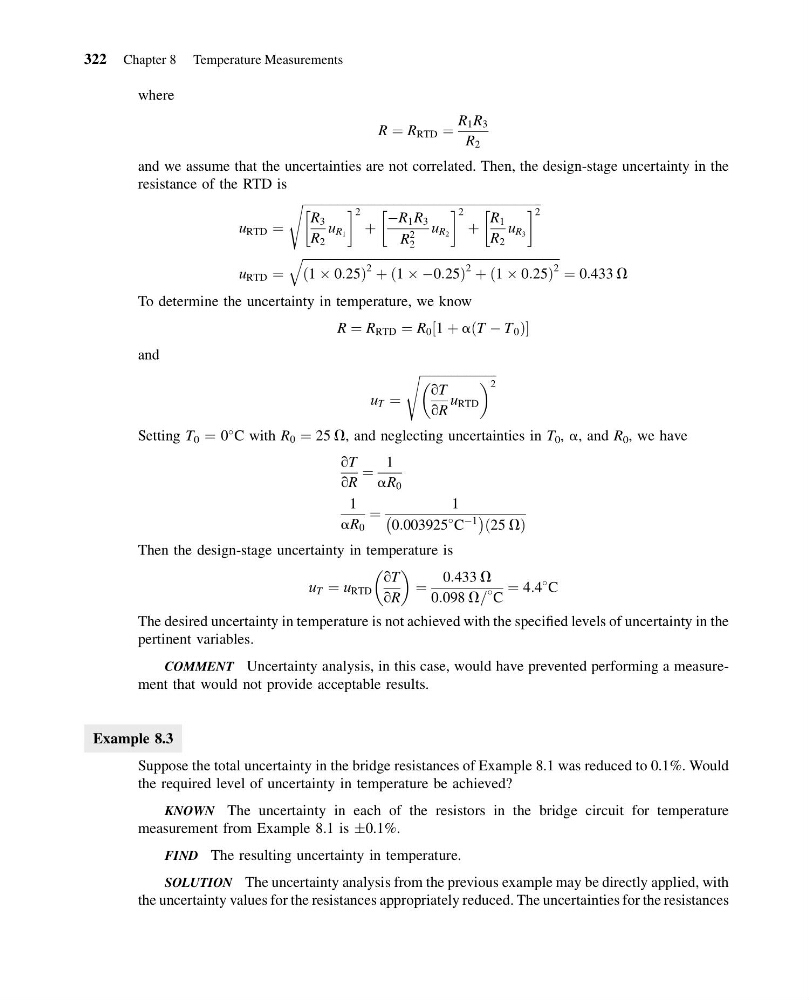
where
R ¼ R RTD ¼
R 1 R 3
R 2
and we assume that the uncertainties are not correlated. Then, the design-stage uncertainty in the
resistance of the RTD is
u RTD ¼
ffiffiffiffiffiffiffiffiffiffiffiffiffiffiffiffiffiffiffiffiffiffiffiffiffiffiffiffiffiffiffiffiffiffiffiffiffiffiffiffiffiffiffiffiffiffiffiffiffiffiffiffiffiffiffiffiffiffiffiffiffiffiffiffiffiffiffiffiffiffiffiffiffiffiffiffi ffi
R 3
R 2
u R 1
! 2
þ
ÀR 1 R 3
R
2
2
u R 2
! 2
þ
R 1
R 2
u R 3
! 2
s
u RTD ¼
ffiffiffiffiffiffiffiffiffiffiffiffiffiffiffiffiffiffiffiffiffiffiffiffiffiffiffiffiffiffiffiffiffiffiffiffiffiffiffiffiffiffiffiffiffiffiffiffiffiffiffiffiffiffiffiffiffiffiffiffiffiffiffiffiffiffiffiffiffiffiffiffiffiffiffiffiffiffiffiffiffiffi ffi
1 Â 0:25
ð
Þ
2 þ 1 Â À0:25
ð
Þ
2 þ 1 Â 0:25
ð
Þ
2
q
¼ 0:433 V
To determine the uncertainty in temperature, we know
R ¼ R RTD ¼ R 0 1 þ a T À T 0
ð
Þ
½
and
u T ¼
ffiffiffiffiffiffiffiffiffiffiffiffiffiffiffiffiffiffiffiffiffiffiffiffiffi
qT
qR
u RTD
2
s
Setting T 0 ¼ 0
C with R 0 ¼ 25 V, and neglecting uncertainties in T 0 , a, and R 0 , we have
qT
qR
¼
1
aR 0
1
aR 0
¼
1
0:003925
C
À1
À
Á
25 V
ð
Þ
Then the design-stage uncertainty in temperature is
u T ¼ u RTD
qT
qR
¼
0:433 V
0:098 V=
C
¼ 4:4
C
The desired uncertainty in temperature is not achieved with the specified levels of uncertainty in the
pertinent variables.
COMMENT Uncertainty analysis, in this case, would have prevented performing a measurement that would not provide acceptable results.
Example 8.3
Suppose the total uncertainty in the bridge resistances of Example 8.1 was reduced to 0.1%. Would
the required level of uncertainty in temperature be achieved?
KNOWN The uncertainty in each of the resistors in the bridge circuit for temperature
measurement from Example 8.1 is Æ0.1%.
FIND The resulting uncertainty in temperature.
SOLUTION The uncertainty analysis from the previous example may be directly applied, with
the uncertainty values for the resistances appropriately reduced. The uncertainties for the resistances
322 Chapter 8 Temperature Measurements
14:53:57 Page 322
where
R ¼ R RTD ¼
R 1 R 3
R 2
and we assume that the uncertainties are not correlated. Then, the design-stage uncertainty in the
resistance of the RTD is
u RTD ¼
ffiffiffiffiffiffiffiffiffiffiffiffiffiffiffiffiffiffiffiffiffiffiffiffiffiffiffiffiffiffiffiffiffiffiffiffiffiffiffiffiffiffiffiffiffiffiffiffiffiffiffiffiffiffiffiffiffiffiffiffiffiffiffiffiffiffiffiffiffiffiffiffiffiffiffiffi ffi
R 3
R 2
u R 1
! 2
þ
ÀR 1 R 3
R
2
2
u R 2
! 2
þ
R 1
R 2
u R 3
! 2
s
u RTD ¼
ffiffiffiffiffiffiffiffiffiffiffiffiffiffiffiffiffiffiffiffiffiffiffiffiffiffiffiffiffiffiffiffiffiffiffiffiffiffiffiffiffiffiffiffiffiffiffiffiffiffiffiffiffiffiffiffiffiffiffiffiffiffiffiffiffiffiffiffiffiffiffiffiffiffiffiffiffiffiffiffiffiffi ffi
1 Â 0:25
ð
Þ
2 þ 1 Â À0:25
ð
Þ
2 þ 1 Â 0:25
ð
Þ
2
q
¼ 0:433 V
To determine the uncertainty in temperature, we know
R ¼ R RTD ¼ R 0 1 þ a T À T 0
ð
Þ
½
and
u T ¼
ffiffiffiffiffiffiffiffiffiffiffiffiffiffiffiffiffiffiffiffiffiffiffiffiffi
qT
qR
u RTD
2
s
Setting T 0 ¼ 0
C with R 0 ¼ 25 V, and neglecting uncertainties in T 0 , a, and R 0 , we have
qT
qR
¼
1
aR 0
1
aR 0
¼
1
0:003925
C
À1
À
Á
25 V
ð
Þ
Then the design-stage uncertainty in temperature is
u T ¼ u RTD
qT
qR
¼
0:433 V
0:098 V=
C
¼ 4:4
C
The desired uncertainty in temperature is not achieved with the specified levels of uncertainty in the
pertinent variables.
COMMENT Uncertainty analysis, in this case, would have prevented performing a measurement that would not provide acceptable results.
Example 8.3
Suppose the total uncertainty in the bridge resistances of Example 8.1 was reduced to 0.1%. Would
the required level of uncertainty in temperature be achieved?
KNOWN The uncertainty in each of the resistors in the bridge circuit for temperature
measurement from Example 8.1 is Æ0.1%.
FIND The resulting uncertainty in temperature.
SOLUTION The uncertainty analysis from the previous example may be directly applied, with
the uncertainty values for the resistances appropriately reduced. The uncertainties for the resistances
322 Chapter 8 Temperature Measurements