

E1C07 09/14/2010
14:43:54 Page 303
7.11 SUMMARY
This chapter has focused on sampling concepts, the interfacing of analog and digital devices, and
data-acquisition systems. Despite the advantages of digital systems, they must interact with an
analog world and the back-and-forth exchange between an analog and digital signal has limitations.
With this in mind, a thorough discussion has been provided on the selection of sample rate and the
number of measurements required to reconstruct a continuous process variable from a discrete
representation. Equations 7.2 and 7.10 explain the criteria by which a periodic waveform can be
accurately represented by such a discrete time series. The limitations resulting from improper
sampling and the discrete representation include frequency alias and leakage, and amplitude
ambiguity.
The fact that practically any electrical instrument can be interfaced with a microcontroller or a
data-acquisition system is significant. The working mechanics of A/D and D/A converters is basic to
interfacing such analog and digital devices with data-acquisition systems. The limitations imposed
by the resolution and range of these devices mandate certain signal conditioning requirements in
terms of signal gain and filtering prior to acquisition. These require analog amplifiers and filters,
devices discussed previously. Communication between digital devices surrounds us. But their
proliferation means that standards for communication must be set. These standards are evaluated
and replaced as newer devices demand faster data transfer.
REFERENCES
1. Bendat, J., and A. Piersol, Random Data: Analysis and Measurement Procedures, WileyInterscience, New York, 1971.
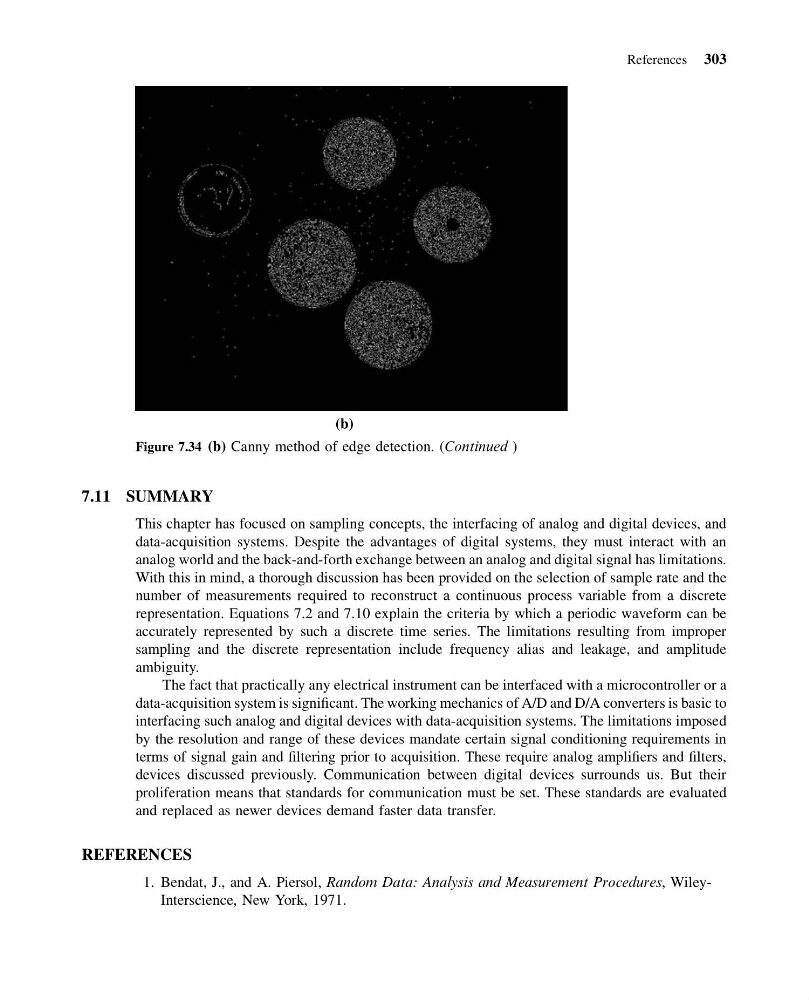
(b)
Figure 7.34 (b) Canny method of edge detection. (Continued )
References 303
14:43:54 Page 303
7.11 SUMMARY
This chapter has focused on sampling concepts, the interfacing of analog and digital devices, and
data-acquisition systems. Despite the advantages of digital systems, they must interact with an
analog world and the back-and-forth exchange between an analog and digital signal has limitations.
With this in mind, a thorough discussion has been provided on the selection of sample rate and the
number of measurements required to reconstruct a continuous process variable from a discrete
representation. Equations 7.2 and 7.10 explain the criteria by which a periodic waveform can be
accurately represented by such a discrete time series. The limitations resulting from improper
sampling and the discrete representation include frequency alias and leakage, and amplitude
ambiguity.
The fact that practically any electrical instrument can be interfaced with a microcontroller or a
data-acquisition system is significant. The working mechanics of A/D and D/A converters is basic to
interfacing such analog and digital devices with data-acquisition systems. The limitations imposed
by the resolution and range of these devices mandate certain signal conditioning requirements in
terms of signal gain and filtering prior to acquisition. These require analog amplifiers and filters,
devices discussed previously. Communication between digital devices surrounds us. But their
proliferation means that standards for communication must be set. These standards are evaluated
and replaced as newer devices demand faster data transfer.
REFERENCES
1. Bendat, J., and A. Piersol, Random Data: Analysis and Measurement Procedures, WileyInterscience, New York, 1971.
(b)
Figure 7.34 (b) Canny method of edge detection. (Continued )
References 303