

E1C05 09/14/2010
14:36:27 Page 178
range of conditions to be used during the actual tests. A set of data (say, N ! 30) would be obtained
under some set operating condition. The first-order uncertainty of our ability to estimate the true
value of a measured value could be estimated as
u 1 ¼ t n;P s x
ð5:22Þ
The uncertainty at u 1 includes the effects of resolution, u o . So only when u 1 ¼ u 0 is time not a factor
in the test. In itself, the first-order uncertainty is inadequate for reporting of test results.
With each successive order, another factor identified as affecting the measured value is
introduced into the analysis, thus giving a higher but more realistic estimate of the uncertainty.
For example, at the second level it might be appropriate to assess the limits of the ability to duplicate
the exact operating conditions and the consequences on the test outcome. Or perhaps spatial
variations that affect the outcome are assessed, such as when a value from a point measurement is
assigned to quantify a larger volume. These are a series of verification tests conducted to assess
causality.
Nth-Order Uncertainty
At the Nth-order estimate, instrument calibration characteristics are entered into the scheme through
the instrument uncertainty u c . A practical estimate of the Nth-order uncertainty u N is given by
u N ¼ u
2
c þ
X NÀ1
1
u
2
i
!
"
# 1=2
ðP%Þ
ð 5:23Þ
Uncertainty estimates at the Nth order allow for the direct comparison between results of similar
tests obtained either using different instruments or at different test facilities. The procedure for a
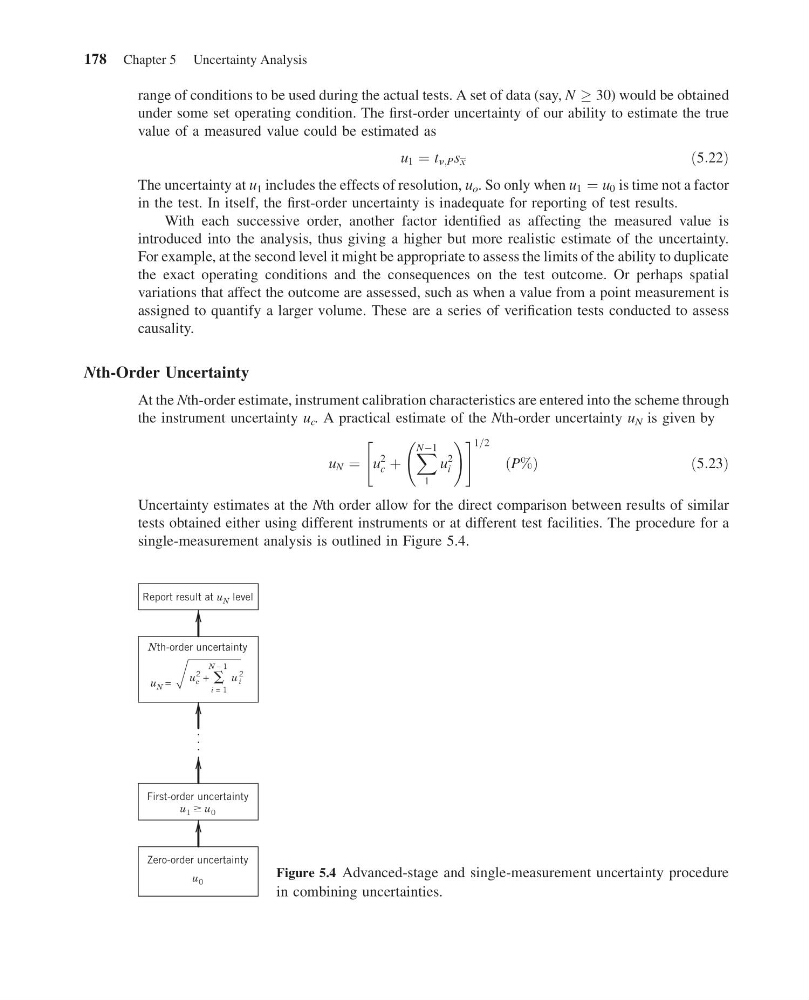
single-measurement analysis is outlined in Figure 5.4.
Zero-order uncertainty
u 0
u c
2 +
u i
2
u N =
Nth-order uncertainty
N – 1
i = 1
Report result at u N level
First-order uncertainty
u 1 u 0
Figure 5.4 Advanced-stage and single-measurement uncertainty procedure
in combining uncertainties.
178 Chapter 5 Uncertainty Analysis
14:36:27 Page 178
range of conditions to be used during the actual tests. A set of data (say, N ! 30) would be obtained
under some set operating condition. The first-order uncertainty of our ability to estimate the true
value of a measured value could be estimated as
u 1 ¼ t n;P s x
ð5:22Þ
The uncertainty at u 1 includes the effects of resolution, u o . So only when u 1 ¼ u 0 is time not a factor
in the test. In itself, the first-order uncertainty is inadequate for reporting of test results.
With each successive order, another factor identified as affecting the measured value is
introduced into the analysis, thus giving a higher but more realistic estimate of the uncertainty.
For example, at the second level it might be appropriate to assess the limits of the ability to duplicate
the exact operating conditions and the consequences on the test outcome. Or perhaps spatial
variations that affect the outcome are assessed, such as when a value from a point measurement is
assigned to quantify a larger volume. These are a series of verification tests conducted to assess
causality.
Nth-Order Uncertainty
At the Nth-order estimate, instrument calibration characteristics are entered into the scheme through
the instrument uncertainty u c . A practical estimate of the Nth-order uncertainty u N is given by
u N ¼ u
2
c þ
X NÀ1
1
u
2
i
!
"
# 1=2
ðP%Þ
ð 5:23Þ
Uncertainty estimates at the Nth order allow for the direct comparison between results of similar
tests obtained either using different instruments or at different test facilities. The procedure for a
single-measurement analysis is outlined in Figure 5.4.
Zero-order uncertainty
u 0
u c
2 +
u i
2
u N =
Nth-order uncertainty
N – 1
i = 1
Report result at u N level
First-order uncertainty
u 1 u 0
Figure 5.4 Advanced-stage and single-measurement uncertainty procedure
in combining uncertainties.
178 Chapter 5 Uncertainty Analysis