

E1C05 09/14/2010
14:36:25 Page 165
Combining Elemental Errors: RSS Method
Each individual measurement error interacts with other errors to affect the uncertainty of a
measurement. This is called uncertainty propagation. Each individual error is called an ‘‘elemental
error.’’ For example, the sensitivity error and linearity error of a transducer are two elemental errors,
and the numbers associated with these are their uncertainties. Consider a measurement of x that is
subject to some K elements of error, each of uncertainty u k , where k ¼ 1; 2; . . . ; K. A realistic
estimate of the uncertainty in the measured variable, u x , due to these elemental errors can be
computed using the RSS method to propagate the elemental uncertainties:
u x ¼
ffiffiffiffiffiffiffiffiffiffiffiffiffiffiffiffiffiffiffiffiffiffiffiffiffiffiffiffiffiffiffiffiffiffiffiffi ffi
u 2
1 þ u 2
2 þ Á Á Á þ u 2
k
q
¼
ffiffiffiffiffiffiffiffiffiffiffi ffi
X K
k¼1
u
2
k
v
u
u
t
ðP%Þ
ð5:2Þ
The RSS method of combining uncertainties is based on the assumption that the square of an
uncertainty is a measure of the variance (i.e., s
2 ) assigned to an error, and the propagation of these
variances yields a probable estimate of the total uncertainty. Note that it is imperative to maintain
consistency in the units of each uncertainty in Equation 5.2 and that each uncertainty term be
assigned at the same probability level.
In test engineering, it is common to report final uncertainties at a 95% probability level
ðP% ¼ 95%Þ, and this is equivalent to assuming the probability covered by two standard deviations.
When a probability level equivalent to a spread of one standard deviation is used, this uncertainty is
called the ‘‘standard’’ uncertainty (1, 2). For a normal distribution, a standard uncertainty is a 68%
probability level. Whatever level is used, consistency is important.
Design-Stage Uncertainty
The design-stage uncertainty, u d , for an instrument or measurement method is an interval found by
combining the instrument uncertainty with the zero-order uncertainty,
u d ¼
ffiffiffiffiffiffiffiffiffiffiffiffiffiffi ffi
u 2
0 þ u 2
c
q
ðP%Þ
ð 5:3Þ
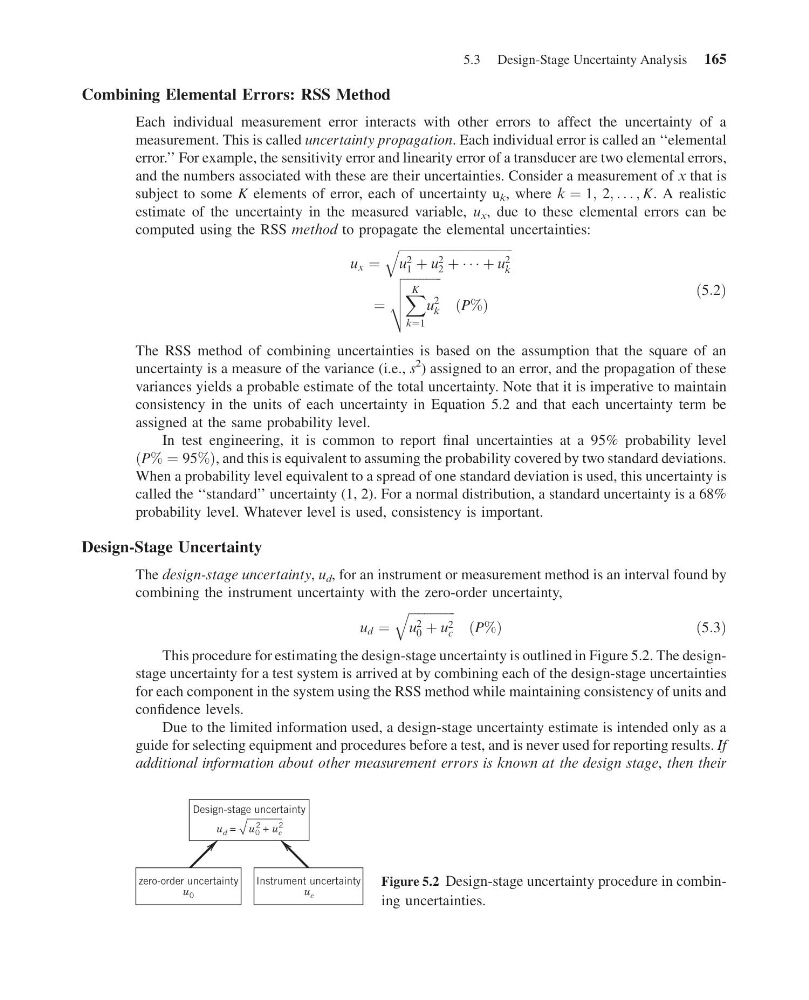
This procedure for estimating the design-stage uncertainty is outlined in Figure 5.2. The designstage uncertainty for a test system is arrived at by combining each of the design-stage uncertainties
for each component in the system using the RSS method while maintaining consistency of units and
confidence levels.
Due to the limited information used, a design-stage uncertainty estimate is intended only as a
guide for selecting equipment and procedures before a test, and is never used for reporting results. If
additional information about other measurement errors is known at the design stage, then their
u d = u 0
2 + u c
2
Design-stage uncertainty
zero-order uncertainty
u 0
Instrument uncertainty
u c
Figure 5.2 Design-stage uncertainty procedure in combining uncertainties.
5.3 Design-Stage Uncertainty Analysis 165
14:36:25 Page 165
Combining Elemental Errors: RSS Method
Each individual measurement error interacts with other errors to affect the uncertainty of a
measurement. This is called uncertainty propagation. Each individual error is called an ‘‘elemental
error.’’ For example, the sensitivity error and linearity error of a transducer are two elemental errors,
and the numbers associated with these are their uncertainties. Consider a measurement of x that is
subject to some K elements of error, each of uncertainty u k , where k ¼ 1; 2; . . . ; K. A realistic
estimate of the uncertainty in the measured variable, u x , due to these elemental errors can be
computed using the RSS method to propagate the elemental uncertainties:
u x ¼
ffiffiffiffiffiffiffiffiffiffiffiffiffiffiffiffiffiffiffiffiffiffiffiffiffiffiffiffiffiffiffiffiffiffiffiffi ffi
u 2
1 þ u 2
2 þ Á Á Á þ u 2
k
q
¼
ffiffiffiffiffiffiffiffiffiffiffi ffi
X K
k¼1
u
2
k
v
u
u
t
ðP%Þ
ð5:2Þ
The RSS method of combining uncertainties is based on the assumption that the square of an
uncertainty is a measure of the variance (i.e., s
2 ) assigned to an error, and the propagation of these
variances yields a probable estimate of the total uncertainty. Note that it is imperative to maintain
consistency in the units of each uncertainty in Equation 5.2 and that each uncertainty term be
assigned at the same probability level.
In test engineering, it is common to report final uncertainties at a 95% probability level
ðP% ¼ 95%Þ, and this is equivalent to assuming the probability covered by two standard deviations.
When a probability level equivalent to a spread of one standard deviation is used, this uncertainty is
called the ‘‘standard’’ uncertainty (1, 2). For a normal distribution, a standard uncertainty is a 68%
probability level. Whatever level is used, consistency is important.
Design-Stage Uncertainty
The design-stage uncertainty, u d , for an instrument or measurement method is an interval found by
combining the instrument uncertainty with the zero-order uncertainty,
u d ¼
ffiffiffiffiffiffiffiffiffiffiffiffiffiffi ffi
u 2
0 þ u 2
c
q
ðP%Þ
ð 5:3Þ
This procedure for estimating the design-stage uncertainty is outlined in Figure 5.2. The designstage uncertainty for a test system is arrived at by combining each of the design-stage uncertainties
for each component in the system using the RSS method while maintaining consistency of units and
confidence levels.
Due to the limited information used, a design-stage uncertainty estimate is intended only as a
guide for selecting equipment and procedures before a test, and is never used for reporting results. If
additional information about other measurement errors is known at the design stage, then their
u d = u 0
2 + u c
2
Design-stage uncertainty
zero-order uncertainty
u 0
Instrument uncertainty
u c
Figure 5.2 Design-stage uncertainty procedure in combining uncertainties.
5.3 Design-Stage Uncertainty Analysis 165