

E1C05 09/14/2010
14:36:25 Page 163
the uncertainty in that value,
x
0
¼ x Æ u x ðP%Þ
ð 4:1Þ
But we considered only the random uncertainty due to the statistics of a measured data set. In this
chapter, we extend this to uncertainty analysis so that the u x term contains the uncertainties assigned
to all known errors. Certain assumptions are implicit in an uncertainty analysis:
1. The test objectives are known and the measurement itself is a clearly defined process.
2. Any known corrections for systematic error have been applied to the data set, in which case
the systematic uncertainty assigned is the uncertainty of the correction.
3. Except where stated otherwise, we assume a normal distribution of errors and reporting of
uncertainties.
4. Unless stated otherwise, the errors are assumed to be independent (uncorrelated) of each
other. But some errors are correlated, and we discuss how to handle these in Section 5.9.
5. The engineer has some ‘‘experience’’ with the system components.
In regards to item 5, by ‘‘experience’’ we mean that the engineer either has prior knowledge of what
to expect from a system or can rely on the manufacturer’s performance specifications or on
information from the technical literature.
We might begin the design of an engineering test with an idea and some catalogs, and
end the project after data have been obtained and analyzed. As with any part of the design process,
the uncertainty analysis evolves as the design of the measurement system and process matures.
We discuss uncertainty analysis for the following measurement situations: (1) design stage,
where tests are planned but information is limited; (2) advanced stage or single measurement,
where additional information about process control can be used to improve a design-stage uncertainty estimate; and (3) multiple measurements, where all available test information is combined
to assess the uncertainty in a test result. The methods for situation 3 follow current engineering
standards.
N
i
4
True value
Measured data
Random
error in x i
x
x'
Measurement number
Measured value,
x
2
0
p(x)
–
Systematic error
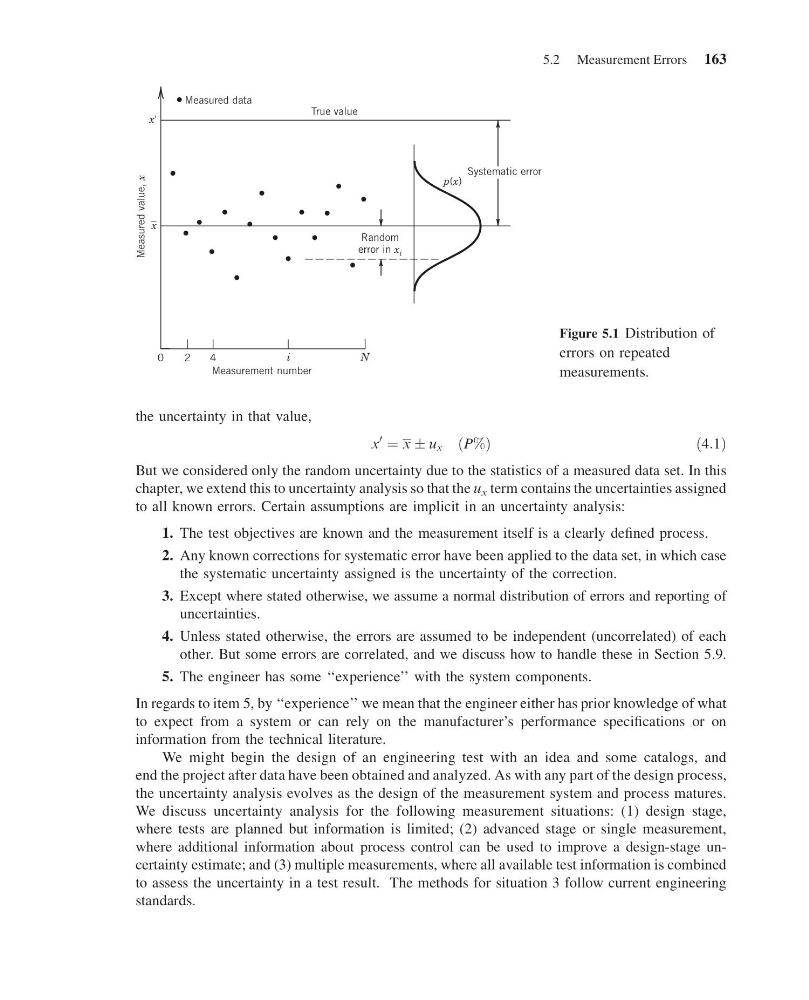
Figure 5.1 Distribution of
errors on repeated
measurements.
5.2 Measurement Errors 163
14:36:25 Page 163
the uncertainty in that value,
x
0
¼ x Æ u x ðP%Þ
ð 4:1Þ
But we considered only the random uncertainty due to the statistics of a measured data set. In this
chapter, we extend this to uncertainty analysis so that the u x term contains the uncertainties assigned
to all known errors. Certain assumptions are implicit in an uncertainty analysis:
1. The test objectives are known and the measurement itself is a clearly defined process.
2. Any known corrections for systematic error have been applied to the data set, in which case
the systematic uncertainty assigned is the uncertainty of the correction.
3. Except where stated otherwise, we assume a normal distribution of errors and reporting of
uncertainties.
4. Unless stated otherwise, the errors are assumed to be independent (uncorrelated) of each
other. But some errors are correlated, and we discuss how to handle these in Section 5.9.
5. The engineer has some ‘‘experience’’ with the system components.
In regards to item 5, by ‘‘experience’’ we mean that the engineer either has prior knowledge of what
to expect from a system or can rely on the manufacturer’s performance specifications or on
information from the technical literature.
We might begin the design of an engineering test with an idea and some catalogs, and
end the project after data have been obtained and analyzed. As with any part of the design process,
the uncertainty analysis evolves as the design of the measurement system and process matures.
We discuss uncertainty analysis for the following measurement situations: (1) design stage,
where tests are planned but information is limited; (2) advanced stage or single measurement,
where additional information about process control can be used to improve a design-stage uncertainty estimate; and (3) multiple measurements, where all available test information is combined
to assess the uncertainty in a test result. The methods for situation 3 follow current engineering
standards.
N
i
4
True value
Measured data
Random
error in x i
x
x'
Measurement number
Measured value,
x
2
0
p(x)
–
Systematic error
Figure 5.1 Distribution of
errors on repeated
measurements.
5.2 Measurement Errors 163