

E1C04 09/14/2010
14:7:43 Page 137
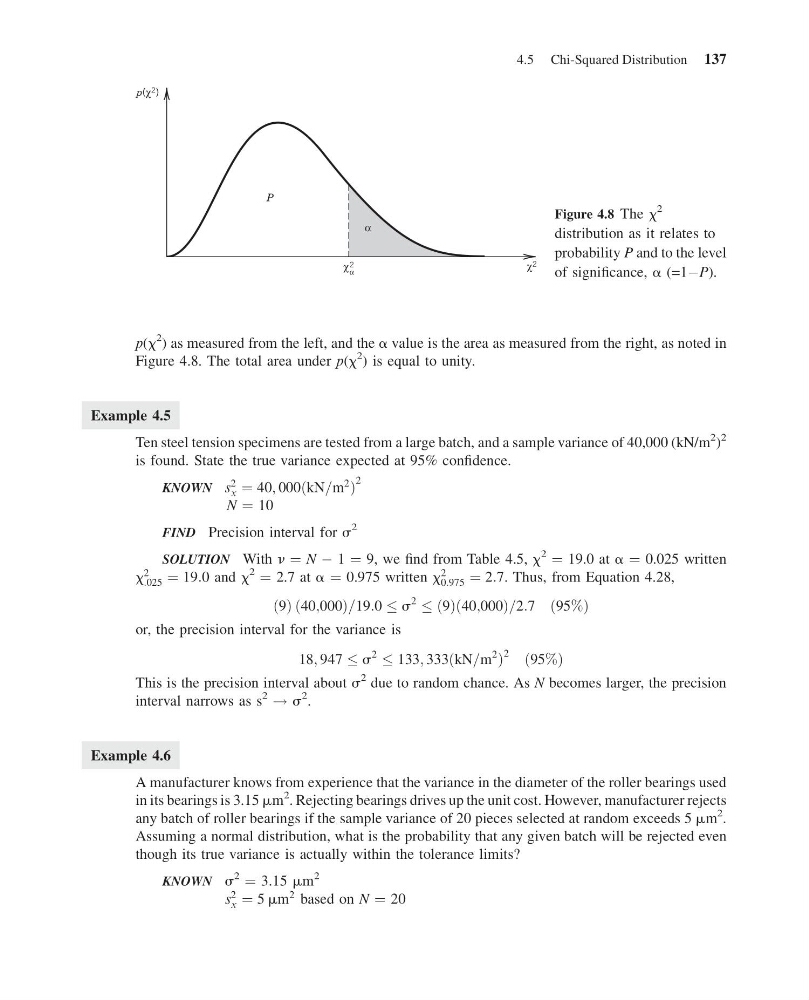
p(x
2 ) as measured from the left, and the a value is the area as measured from the right, as noted in
Figure 4.8. The total area under p(x
2 ) is equal to unity.
Example 4.5
Ten steel tension specimens are tested from a large batch, and a sample variance of 40,000 (kN/m
2 )
2
is found. State the true variance expected at 95% confidence.
KNOWN s
2
x ¼ 40; 000 kN=m
2
ð
Þ
2
N ¼ 10
FIND Precision interval for s
2
SOLUTION With n ¼ N À 1 ¼ 9, we find from Table 4.5, x
2
¼ 19.0 at a ¼ 0.025 written
x
2
:025 ¼ 19:0 and x
2
¼ 2.7 at a ¼ 0.975 written x
2
0:975 ¼ 2:7. Thus, from Equation 4.28,
ð9Þ ð40;000Þ=19:0 s
2
ð9Þð40;000Þ=2:7 ð95%Þ
or, the precision interval for the variance is
18; 947 s
2
133; 333ðkN=m
2
Þ
2 ð95%Þ
This is the precision interval about s
2 due to random chance. As N becomes larger, the precision
interval narrows as s
2
! s
2 .
Example 4.6
A manufacturer knows from experience that the variance in the diameter of the roller bearings used
in its bearings is 3.15 mm
2 . Rejecting bearings drives up the unit cost. However, manufacturer rejects
any batch of roller bearings if the sample variance of 20 pieces selected at random exceeds 5 mm
2 .
Assuming a normal distribution, what is the probability that any given batch will be rejected even
though its true variance is actually within the tolerance limits?
KNOWN s
2
¼ 3.15 mm
2
s
2
x ¼ 5 mm
2 based on N ¼ 20
p(χ 2 )
χ 2
P
α
χ 2
α
Figure 4.8 The x
2
distribution as it relates to
probability P and to the level
of significance, a (=1ÀP).
4.5 Chi-Squared Distribution 137
14:7:43 Page 137
p(x
2 ) as measured from the left, and the a value is the area as measured from the right, as noted in
Figure 4.8. The total area under p(x
2 ) is equal to unity.
Example 4.5
Ten steel tension specimens are tested from a large batch, and a sample variance of 40,000 (kN/m
2 )
2
is found. State the true variance expected at 95% confidence.
KNOWN s
2
x ¼ 40; 000 kN=m
2
ð
Þ
2
N ¼ 10
FIND Precision interval for s
2
SOLUTION With n ¼ N À 1 ¼ 9, we find from Table 4.5, x
2
¼ 19.0 at a ¼ 0.025 written
x
2
:025 ¼ 19:0 and x
2
¼ 2.7 at a ¼ 0.975 written x
2
0:975 ¼ 2:7. Thus, from Equation 4.28,
ð9Þ ð40;000Þ=19:0 s
2
ð9Þð40;000Þ=2:7 ð95%Þ
or, the precision interval for the variance is
18; 947 s
2
133; 333ðkN=m
2
Þ
2 ð95%Þ
This is the precision interval about s
2 due to random chance. As N becomes larger, the precision
interval narrows as s
2
! s
2 .
Example 4.6
A manufacturer knows from experience that the variance in the diameter of the roller bearings used
in its bearings is 3.15 mm
2 . Rejecting bearings drives up the unit cost. However, manufacturer rejects
any batch of roller bearings if the sample variance of 20 pieces selected at random exceeds 5 mm
2 .
Assuming a normal distribution, what is the probability that any given batch will be rejected even
though its true variance is actually within the tolerance limits?
KNOWN s
2
¼ 3.15 mm
2
s
2
x ¼ 5 mm
2 based on N ¼ 20
p(χ 2 )
χ 2
P
α
χ 2
α
Figure 4.8 The x
2
distribution as it relates to
probability P and to the level
of significance, a (=1ÀP).
4.5 Chi-Squared Distribution 137