

E1C03 09/14/2010
15:24:57 Page 117
3.48 Run program Temperature Response. The program allows the user to vary time constant t and signal
amplitude. To impose a step change move the input value up/down. Discuss the effect of time
constant on the time required to achieve a steady signal following a new step change.
3.49 A lumped parameter model of the human systemic circulation includes the systemic vascular
resistance and systemic vascular compliance. Compliance is the inverse of mechanical stiffness and
is estimated by C ¼ D8=Dp, that is, the compliance is related to the pressure change required to
accommodate a volume change. The typical stroke volume of each heart beat might eject 80 mL of
blood into the artery during which the end-diastolic pressure of 80 mm Hg rises to a peak systolic
pressure of 120 mm Hg. Similarly, the resistance to the 6 L/min of blood flow requires an average
pressure over the pulse cycle of about 100 mm Hg to drive it. Estimate values for the systemic
vascular compliance and resistance. Incidentally, these relations are similarly used in describing the
physical properties of pressure measuring systems.
t = 0
E i
I
L
R
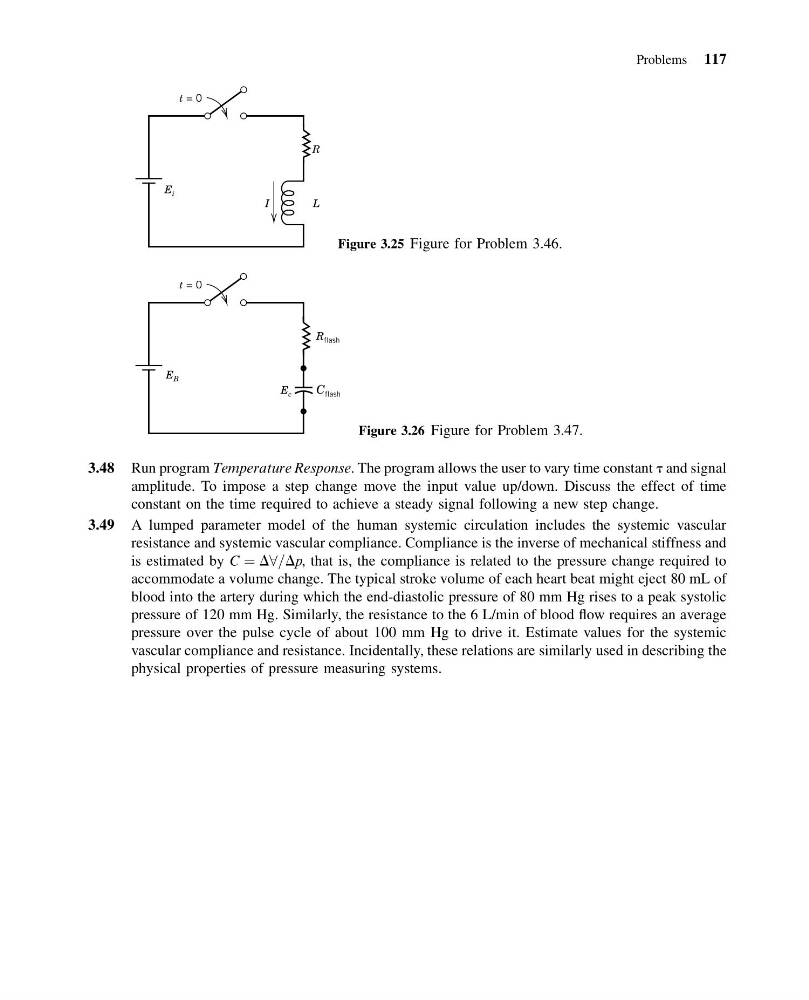
Figure 3.25 Figure for Problem 3.46.
t = 0
E B
E c
R flash
C flash
Figure 3.26 Figure for Problem 3.47.
Problems 117
15:24:57 Page 117
3.48 Run program Temperature Response. The program allows the user to vary time constant t and signal
amplitude. To impose a step change move the input value up/down. Discuss the effect of time
constant on the time required to achieve a steady signal following a new step change.
3.49 A lumped parameter model of the human systemic circulation includes the systemic vascular
resistance and systemic vascular compliance. Compliance is the inverse of mechanical stiffness and
is estimated by C ¼ D8=Dp, that is, the compliance is related to the pressure change required to
accommodate a volume change. The typical stroke volume of each heart beat might eject 80 mL of
blood into the artery during which the end-diastolic pressure of 80 mm Hg rises to a peak systolic
pressure of 120 mm Hg. Similarly, the resistance to the 6 L/min of blood flow requires an average
pressure over the pulse cycle of about 100 mm Hg to drive it. Estimate values for the systemic
vascular compliance and resistance. Incidentally, these relations are similarly used in describing the
physical properties of pressure measuring systems.
t = 0
E i
I
L
R
Figure 3.25 Figure for Problem 3.46.
t = 0
E B
E c
R flash
C flash
Figure 3.26 Figure for Problem 3.47.
Problems 117