

58
3 Fundamentals of DET-Type Bioelectrocatalysis
MCO contains blue T1Cu and T2/3Cu cluster and catalyzes the reaction: DH 2
+ O 2 + 2H
+
→ D + 2H 2 O, DH 2 being an electron donor. Electrons form DH 2 are
accepted at the T1Cu site and transferred to the T2/3Cu cluster, at which O 2 is reduced
to H 2 O. p-Cresolmethylhydroxylase catalyzes the reaction: 4-cresol + A + H 2 O → 4hydroxybenzaldehyde + AH 2 , A being an electron acceptor. Other name in common
is 4-cresol dehydrogenase (hydroxylating). This enzyme is a flavohemoprotein with
an α 2 β 2 structure containing one heme c in small subunit (8.5 kDa) and one FAD in
large subunit (79 kDa)). Methylamine dehydrogenase is a quinohemoprotein with an
α 2 β 2 structure containing one covalently bound TTQ [13] in α-subunit (43 kDa) and
one heme c in β-subunit (14 kDa). This enzyme catalyzes the reaction: RCH 2 NH 2 + A
+ H 2 O → RCHO + NH 3 + AH 2 , A being amicyanine or cyt c 552 in nature. GADH
is a membrane-bound flavohemoprotein and catalyzes the 2-electron oxidation of
d-gluconate to 2-keto d-gluconate. This enzyme is a heterotrimer containing one
covalently bound FAD, two hemes c, and one FeS. FDH is a membrane-bound
flavohemoprotein and catalyzes the 2-electron oxidation of d-fructose to 5-keto-dfructose. The enzyme is a heterotrimer containing one covalently bound FAD and
three hemes c; in the past days, the catalytic center of FDH was believed to be
PQQ. PQQ-dependent ADH (type III) is a membrane-bound quinonehemoprotein
and catalyzes the oxidation of ethanol to acetaldehyde. This enzyme is a heterotrimer
containing one PQQ and one heme c in subunit I and three hemes c in subunit II,
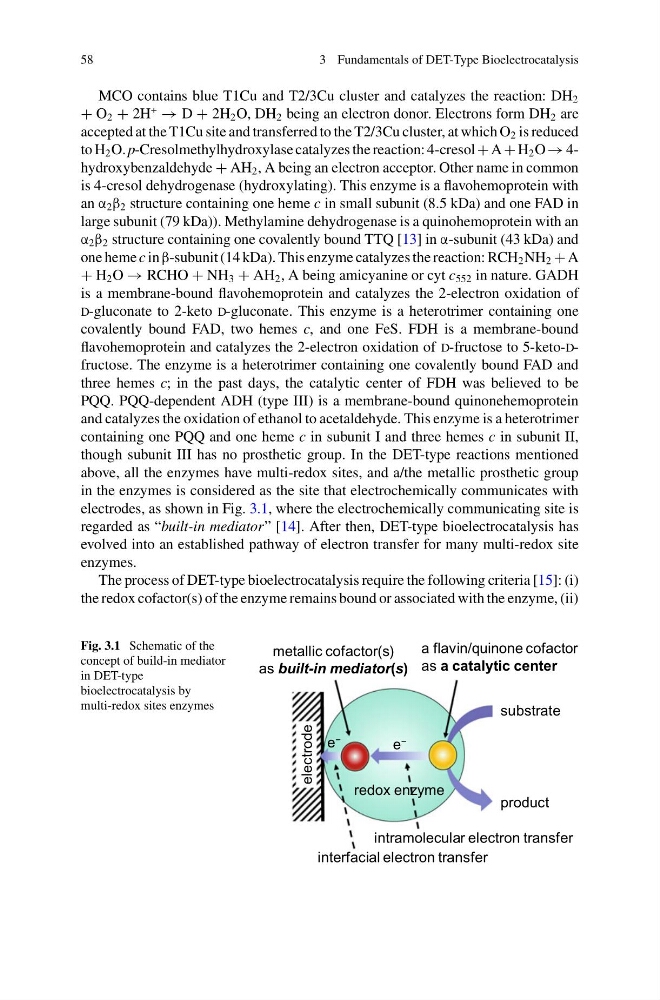
though subunit III has no prosthetic group. In the DET-type reactions mentioned
above, all the enzymes have multi-redox sites, and a/the metallic prosthetic group
in the enzymes is considered as the site that electrochemically communicates with
electrodes, as shown in Fig. 3.1, where the electrochemically communicating site is
regarded as “built-in mediator” [14]. After then, DET-type bioelectrocatalysis has
evolved into an established pathway of electron transfer for many multi-redox site
enzymes.
The process of DET-type bioelectrocatalysis require the following criteria [15]: (i)
the redox cofactor(s) of the enzyme remains bound or associated with the enzyme, (ii)
Fig. 3.1 Schematic of the
concept of build-in mediator
in DET-type
bioelectrocatalysis by
multi-redox sites enzymes
substrate
product
a flavin/quinone cofactor
as a catalytic center
e −
e −
metallic cofactor(s)
as built-in mediator(s)
intramolecular electron transfer
interfacial electron transfer
redox enzyme
electrode
3 Fundamentals of DET-Type Bioelectrocatalysis
MCO contains blue T1Cu and T2/3Cu cluster and catalyzes the reaction: DH 2
+ O 2 + 2H
+
→ D + 2H 2 O, DH 2 being an electron donor. Electrons form DH 2 are
accepted at the T1Cu site and transferred to the T2/3Cu cluster, at which O 2 is reduced
to H 2 O. p-Cresolmethylhydroxylase catalyzes the reaction: 4-cresol + A + H 2 O → 4hydroxybenzaldehyde + AH 2 , A being an electron acceptor. Other name in common
is 4-cresol dehydrogenase (hydroxylating). This enzyme is a flavohemoprotein with
an α 2 β 2 structure containing one heme c in small subunit (8.5 kDa) and one FAD in
large subunit (79 kDa)). Methylamine dehydrogenase is a quinohemoprotein with an
α 2 β 2 structure containing one covalently bound TTQ [13] in α-subunit (43 kDa) and
one heme c in β-subunit (14 kDa). This enzyme catalyzes the reaction: RCH 2 NH 2 + A
+ H 2 O → RCHO + NH 3 + AH 2 , A being amicyanine or cyt c 552 in nature. GADH
is a membrane-bound flavohemoprotein and catalyzes the 2-electron oxidation of
d-gluconate to 2-keto d-gluconate. This enzyme is a heterotrimer containing one
covalently bound FAD, two hemes c, and one FeS. FDH is a membrane-bound
flavohemoprotein and catalyzes the 2-electron oxidation of d-fructose to 5-keto-dfructose. The enzyme is a heterotrimer containing one covalently bound FAD and
three hemes c; in the past days, the catalytic center of FDH was believed to be
PQQ. PQQ-dependent ADH (type III) is a membrane-bound quinonehemoprotein
and catalyzes the oxidation of ethanol to acetaldehyde. This enzyme is a heterotrimer
containing one PQQ and one heme c in subunit I and three hemes c in subunit II,
though subunit III has no prosthetic group. In the DET-type reactions mentioned
above, all the enzymes have multi-redox sites, and a/the metallic prosthetic group
in the enzymes is considered as the site that electrochemically communicates with
electrodes, as shown in Fig. 3.1, where the electrochemically communicating site is
regarded as “built-in mediator” [14]. After then, DET-type bioelectrocatalysis has
evolved into an established pathway of electron transfer for many multi-redox site
enzymes.
The process of DET-type bioelectrocatalysis require the following criteria [15]: (i)
the redox cofactor(s) of the enzyme remains bound or associated with the enzyme, (ii)
Fig. 3.1 Schematic of the
concept of build-in mediator
in DET-type
bioelectrocatalysis by
multi-redox sites enzymes
substrate
product
a flavin/quinone cofactor
as a catalytic center
e −
e −
metallic cofactor(s)
as built-in mediator(s)
intramolecular electron transfer
interfacial electron transfer
redox enzyme
electrode