

References
19
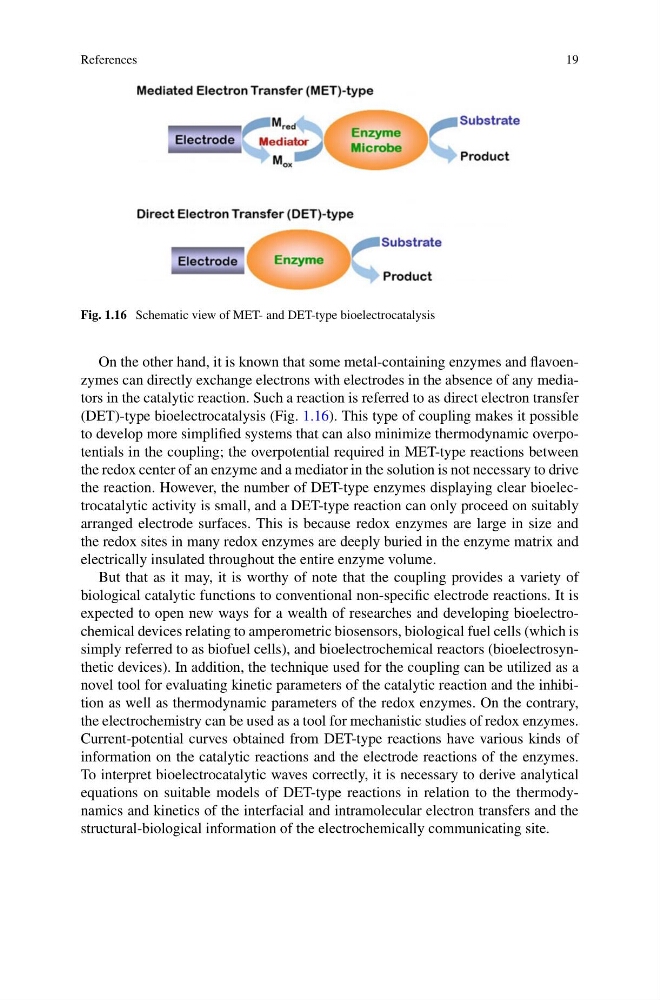
Fig. 1.16 Schematic view of MET- and DET-type bioelectrocatalysis
On the other hand, it is known that some metal-containing enzymes and flavoenzymes can directly exchange electrons with electrodes in the absence of any mediators in the catalytic reaction. Such a reaction is referred to as direct electron transfer
(DET)-type bioelectrocatalysis (Fig. 1.16). This type of coupling makes it possible
to develop more simplified systems that can also minimize thermodynamic overpotentials in the coupling; the overpotential required in MET-type reactions between
the redox center of an enzyme and a mediator in the solution is not necessary to drive
the reaction. However, the number of DET-type enzymes displaying clear bioelectrocatalytic activity is small, and a DET-type reaction can only proceed on suitably
arranged electrode surfaces. This is because redox enzymes are large in size and
the redox sites in many redox enzymes are deeply buried in the enzyme matrix and
electrically insulated throughout the entire enzyme volume.
But that as it may, it is worthy of note that the coupling provides a variety of
biological catalytic functions to conventional non-specific electrode reactions. It is
expected to open new ways for a wealth of researches and developing bioelectrochemical devices relating to amperometric biosensors, biological fuel cells (which is
simply referred to as biofuel cells), and bioelectrochemical reactors (bioelectrosynthetic devices). In addition, the technique used for the coupling can be utilized as a
novel tool for evaluating kinetic parameters of the catalytic reaction and the inhibition as well as thermodynamic parameters of the redox enzymes. On the contrary,
the electrochemistry can be used as a tool for mechanistic studies of redox enzymes.
Current-potential curves obtained from DET-type reactions have various kinds of
information on the catalytic reactions and the electrode reactions of the enzymes.
To interpret bioelectrocatalytic waves correctly, it is necessary to derive analytical
equations on suitable models of DET-type reactions in relation to the thermodynamics and kinetics of the interfacial and intramolecular electron transfers and the
structural-biological information of the electrochemically communicating site.
19
Fig. 1.16 Schematic view of MET- and DET-type bioelectrocatalysis
On the other hand, it is known that some metal-containing enzymes and flavoenzymes can directly exchange electrons with electrodes in the absence of any mediators in the catalytic reaction. Such a reaction is referred to as direct electron transfer
(DET)-type bioelectrocatalysis (Fig. 1.16). This type of coupling makes it possible
to develop more simplified systems that can also minimize thermodynamic overpotentials in the coupling; the overpotential required in MET-type reactions between
the redox center of an enzyme and a mediator in the solution is not necessary to drive
the reaction. However, the number of DET-type enzymes displaying clear bioelectrocatalytic activity is small, and a DET-type reaction can only proceed on suitably
arranged electrode surfaces. This is because redox enzymes are large in size and
the redox sites in many redox enzymes are deeply buried in the enzyme matrix and
electrically insulated throughout the entire enzyme volume.
But that as it may, it is worthy of note that the coupling provides a variety of
biological catalytic functions to conventional non-specific electrode reactions. It is
expected to open new ways for a wealth of researches and developing bioelectrochemical devices relating to amperometric biosensors, biological fuel cells (which is
simply referred to as biofuel cells), and bioelectrochemical reactors (bioelectrosynthetic devices). In addition, the technique used for the coupling can be utilized as a
novel tool for evaluating kinetic parameters of the catalytic reaction and the inhibition as well as thermodynamic parameters of the redox enzymes. On the contrary,
the electrochemistry can be used as a tool for mechanistic studies of redox enzymes.
Current-potential curves obtained from DET-type reactions have various kinds of
information on the catalytic reactions and the electrode reactions of the enzymes.
To interpret bioelectrocatalytic waves correctly, it is necessary to derive analytical
equations on suitable models of DET-type reactions in relation to the thermodynamics and kinetics of the interfacial and intramolecular electron transfers and the
structural-biological information of the electrochemically communicating site.