

122
7 Applications to Biofuel Cells and Bioreactors
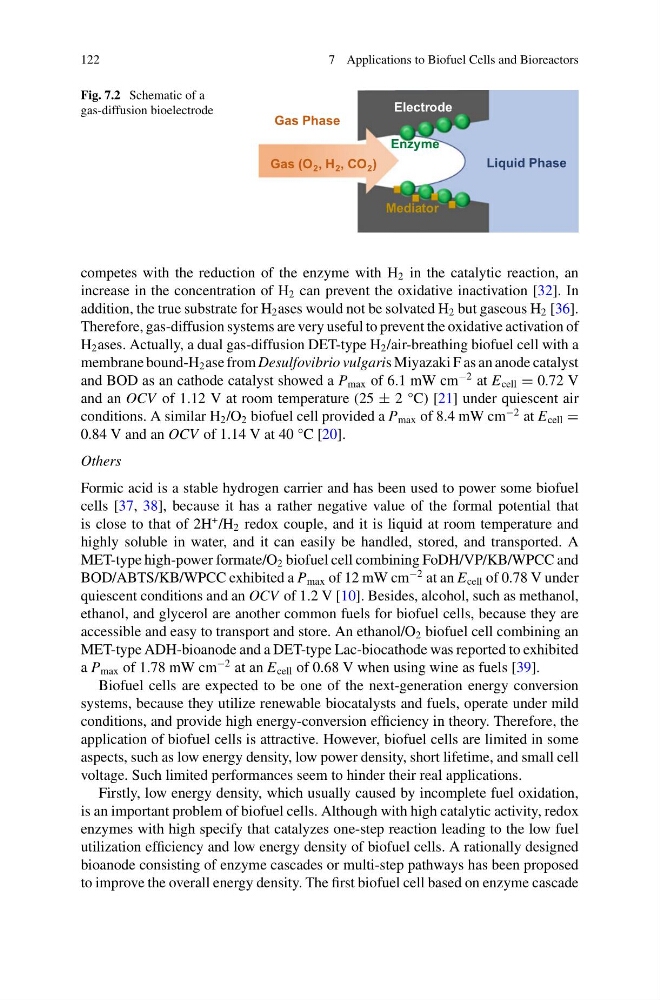
Fig. 7.2 Schematic of a
gas-diffusion bioelectrode
Gas (O 2 , H 2 , CO 2 )
Electrode
Liquid Phase
Gas Phase
Mediator
Enzyme
competes with the reduction of the enzyme with H 2 in the catalytic reaction, an
increase in the concentration of H 2 can prevent the oxidative inactivation [32]. In
addition, the true substrate for H 2 ases would not be solvated H 2 but gaseous H 2 [36].
Therefore, gas-diffusion systems are very useful to prevent the oxidative activation of
H 2 ases. Actually, a dual gas-diffusion DET-type H 2 /air-breathing biofuel cell with a
membrane bound-H 2 ase from Desulfovibrio vulgaris Miyazaki F as an anode catalyst
and BOD as an cathode catalyst showed a P max of 6.1 mW cm
−2 at E cell = 0.72 V
and an OCV of 1.12 V at room temperature (25 ± 2 °C) [21] under quiescent air
conditions. A similar H 2 /O 2 biofuel cell provided a P max of 8.4 mW cm
−2 at E cell =
0.84 V and an OCV of 1.14 V at 40 °C [20].
Others
Formic acid is a stable hydrogen carrier and has been used to power some biofuel
cells [37, 38], because it has a rather negative value of the formal potential that
is close to that of 2H
+ /H 2 redox couple, and it is liquid at room temperature and
highly soluble in water, and it can easily be handled, stored, and transported. A
MET-type high-power formate/O 2 biofuel cell combining FoDH/VP/KB/WPCC and
BOD/ABTS/KB/WPCC exhibited a P max of 12 mW cm
−2 at an E cell of 0.78 V under
quiescent conditions and an OCV of 1.2 V [10]. Besides, alcohol, such as methanol,
ethanol, and glycerol are another common fuels for biofuel cells, because they are
accessible and easy to transport and store. An ethanol/O 2 biofuel cell combining an
MET-type ADH-bioanode and a DET-type Lac-biocathode was reported to exhibited
a P max of 1.78 mW cm
−2 at an E cell of 0.68 V when using wine as fuels [39].
Biofuel cells are expected to be one of the next-generation energy conversion
systems, because they utilize renewable biocatalysts and fuels, operate under mild
conditions, and provide high energy-conversion efficiency in theory. Therefore, the
application of biofuel cells is attractive. However, biofuel cells are limited in some
aspects, such as low energy density, low power density, short lifetime, and small cell
voltage. Such limited performances seem to hinder their real applications.
Firstly, low energy density, which usually caused by incomplete fuel oxidation,
is an important problem of biofuel cells. Although with high catalytic activity, redox
enzymes with high specify that catalyzes one-step reaction leading to the low fuel
utilization efficiency and low energy density of biofuel cells. A rationally designed
bioanode consisting of enzyme cascades or multi-step pathways has been proposed
to improve the overall energy density. The first biofuel cell based on enzyme cascade
7 Applications to Biofuel Cells and Bioreactors
Fig. 7.2 Schematic of a
gas-diffusion bioelectrode
Gas (O 2 , H 2 , CO 2 )
Electrode
Liquid Phase
Gas Phase
Mediator
Enzyme
competes with the reduction of the enzyme with H 2 in the catalytic reaction, an
increase in the concentration of H 2 can prevent the oxidative inactivation [32]. In
addition, the true substrate for H 2 ases would not be solvated H 2 but gaseous H 2 [36].
Therefore, gas-diffusion systems are very useful to prevent the oxidative activation of
H 2 ases. Actually, a dual gas-diffusion DET-type H 2 /air-breathing biofuel cell with a
membrane bound-H 2 ase from Desulfovibrio vulgaris Miyazaki F as an anode catalyst
and BOD as an cathode catalyst showed a P max of 6.1 mW cm
−2 at E cell = 0.72 V
and an OCV of 1.12 V at room temperature (25 ± 2 °C) [21] under quiescent air
conditions. A similar H 2 /O 2 biofuel cell provided a P max of 8.4 mW cm
−2 at E cell =
0.84 V and an OCV of 1.14 V at 40 °C [20].
Others
Formic acid is a stable hydrogen carrier and has been used to power some biofuel
cells [37, 38], because it has a rather negative value of the formal potential that
is close to that of 2H
+ /H 2 redox couple, and it is liquid at room temperature and
highly soluble in water, and it can easily be handled, stored, and transported. A
MET-type high-power formate/O 2 biofuel cell combining FoDH/VP/KB/WPCC and
BOD/ABTS/KB/WPCC exhibited a P max of 12 mW cm
−2 at an E cell of 0.78 V under
quiescent conditions and an OCV of 1.2 V [10]. Besides, alcohol, such as methanol,
ethanol, and glycerol are another common fuels for biofuel cells, because they are
accessible and easy to transport and store. An ethanol/O 2 biofuel cell combining an
MET-type ADH-bioanode and a DET-type Lac-biocathode was reported to exhibited
a P max of 1.78 mW cm
−2 at an E cell of 0.68 V when using wine as fuels [39].
Biofuel cells are expected to be one of the next-generation energy conversion
systems, because they utilize renewable biocatalysts and fuels, operate under mild
conditions, and provide high energy-conversion efficiency in theory. Therefore, the
application of biofuel cells is attractive. However, biofuel cells are limited in some
aspects, such as low energy density, low power density, short lifetime, and small cell
voltage. Such limited performances seem to hinder their real applications.
Firstly, low energy density, which usually caused by incomplete fuel oxidation,
is an important problem of biofuel cells. Although with high catalytic activity, redox
enzymes with high specify that catalyzes one-step reaction leading to the low fuel
utilization efficiency and low energy density of biofuel cells. A rationally designed
bioanode consisting of enzyme cascades or multi-step pathways has been proposed
to improve the overall energy density. The first biofuel cell based on enzyme cascade