

116
7 Applications to Biofuel Cells and Bioreactors
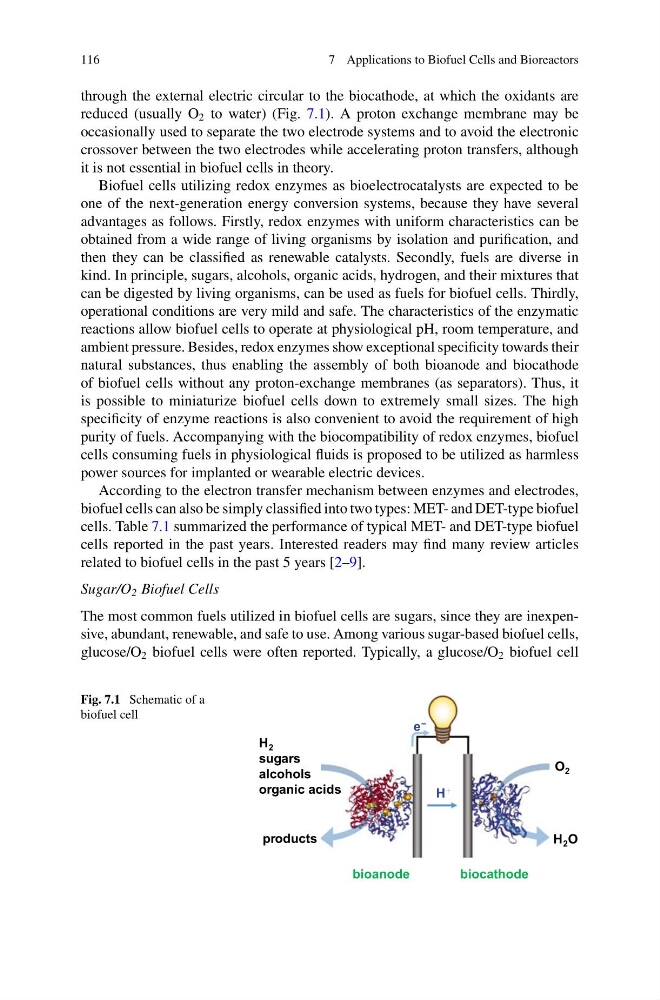
through the external electric circular to the biocathode, at which the oxidants are
reduced (usually O 2 to water) (Fig. 7.1). A proton exchange membrane may be
occasionally used to separate the two electrode systems and to avoid the electronic
crossover between the two electrodes while accelerating proton transfers, although
it is not essential in biofuel cells in theory.
Biofuel cells utilizing redox enzymes as bioelectrocatalysts are expected to be
one of the next-generation energy conversion systems, because they have several
advantages as follows. Firstly, redox enzymes with uniform characteristics can be
obtained from a wide range of living organisms by isolation and purification, and
then they can be classified as renewable catalysts. Secondly, fuels are diverse in
kind. In principle, sugars, alcohols, organic acids, hydrogen, and their mixtures that
can be digested by living organisms, can be used as fuels for biofuel cells. Thirdly,
operational conditions are very mild and safe. The characteristics of the enzymatic
reactions allow biofuel cells to operate at physiological pH, room temperature, and
ambient pressure. Besides, redox enzymes show exceptional specificity towards their
natural substances, thus enabling the assembly of both bioanode and biocathode
of biofuel cells without any proton-exchange membranes (as separators). Thus, it
is possible to miniaturize biofuel cells down to extremely small sizes. The high
specificity of enzyme reactions is also convenient to avoid the requirement of high
purity of fuels. Accompanying with the biocompatibility of redox enzymes, biofuel
cells consuming fuels in physiological fluids is proposed to be utilized as harmless
power sources for implanted or wearable electric devices.
According to the electron transfer mechanism between enzymes and electrodes,
biofuel cells can also be simply classified into two types: MET- and DET-type biofuel
cells. Table 7.1 summarized the performance of typical MET- and DET-type biofuel
cells reported in the past years. Interested readers may find many review articles
related to biofuel cells in the past 5 years [2–9].
Sugar/O 2 Biofuel Cells
The most common fuels utilized in biofuel cells are sugars, since they are inexpensive, abundant, renewable, and safe to use. Among various sugar-based biofuel cells,
glucose/O 2 biofuel cells were often reported. Typically, a glucose/O 2 biofuel cell
Fig. 7.1 Schematic of a
biofuel cell
e −
O 2
H 2 O
biocathode
bioanode
H 2
sugars
alcohols
organic acids
products
H +
7 Applications to Biofuel Cells and Bioreactors
through the external electric circular to the biocathode, at which the oxidants are
reduced (usually O 2 to water) (Fig. 7.1). A proton exchange membrane may be
occasionally used to separate the two electrode systems and to avoid the electronic
crossover between the two electrodes while accelerating proton transfers, although
it is not essential in biofuel cells in theory.
Biofuel cells utilizing redox enzymes as bioelectrocatalysts are expected to be
one of the next-generation energy conversion systems, because they have several
advantages as follows. Firstly, redox enzymes with uniform characteristics can be
obtained from a wide range of living organisms by isolation and purification, and
then they can be classified as renewable catalysts. Secondly, fuels are diverse in
kind. In principle, sugars, alcohols, organic acids, hydrogen, and their mixtures that
can be digested by living organisms, can be used as fuels for biofuel cells. Thirdly,
operational conditions are very mild and safe. The characteristics of the enzymatic
reactions allow biofuel cells to operate at physiological pH, room temperature, and
ambient pressure. Besides, redox enzymes show exceptional specificity towards their
natural substances, thus enabling the assembly of both bioanode and biocathode
of biofuel cells without any proton-exchange membranes (as separators). Thus, it
is possible to miniaturize biofuel cells down to extremely small sizes. The high
specificity of enzyme reactions is also convenient to avoid the requirement of high
purity of fuels. Accompanying with the biocompatibility of redox enzymes, biofuel
cells consuming fuels in physiological fluids is proposed to be utilized as harmless
power sources for implanted or wearable electric devices.
According to the electron transfer mechanism between enzymes and electrodes,
biofuel cells can also be simply classified into two types: MET- and DET-type biofuel
cells. Table 7.1 summarized the performance of typical MET- and DET-type biofuel
cells reported in the past years. Interested readers may find many review articles
related to biofuel cells in the past 5 years [2–9].
Sugar/O 2 Biofuel Cells
The most common fuels utilized in biofuel cells are sugars, since they are inexpensive, abundant, renewable, and safe to use. Among various sugar-based biofuel cells,
glucose/O 2 biofuel cells were often reported. Typically, a glucose/O 2 biofuel cell
Fig. 7.1 Schematic of a
biofuel cell
e −
O 2
H 2 O
biocathode
bioanode
H 2
sugars
alcohols
organic acids
products
H +