

98
5 Protein-Engineering Approach for Improvement …
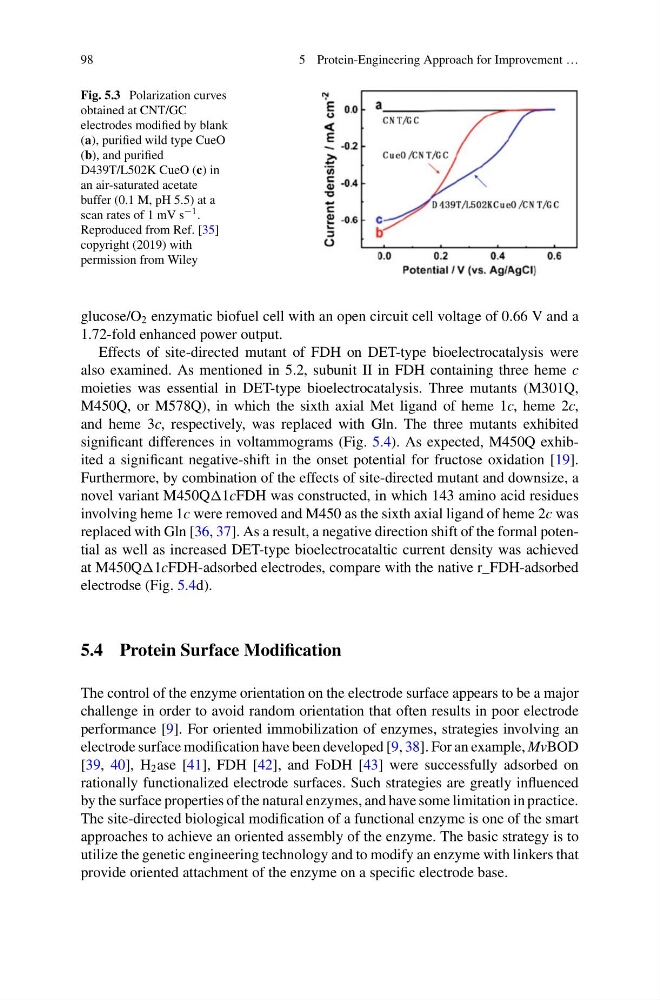
Fig. 5.3 Polarization curves
obtained at CNT/GC
electrodes modified by blank
(a), purified wild type CueO
(b), and purified
D439T/L502K CueO (c) in
an air-saturated acetate
buffer (0.1 M, pH 5.5) at a
scan rates of 1 mV s −1 .
Reproduced from Ref. [35]
copyright (2019) with
permission from Wiley
glucose/O 2 enzymatic biofuel cell with an open circuit cell voltage of 0.66 V and a
1.72-fold enhanced power output.
Effects of site-directed mutant of FDH on DET-type bioelectrocatalysis were
also examined. As mentioned in 5.2, subunit II in FDH containing three heme c
moieties was essential in DET-type bioelectrocatalysis. Three mutants (M301Q,
M450Q, or M578Q), in which the sixth axial Met ligand of heme 1c, heme 2c,
and heme 3c, respectively, was replaced with Gln. The three mutants exhibited
significant differences in voltammograms (Fig. 5.4). As expected, M450Q exhibited a significant negative-shift in the onset potential for fructose oxidation [19].
Furthermore, by combination of the effects of site-directed mutant and downsize, a
novel variant M450Q1cFDH was constructed, in which 143 amino acid residues
involving heme 1c were removed and M450 as the sixth axial ligand of heme 2c was
replaced with Gln [36, 37]. As a result, a negative direction shift of the formal potential as well as increased DET-type bioelectrocataltic current density was achieved
at M450Q1cFDH-adsorbed electrodes, compare with the native r_FDH-adsorbed
electrodse (Fig. 5.4d).
5.4 Protein Surface Modification
The control of the enzyme orientation on the electrode surface appears to be a major
challenge in order to avoid random orientation that often results in poor electrode
performance [9]. For oriented immobilization of enzymes, strategies involving an
electrode surface modification have been developed [9, 38]. For an example, MvBOD
[39, 40], H 2 ase [41], FDH [42], and FoDH [43] were successfully adsorbed on
rationally functionalized electrode surfaces. Such strategies are greatly influenced
by the surface properties of the natural enzymes, and have some limitation in practice.
The site-directed biological modification of a functional enzyme is one of the smart
approaches to achieve an oriented assembly of the enzyme. The basic strategy is to
utilize the genetic engineering technology and to modify an enzyme with linkers that
provide oriented attachment of the enzyme on a specific electrode base.
5 Protein-Engineering Approach for Improvement …
Fig. 5.3 Polarization curves
obtained at CNT/GC
electrodes modified by blank
(a), purified wild type CueO
(b), and purified
D439T/L502K CueO (c) in
an air-saturated acetate
buffer (0.1 M, pH 5.5) at a
scan rates of 1 mV s −1 .
Reproduced from Ref. [35]
copyright (2019) with
permission from Wiley
glucose/O 2 enzymatic biofuel cell with an open circuit cell voltage of 0.66 V and a
1.72-fold enhanced power output.
Effects of site-directed mutant of FDH on DET-type bioelectrocatalysis were
also examined. As mentioned in 5.2, subunit II in FDH containing three heme c
moieties was essential in DET-type bioelectrocatalysis. Three mutants (M301Q,
M450Q, or M578Q), in which the sixth axial Met ligand of heme 1c, heme 2c,
and heme 3c, respectively, was replaced with Gln. The three mutants exhibited
significant differences in voltammograms (Fig. 5.4). As expected, M450Q exhibited a significant negative-shift in the onset potential for fructose oxidation [19].
Furthermore, by combination of the effects of site-directed mutant and downsize, a
novel variant M450Q1cFDH was constructed, in which 143 amino acid residues
involving heme 1c were removed and M450 as the sixth axial ligand of heme 2c was
replaced with Gln [36, 37]. As a result, a negative direction shift of the formal potential as well as increased DET-type bioelectrocataltic current density was achieved
at M450Q1cFDH-adsorbed electrodes, compare with the native r_FDH-adsorbed
electrodse (Fig. 5.4d).
5.4 Protein Surface Modification
The control of the enzyme orientation on the electrode surface appears to be a major
challenge in order to avoid random orientation that often results in poor electrode
performance [9]. For oriented immobilization of enzymes, strategies involving an
electrode surface modification have been developed [9, 38]. For an example, MvBOD
[39, 40], H 2 ase [41], FDH [42], and FoDH [43] were successfully adsorbed on
rationally functionalized electrode surfaces. Such strategies are greatly influenced
by the surface properties of the natural enzymes, and have some limitation in practice.
The site-directed biological modification of a functional enzyme is one of the smart
approaches to achieve an oriented assembly of the enzyme. The basic strategy is to
utilize the genetic engineering technology and to modify an enzyme with linkers that
provide oriented attachment of the enzyme on a specific electrode base.