

2.6 The Second Law and Stability
85
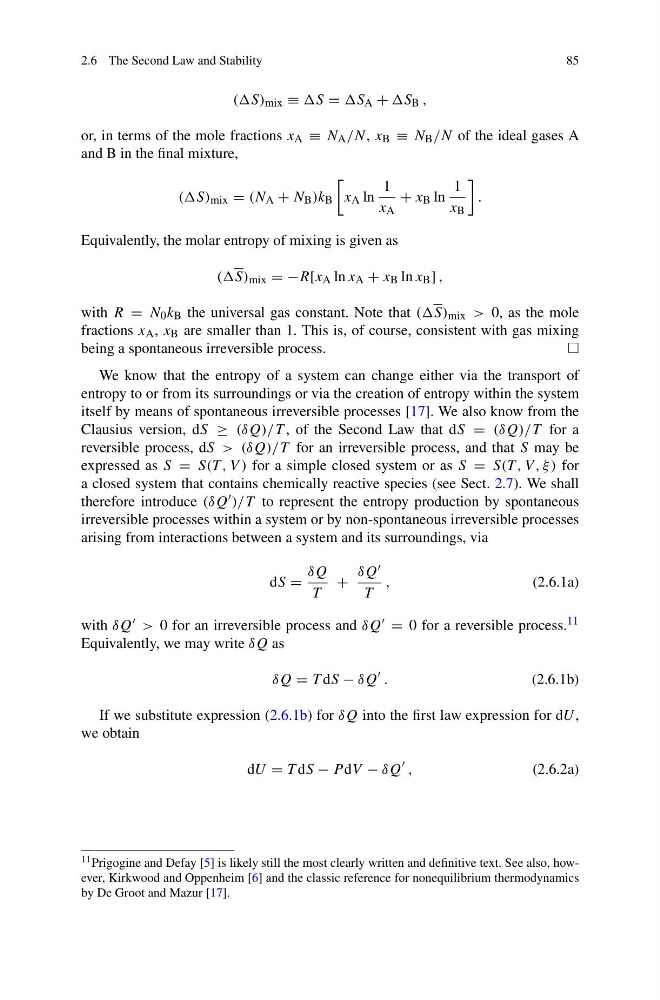
((S) mix ≡ S = S A + S B ,
or, in terms of the mole fractions x A ≡ N A /N , x B ≡ N B /N of the ideal gases A
and B in the final mixture,
((S) mix = (N A + N B )k B
x A ln
1
x A
+ x B ln
1
x B
.
Equivalently, the molar entropy of mixing is given as
((S) mix = −R[x A ln x A + x B ln x B ] ,
with R = N 0 k B the universal gas constant. Note that ((S) mix > 0, as the mole
fractions x A , x B are smaller than 1. This is, of course, consistent with gas mixing
being a spontaneous irreversible process.
We know that the entropy of a system can change either via the transport of
entropy to or from its surroundings or via the creation of entropy within the system
itself by means of spontaneous irreversible processes [17]. We also know from the
Clausius version, dS ≥ (δQ)/T , of the Second Law that dS = (δQ)/T for a
reversible process, dS > (δQ)/T for an irreversible process, and that S may be
expressed as S = S(T , V ) for a simple closed system or as S = S(T , V , ξ ) for
a closed system that contains chemically reactive species (see Sect. 2.7). We shall
therefore introduce (δQ )/T to represent the entropy production by spontaneous
irreversible processes within a system or by non-spontaneous irreversible processes
arising from interactions between a system and its surroundings, via
dS =
δQ
T
+
δQ
T
,
(2.6.1a)
with δQ > 0 for an irreversible process and δQ = 0 for a reversible process. 11
Equivalently, we may write δQ as
δQ = T dS − δQ
.
(2.6.1b)
If we substitute expression (2.6.1b) for δQ into the first law expression for dU ,
we obtain
dU = T dS − P dV − δQ
,
(2.6.2a)
11 Prigogine and Defay [5] is likely still the most clearly written and definitive text. See also, however, Kirkwood and Oppenheim [6] and the classic reference for nonequilibrium thermodynamics
by De Groot and Mazur [17].
85
((S) mix ≡ S = S A + S B ,
or, in terms of the mole fractions x A ≡ N A /N , x B ≡ N B /N of the ideal gases A
and B in the final mixture,
((S) mix = (N A + N B )k B
x A ln
1
x A
+ x B ln
1
x B
.
Equivalently, the molar entropy of mixing is given as
((S) mix = −R[x A ln x A + x B ln x B ] ,
with R = N 0 k B the universal gas constant. Note that ((S) mix > 0, as the mole
fractions x A , x B are smaller than 1. This is, of course, consistent with gas mixing
being a spontaneous irreversible process.
We know that the entropy of a system can change either via the transport of
entropy to or from its surroundings or via the creation of entropy within the system
itself by means of spontaneous irreversible processes [17]. We also know from the
Clausius version, dS ≥ (δQ)/T , of the Second Law that dS = (δQ)/T for a
reversible process, dS > (δQ)/T for an irreversible process, and that S may be
expressed as S = S(T , V ) for a simple closed system or as S = S(T , V , ξ ) for
a closed system that contains chemically reactive species (see Sect. 2.7). We shall
therefore introduce (δQ )/T to represent the entropy production by spontaneous
irreversible processes within a system or by non-spontaneous irreversible processes
arising from interactions between a system and its surroundings, via
dS =
δQ
T
+
δQ
T
,
(2.6.1a)
with δQ > 0 for an irreversible process and δQ = 0 for a reversible process. 11
Equivalently, we may write δQ as
δQ = T dS − δQ
.
(2.6.1b)
If we substitute expression (2.6.1b) for δQ into the first law expression for dU ,
we obtain
dU = T dS − P dV − δQ
,
(2.6.2a)
11 Prigogine and Defay [5] is likely still the most clearly written and definitive text. See also, however, Kirkwood and Oppenheim [6] and the classic reference for nonequilibrium thermodynamics
by De Groot and Mazur [17].