

2.5 Thermodynamic Engines
75
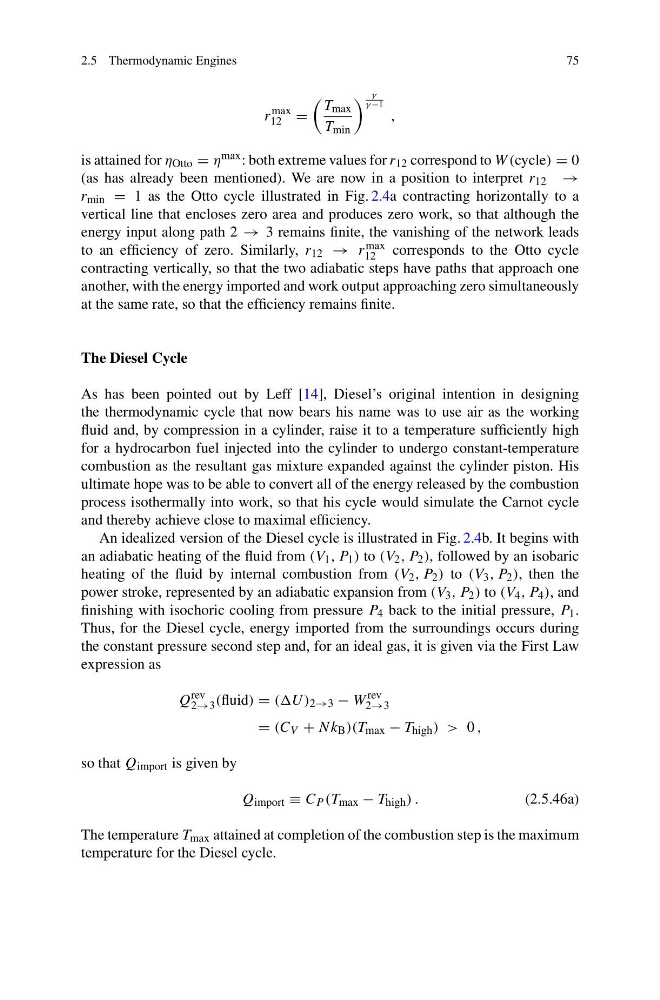
r
max
12 =
T max
T min
γ
γ −1
,
is attained for η Otto = η max : both extreme values for r 12 correspond to W (cycle) = 0
(as has already been mentioned). We are now in a position to interpret r 12 →
r min = 1 as the Otto cycle illustrated in Fig. 2.4a contracting horizontally to a
vertical line that encloses zero area and produces zero work, so that although the
energy input along path 2 → 3 remains finite, the vanishing of the network leads
to an efficiency of zero. Similarly, r 12 → r max
12 corresponds to the Otto cycle
contracting vertically, so that the two adiabatic steps have paths that approach one
another, with the energy imported and work output approaching zero simultaneously
at the same rate, so that the efficiency remains finite.
The Diesel Cycle
As has been pointed out by Leff [14], Diesel’s original intention in designing
the thermodynamic cycle that now bears his name was to use air as the working
fluid and, by compression in a cylinder, raise it to a temperature sufficiently high
for a hydrocarbon fuel injected into the cylinder to undergo constant-temperature
combustion as the resultant gas mixture expanded against the cylinder piston. His
ultimate hope was to be able to convert all of the energy released by the combustion
process isothermally into work, so that his cycle would simulate the Carnot cycle
and thereby achieve close to maximal efficiency.
An idealized version of the Diesel cycle is illustrated in Fig. 2.4b. It begins with
an adiabatic heating of the fluid from (V 1 , P 1 ) to (V 2 , P 2 ), followed by an isobaric
heating of the fluid by internal combustion from (V 2 , P 2 ) to (V 3 , P 2 ), then the
power stroke, represented by an adiabatic expansion from (V 3 , P 2 ) to (V 4 , P 4 ), and
finishing with isochoric cooling from pressure P 4 back to the initial pressure, P 1 .
Thus, for the Diesel cycle, energy imported from the surroundings occurs during
the constant pressure second step and, for an ideal gas, it is given via the First Law
expression as
Q
rev
2→3 (fluid) = ((U ) 2→3 − W
rev
2→3
= (C V + Nk B )(T max − T high ) > 0 ,
so that Q import is given by
Q import ≡ C P (T max − T high ) .
(2.5.46a)
The temperature T max attained at completion of the combustion step is the maximum
temperature for the Diesel cycle.
75
r
max
12 =
T max
T min
γ
γ −1
,
is attained for η Otto = η max : both extreme values for r 12 correspond to W (cycle) = 0
(as has already been mentioned). We are now in a position to interpret r 12 →
r min = 1 as the Otto cycle illustrated in Fig. 2.4a contracting horizontally to a
vertical line that encloses zero area and produces zero work, so that although the
energy input along path 2 → 3 remains finite, the vanishing of the network leads
to an efficiency of zero. Similarly, r 12 → r max
12 corresponds to the Otto cycle
contracting vertically, so that the two adiabatic steps have paths that approach one
another, with the energy imported and work output approaching zero simultaneously
at the same rate, so that the efficiency remains finite.
The Diesel Cycle
As has been pointed out by Leff [14], Diesel’s original intention in designing
the thermodynamic cycle that now bears his name was to use air as the working
fluid and, by compression in a cylinder, raise it to a temperature sufficiently high
for a hydrocarbon fuel injected into the cylinder to undergo constant-temperature
combustion as the resultant gas mixture expanded against the cylinder piston. His
ultimate hope was to be able to convert all of the energy released by the combustion
process isothermally into work, so that his cycle would simulate the Carnot cycle
and thereby achieve close to maximal efficiency.
An idealized version of the Diesel cycle is illustrated in Fig. 2.4b. It begins with
an adiabatic heating of the fluid from (V 1 , P 1 ) to (V 2 , P 2 ), followed by an isobaric
heating of the fluid by internal combustion from (V 2 , P 2 ) to (V 3 , P 2 ), then the
power stroke, represented by an adiabatic expansion from (V 3 , P 2 ) to (V 4 , P 4 ), and
finishing with isochoric cooling from pressure P 4 back to the initial pressure, P 1 .
Thus, for the Diesel cycle, energy imported from the surroundings occurs during
the constant pressure second step and, for an ideal gas, it is given via the First Law
expression as
Q
rev
2→3 (fluid) = ((U ) 2→3 − W
rev
2→3
= (C V + Nk B )(T max − T high ) > 0 ,
so that Q import is given by
Q import ≡ C P (T max − T high ) .
(2.5.46a)
The temperature T max attained at completion of the combustion step is the maximum
temperature for the Diesel cycle.