

2.5 Thermodynamic Engines
73
W (cycle) = C V [(T min − 2
T min T max + T max ) − (T high − 2
T high T low + T low )]
= C V [(
T min −
T max )
2
− (
T high −
T low )
2
] .
(2.5.40a)
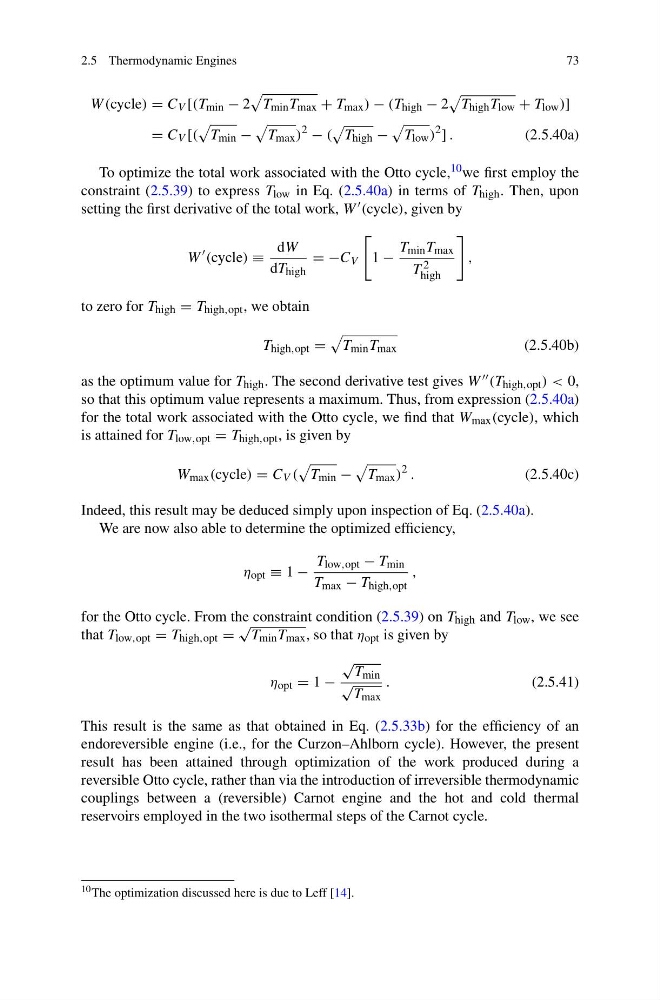
To optimize the total work associated with the Otto cycle, 10 we first employ the
constraint (2.5.39) to express T low in Eq. (2.5.40a) in terms of T high . Then, upon
setting the first derivative of the total work, W (cycle), given by
W
(cycle) ≡
dW
dT high
= −C V
1 −
T min T max
T 2
high
,
to zero for T high = T high,opt , we obtain
T high,opt =
T min T max
(2.5.40b)
as the optimum value for T high . The second derivative test gives W (T high,opt ) < 0,
so that this optimum value represents a maximum. Thus, from expression (2.5.40a)
for the total work associated with the Otto cycle, we find that W max (cycle), which
is attained for T low,opt = T high,opt , is given by
W max (cycle) = C V (
T min −
T max )
2 .
(2.5.40c)
Indeed, this result may be deduced simply upon inspection of Eq. (2.5.40a).
We are now also able to determine the optimized efficiency,
η opt ≡ 1 −
T low,opt − T min
T max − T high,opt
,
for the Otto cycle. From the constraint condition (2.5.39) on T high and T low , we see
that T low,opt = T high,opt =
√
T min T max , so that η opt is given by
η opt = 1 −
√
T min
√
T max
.
(2.5.41)
This result is the same as that obtained in Eq. (2.5.33b) for the efficiency of an
endoreversible engine (i.e., for the Curzon–Ahlborn cycle). However, the present
result has been attained through optimization of the work produced during a
reversible Otto cycle, rather than via the introduction of irreversible thermodynamic
couplings between a (reversible) Carnot engine and the hot and cold thermal
reservoirs employed in the two isothermal steps of the Carnot cycle.
10 The optimization discussed here is due to Leff [14].
73
W (cycle) = C V [(T min − 2
T min T max + T max ) − (T high − 2
T high T low + T low )]
= C V [(
T min −
T max )
2
− (
T high −
T low )
2
] .
(2.5.40a)
To optimize the total work associated with the Otto cycle, 10 we first employ the
constraint (2.5.39) to express T low in Eq. (2.5.40a) in terms of T high . Then, upon
setting the first derivative of the total work, W (cycle), given by
W
(cycle) ≡
dW
dT high
= −C V
1 −
T min T max
T 2
high
,
to zero for T high = T high,opt , we obtain
T high,opt =
T min T max
(2.5.40b)
as the optimum value for T high . The second derivative test gives W (T high,opt ) < 0,
so that this optimum value represents a maximum. Thus, from expression (2.5.40a)
for the total work associated with the Otto cycle, we find that W max (cycle), which
is attained for T low,opt = T high,opt , is given by
W max (cycle) = C V (
T min −
T max )
2 .
(2.5.40c)
Indeed, this result may be deduced simply upon inspection of Eq. (2.5.40a).
We are now also able to determine the optimized efficiency,
η opt ≡ 1 −
T low,opt − T min
T max − T high,opt
,
for the Otto cycle. From the constraint condition (2.5.39) on T high and T low , we see
that T low,opt = T high,opt =
√
T min T max , so that η opt is given by
η opt = 1 −
√
T min
√
T max
.
(2.5.41)
This result is the same as that obtained in Eq. (2.5.33b) for the efficiency of an
endoreversible engine (i.e., for the Curzon–Ahlborn cycle). However, the present
result has been attained through optimization of the work produced during a
reversible Otto cycle, rather than via the introduction of irreversible thermodynamic
couplings between a (reversible) Carnot engine and the hot and cold thermal
reservoirs employed in the two isothermal steps of the Carnot cycle.
10 The optimization discussed here is due to Leff [14].