

2.5 Thermodynamic Engines
71
ln V
ln P
1
2
3
4
(a)
ln V
ln P
1
2
3
4
(b)
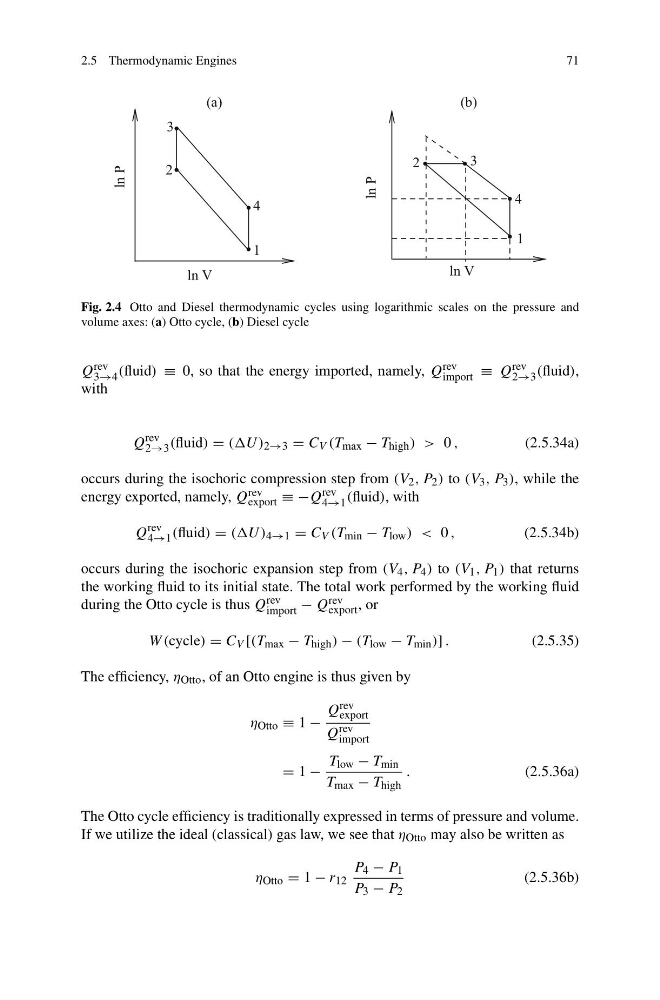
Fig. 2.4 Otto and Diesel thermodynamic cycles using logarithmic scales on the pressure and
volume axes: (a) Otto cycle, (b) Diesel cycle
Q rev
3→4 (fluid) ≡ 0, so that the energy imported, namely, Q rev
import ≡ Q rev
2→3 (fluid),
with
Q
rev
2→3 (fluid) = ((U ) 2→3 = C V (T max − T high ) > 0 ,
(2.5.34a)
occurs during the isochoric compression step from (V 2 , P 2 ) to (V 3 , P 3 ), while the
energy exported, namely, Q rev
export ≡ −Q rev
4→1 (fluid), with
Q
rev
4→1 (fluid) = ((U ) 4→1 = C V (T min − T low ) < 0 ,
(2.5.34b)
occurs during the isochoric expansion step from (V 4 , P 4 ) to (V 1 , P 1 ) that returns
the working fluid to its initial state. The total work performed by the working fluid
during the Otto cycle is thus Q rev
import − Q rev
export , or
W (cycle) = C V [(T max − T high ) − (T low − T min )] .
(2.5.35)
The efficiency, η Otto , of an Otto engine is thus given by
η Otto ≡ 1 −
Q rev
export
Q rev
import
= 1 −
T low − T min
T max − T high
.
(2.5.36a)
The Otto cycle efficiency is traditionally expressed in terms of pressure and volume.
If we utilize the ideal (classical) gas law, we see that η Otto may also be written as
η Otto = 1 − r 12
P 4 − P 1
P 3 − P 2
(2.5.36b)
71
ln V
ln P
1
2
3
4
(a)
ln V
ln P
1
2
3
4
(b)
Fig. 2.4 Otto and Diesel thermodynamic cycles using logarithmic scales on the pressure and
volume axes: (a) Otto cycle, (b) Diesel cycle
Q rev
3→4 (fluid) ≡ 0, so that the energy imported, namely, Q rev
import ≡ Q rev
2→3 (fluid),
with
Q
rev
2→3 (fluid) = ((U ) 2→3 = C V (T max − T high ) > 0 ,
(2.5.34a)
occurs during the isochoric compression step from (V 2 , P 2 ) to (V 3 , P 3 ), while the
energy exported, namely, Q rev
export ≡ −Q rev
4→1 (fluid), with
Q
rev
4→1 (fluid) = ((U ) 4→1 = C V (T min − T low ) < 0 ,
(2.5.34b)
occurs during the isochoric expansion step from (V 4 , P 4 ) to (V 1 , P 1 ) that returns
the working fluid to its initial state. The total work performed by the working fluid
during the Otto cycle is thus Q rev
import − Q rev
export , or
W (cycle) = C V [(T max − T high ) − (T low − T min )] .
(2.5.35)
The efficiency, η Otto , of an Otto engine is thus given by
η Otto ≡ 1 −
Q rev
export
Q rev
import
= 1 −
T low − T min
T max − T high
.
(2.5.36a)
The Otto cycle efficiency is traditionally expressed in terms of pressure and volume.
If we utilize the ideal (classical) gas law, we see that η Otto may also be written as
η Otto = 1 − r 12
P 4 − P 1
P 3 − P 2
(2.5.36b)