

2.5 Thermodynamic Engines
69
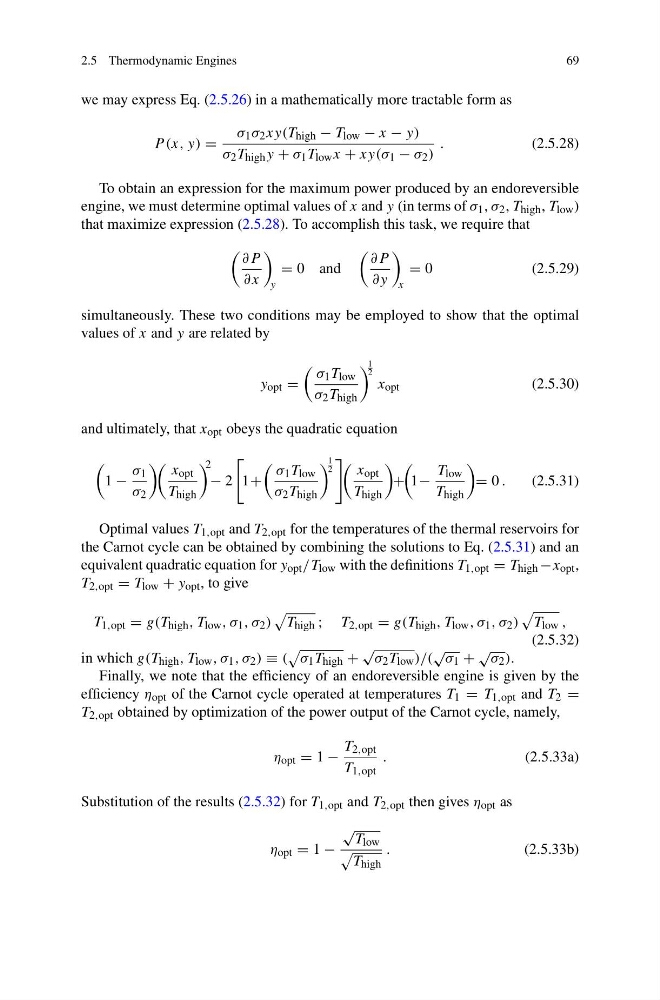
we may express Eq. (2.5.26) in a mathematically more tractable form as
P (x, y) =
σ 1 σ 2 xy(T high − T low − x − y)
σ 2 T high y + σ 1 T low x + xy(σ 1 − σ 2 )
.
(2.5.28)
To obtain an expression for the maximum power produced by an endoreversible
engine, we must determine optimal values of x and y (in terms of σ 1 , σ 2 , T high , T low )
that maximize expression (2.5.28). To accomplish this task, we require that
∂P
∂x
y
= 0 and
∂P
∂y
x
= 0
(2.5.29)
simultaneously. These two conditions may be employed to show that the optimal
values of x and y are related by
y opt =
σ 1 T low
σ 2 T high
1
2
x opt
(2.5.30)
and ultimately, that x opt obeys the quadratic equation
1 −
σ 1
σ 2
x opt
T high
2
− 2
1+
σ 1 T low
σ 2 T high
1
2
x opt
T high
+
1−
T low
T high
= 0 .
(2.5.31)
Optimal values T 1,opt and T 2,opt for the temperatures of the thermal reservoirs for
the Carnot cycle can be obtained by combining the solutions to Eq. (2.5.31) and an
equivalent quadratic equation for y opt /T low with the definitions T 1,opt = T high −x opt ,
T 2,opt = T low + y opt , to give
T 1,opt = g(T high , T low , σ 1 , σ 2 )
T high ; T 2,opt = g(T high , T low , σ 1 , σ 2 )
T low ,
(2.5.32)
in which g(T high , T low , σ 1 , σ 2 ) ≡ (
σ 1 T high +
√
σ 2 T low )/(
√
σ 1 +
√
σ 2 ).
Finally, we note that the efficiency of an endoreversible engine is given by the
efficiency η opt of the Carnot cycle operated at temperatures T 1 = T 1,opt and T 2 =
T 2,opt obtained by optimization of the power output of the Carnot cycle, namely,
η opt = 1 −
T 2,opt
T 1,opt
.
(2.5.33a)
Substitution of the results (2.5.32) for T 1,opt and T 2,opt then gives η opt as
η opt = 1 −
√
T low
T high
.
(2.5.33b)
69
we may express Eq. (2.5.26) in a mathematically more tractable form as
P (x, y) =
σ 1 σ 2 xy(T high − T low − x − y)
σ 2 T high y + σ 1 T low x + xy(σ 1 − σ 2 )
.
(2.5.28)
To obtain an expression for the maximum power produced by an endoreversible
engine, we must determine optimal values of x and y (in terms of σ 1 , σ 2 , T high , T low )
that maximize expression (2.5.28). To accomplish this task, we require that
∂P
∂x
y
= 0 and
∂P
∂y
x
= 0
(2.5.29)
simultaneously. These two conditions may be employed to show that the optimal
values of x and y are related by
y opt =
σ 1 T low
σ 2 T high
1
2
x opt
(2.5.30)
and ultimately, that x opt obeys the quadratic equation
1 −
σ 1
σ 2
x opt
T high
2
− 2
1+
σ 1 T low
σ 2 T high
1
2
x opt
T high
+
1−
T low
T high
= 0 .
(2.5.31)
Optimal values T 1,opt and T 2,opt for the temperatures of the thermal reservoirs for
the Carnot cycle can be obtained by combining the solutions to Eq. (2.5.31) and an
equivalent quadratic equation for y opt /T low with the definitions T 1,opt = T high −x opt ,
T 2,opt = T low + y opt , to give
T 1,opt = g(T high , T low , σ 1 , σ 2 )
T high ; T 2,opt = g(T high , T low , σ 1 , σ 2 )
T low ,
(2.5.32)
in which g(T high , T low , σ 1 , σ 2 ) ≡ (
σ 1 T high +
√
σ 2 T low )/(
√
σ 1 +
√
σ 2 ).
Finally, we note that the efficiency of an endoreversible engine is given by the
efficiency η opt of the Carnot cycle operated at temperatures T 1 = T 1,opt and T 2 =
T 2,opt obtained by optimization of the power output of the Carnot cycle, namely,
η opt = 1 −
T 2,opt
T 1,opt
.
(2.5.33a)
Substitution of the results (2.5.32) for T 1,opt and T 2,opt then gives η opt as
η opt = 1 −
√
T low
T high
.
(2.5.33b)