

62
2 Macroscopic Thermodynamics
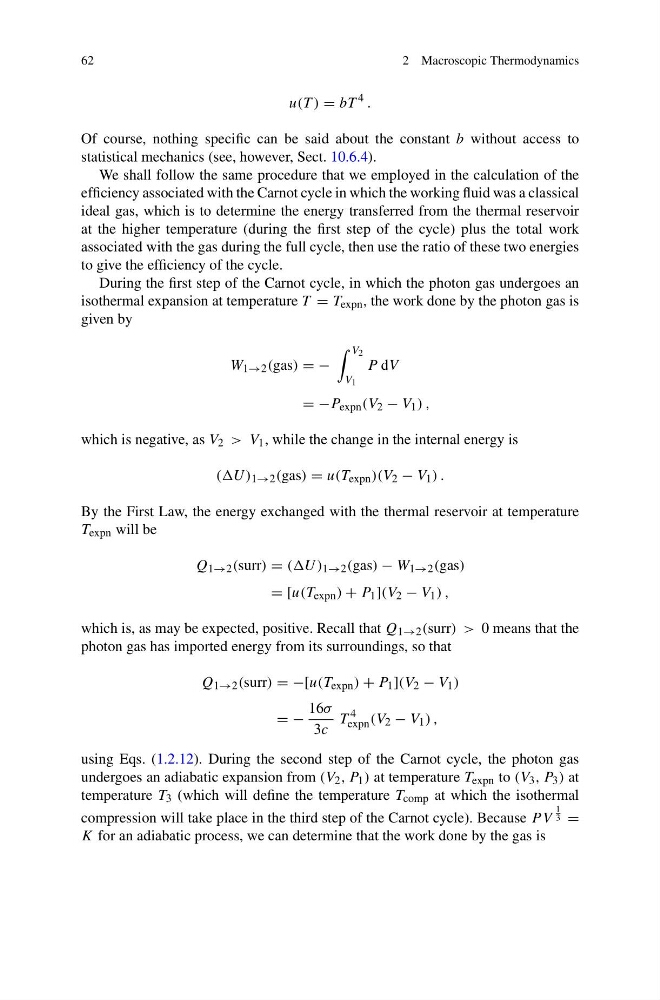
u(T ) = bT
4 .
Of course, nothing specific can be said about the constant b without access to
statistical mechanics (see, however, Sect. 10.6.4).
We shall follow the same procedure that we employed in the calculation of the
efficiency associated with the Carnot cycle in which the working fluid was a classical
ideal gas, which is to determine the energy transferred from the thermal reservoir
at the higher temperature (during the first step of the cycle) plus the total work
associated with the gas during the full cycle, then use the ratio of these two energies
to give the efficiency of the cycle.
During the first step of the Carnot cycle, in which the photon gas undergoes an
isothermal expansion at temperature T = T expn , the work done by the photon gas is
given by
W 1→2 (gas) = −
V 2
V 1
P dV
= −P expn (V 2 − V 1 ) ,
which is negative, as V 2 > V 1 , while the change in the internal energy is
((U ) 1→2 (gas) = u(T expn )(V 2 − V 1 ) .
By the First Law, the energy exchanged with the thermal reservoir at temperature
T expn will be
Q 1→2 (surr) = ((U ) 1→2 (gas) − W 1→2 (gas)
= [u(T expn ) + P 1 ](V 2 − V 1 ) ,
which is, as may be expected, positive. Recall that Q 1→2 (surr) > 0 means that the
photon gas has imported energy from its surroundings, so that
Q 1→2 (surr) = −[u(T expn ) + P 1 ](V 2 − V 1 )
= −
16σ
3c
T
4
expn (V 2 − V 1 ) ,
using Eqs. (1.2.12). During the second step of the Carnot cycle, the photon gas
undergoes an adiabatic expansion from (V 2 , P 1 ) at temperature T expn to (V 3 , P 3 ) at
temperature T 3 (which will define the temperature T comp at which the isothermal
compression will take place in the third step of the Carnot cycle). Because P V
1
3 =
K for an adiabatic process, we can determine that the work done by the gas is
2 Macroscopic Thermodynamics
u(T ) = bT
4 .
Of course, nothing specific can be said about the constant b without access to
statistical mechanics (see, however, Sect. 10.6.4).
We shall follow the same procedure that we employed in the calculation of the
efficiency associated with the Carnot cycle in which the working fluid was a classical
ideal gas, which is to determine the energy transferred from the thermal reservoir
at the higher temperature (during the first step of the cycle) plus the total work
associated with the gas during the full cycle, then use the ratio of these two energies
to give the efficiency of the cycle.
During the first step of the Carnot cycle, in which the photon gas undergoes an
isothermal expansion at temperature T = T expn , the work done by the photon gas is
given by
W 1→2 (gas) = −
V 2
V 1
P dV
= −P expn (V 2 − V 1 ) ,
which is negative, as V 2 > V 1 , while the change in the internal energy is
((U ) 1→2 (gas) = u(T expn )(V 2 − V 1 ) .
By the First Law, the energy exchanged with the thermal reservoir at temperature
T expn will be
Q 1→2 (surr) = ((U ) 1→2 (gas) − W 1→2 (gas)
= [u(T expn ) + P 1 ](V 2 − V 1 ) ,
which is, as may be expected, positive. Recall that Q 1→2 (surr) > 0 means that the
photon gas has imported energy from its surroundings, so that
Q 1→2 (surr) = −[u(T expn ) + P 1 ](V 2 − V 1 )
= −
16σ
3c
T
4
expn (V 2 − V 1 ) ,
using Eqs. (1.2.12). During the second step of the Carnot cycle, the photon gas
undergoes an adiabatic expansion from (V 2 , P 1 ) at temperature T expn to (V 3 , P 3 ) at
temperature T 3 (which will define the temperature T comp at which the isothermal
compression will take place in the third step of the Carnot cycle). Because P V
1
3 =
K for an adiabatic process, we can determine that the work done by the gas is