

2.5 Thermodynamic Engines
57
Q import ≡ Q 1→2 (gas) = Nk B T high ln
V 2
V 1
> 0
(2.5.9a)
represents the heat imported by the system from its surroundings during the
reversible isothermal expansion.
For the adiabatic expansion of the second step of the Carnot cycle, we have
Q 2→3 (gas) ≡ 0, so that 8
W 2→3 (gas) = ((U ) 2→3 =
3
2 Nk B (T low − T high ) .
(2.5.9b)
The reversible isothermal compression of the third step in the Carnot cycle involves
the work done on the gas, namely,
W 3→4 (gas) = −
V 4
V 3
P dV = −Nk B T low ln
V 4
V 3
> 0 ,
which implies (because V 4 < V 3 ) that the heat Q 3→4 (gas) = −W 3→4 (gas) will be
negative. Thus,
Q export ≡ Q 3→4 (surr) = −Nk B T low ln
V 4
V 3
> 0
(2.5.9c)
represents the amount of heat exported to the surroundings during the compression.
Lastly, the adiabatic compression of the final step of the Carnot cycle, with
Q 4→1 (gas) ≡ 0, leads to
W 4→1 (gas) = −
3
2 Nk B (T low − T high ) .
(2.5.9d)
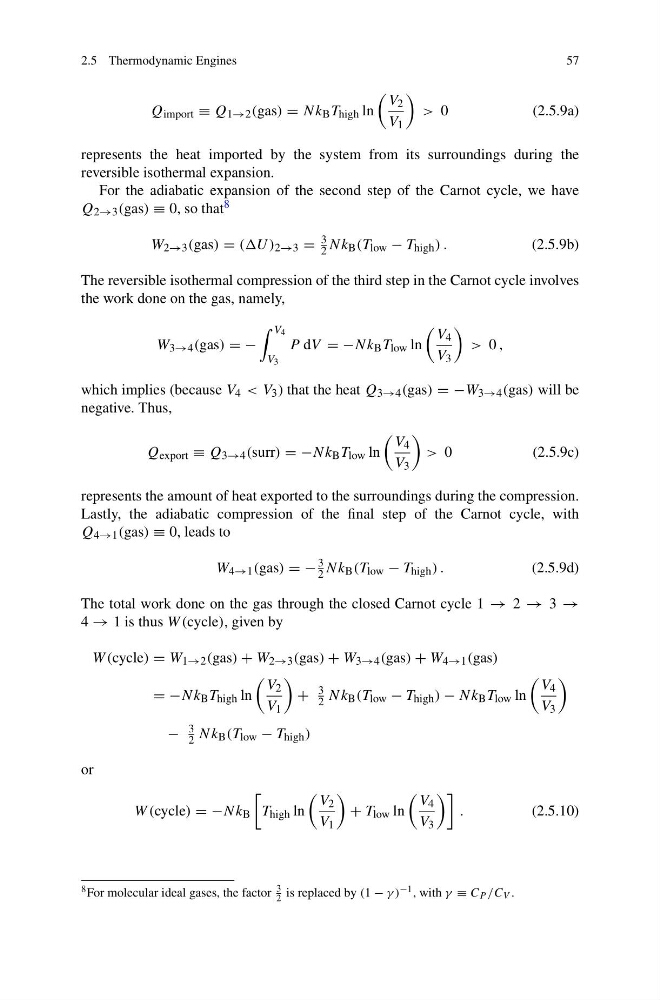
The total work done on the gas through the closed Carnot cycle 1 → 2 → 3 →
4 → 1 is thus W (cycle), given by
W (cycle) = W 1→2 (gas) + W 2→3 (gas) + W 3→4 (gas) + W 4→1 (gas)
= −Nk B T high ln
V 2
V 1
+
3
2 Nk B (T low − T high ) − Nk B T low ln
V 4
V 3
−
3
2 Nk B (T low − T high )
or
W (cycle) = −Nk B
T high ln
V 2
V 1
+ T low ln
V 4
V 3
.
(2.5.10)
8 For molecular ideal gases, the factor
3
2 is replaced by (1 − γ ) −1 , with γ ≡ C P /C V .
57
Q import ≡ Q 1→2 (gas) = Nk B T high ln
V 2
V 1
> 0
(2.5.9a)
represents the heat imported by the system from its surroundings during the
reversible isothermal expansion.
For the adiabatic expansion of the second step of the Carnot cycle, we have
Q 2→3 (gas) ≡ 0, so that 8
W 2→3 (gas) = ((U ) 2→3 =
3
2 Nk B (T low − T high ) .
(2.5.9b)
The reversible isothermal compression of the third step in the Carnot cycle involves
the work done on the gas, namely,
W 3→4 (gas) = −
V 4
V 3
P dV = −Nk B T low ln
V 4
V 3
> 0 ,
which implies (because V 4 < V 3 ) that the heat Q 3→4 (gas) = −W 3→4 (gas) will be
negative. Thus,
Q export ≡ Q 3→4 (surr) = −Nk B T low ln
V 4
V 3
> 0
(2.5.9c)
represents the amount of heat exported to the surroundings during the compression.
Lastly, the adiabatic compression of the final step of the Carnot cycle, with
Q 4→1 (gas) ≡ 0, leads to
W 4→1 (gas) = −
3
2 Nk B (T low − T high ) .
(2.5.9d)
The total work done on the gas through the closed Carnot cycle 1 → 2 → 3 →
4 → 1 is thus W (cycle), given by
W (cycle) = W 1→2 (gas) + W 2→3 (gas) + W 3→4 (gas) + W 4→1 (gas)
= −Nk B T high ln
V 2
V 1
+
3
2 Nk B (T low − T high ) − Nk B T low ln
V 4
V 3
−
3
2 Nk B (T low − T high )
or
W (cycle) = −Nk B
T high ln
V 2
V 1
+ T low ln
V 4
V 3
.
(2.5.10)
8 For molecular ideal gases, the factor
3
2 is replaced by (1 − γ ) −1 , with γ ≡ C P /C V .