

G.3 Hamilton’s Equations
675
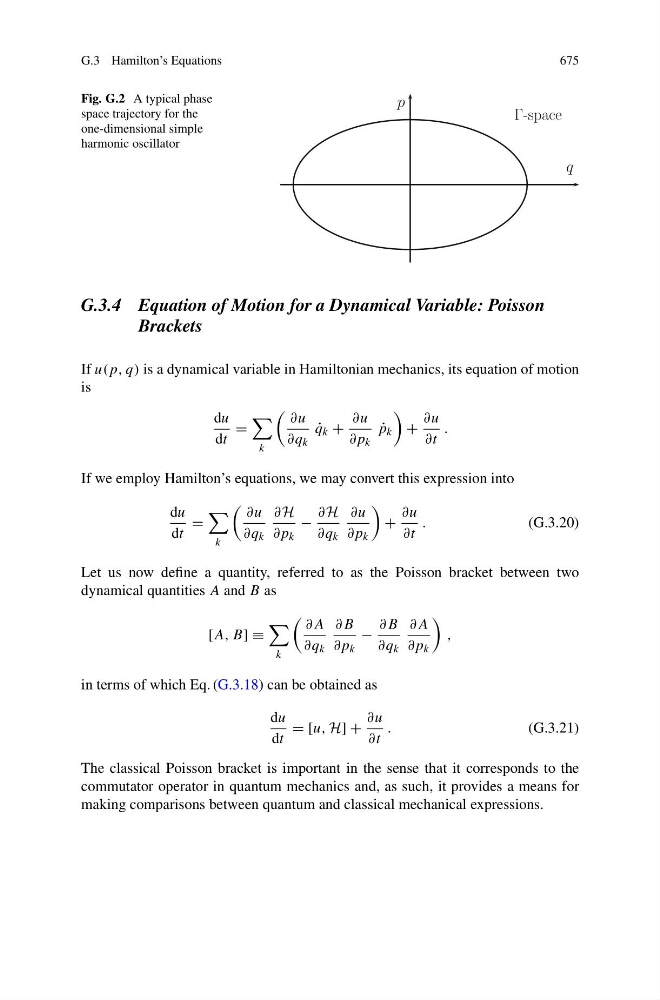
Fig. G.2 A typical phase
space trajectory for the
one-dimensional simple
harmonic oscillator
G.3.4 Equation of Motion for a Dynamical Variable: Poisson
Brackets
If u(p, q) is a dynamical variable in Hamiltonian mechanics, its equation of motion
is
du
dt
=
k
∂u
∂q k
˙
q k +
∂u
∂p k
˙
p k
+
∂u
∂t
.
If we employ Hamilton’s equations, we may convert this expression into
du
dt
=
k
∂u
∂q k
∂H
∂p k
−
∂H
∂q k
∂u
∂p k
+
∂u
∂t
.
(G.3.20)
Let us now define a quantity, referred to as the Poisson bracket between two
dynamical quantities A and B as
[A, B] ≡
k
∂A
∂q k
∂B
∂p k
−
∂B
∂q k
∂A
∂p k
,
in terms of which Eq. (G.3.18) can be obtained as
du
dt
= [u, H] +
∂u
∂t
.
(G.3.21)
The classical Poisson bracket is important in the sense that it corresponds to the
commutator operator in quantum mechanics and, as such, it provides a means for
making comparisons between quantum and classical mechanical expressions.