

654
F Review of Solid State Concepts
v g ≡
dω
dk
,
ω=
¯
h
,
it can be written for our purposes as
v g =
1
¯
h
d
dk
.
(F.3.8)
If we combine Newton’s second law
F =
dp
dt
,
with the relation p = ¯
hk between linear momentum and wave number, we have
F = ¯
h
dk
dt
,
(F.3.9)
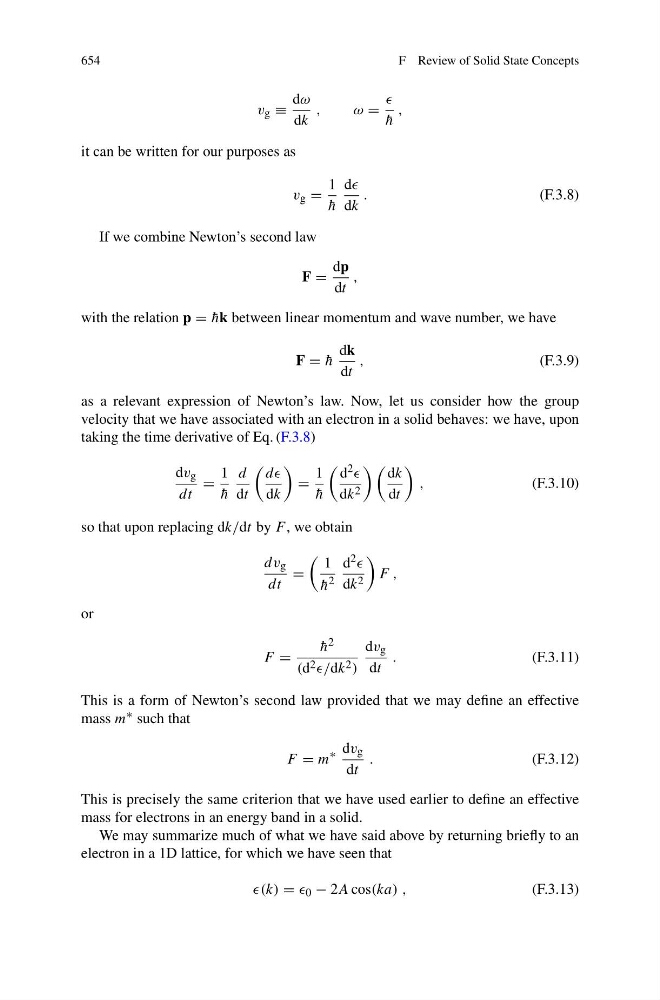
as a relevant expression of Newton’s law. Now, let us consider how the group
velocity that we have associated with an electron in a solid behaves: we have, upon
taking the time derivative of Eq. (F.3.8)
dv g
dt
=
1
¯
h
d
dt
dd
dk
=
1
¯
h
d 2
dk 2
dk
dt
,
(F.3.10)
so that upon replacing dk/dt by F , we obtain
dv g
dt
=
1
¯
h 2
d 2
dk 2
F ,
or
F =
¯
h 2
(d 2 /dk 2 )
dv g
dt
.
(F.3.11)
This is a form of Newton’s second law provided that we may define an effective
mass m ∗ such that
F = m
∗ dv g
dt
.
(F.3.12)
This is precisely the same criterion that we have used earlier to define an effective
mass for electrons in an energy band in a solid.
We may summarize much of what we have said above by returning briefly to an
electron in a 1D lattice, for which we have seen that
= 0 − 2A cos(ka) ,
(F.3.13)