

F.2 Generalization of the Feynman Model to Solids
651
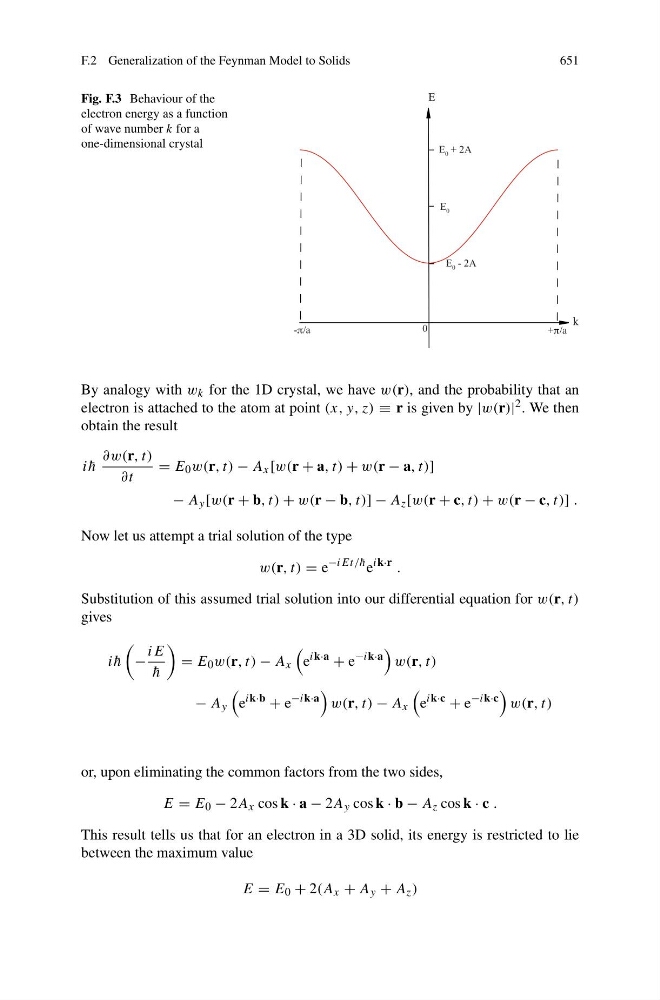
Fig. F.3 Behaviour of the
electron energy as a function
of wave number k for a
one-dimensional crystal
By analogy with w k for the 1D crystal, we have w(r), and the probability that an
electron is attached to the atom at point (x, y, z) ≡ r is given by |w(r)| 2 . We then
obtain the result
i ¯
h
∂w(r, t)
∂t
= E 0 w(r, t) − A x [w(r + a, t) + w(r − a, t)]
− A y [w(r + b, t) + w(r − b, t)] − A z [w(r + c, t) + w(r − c, t)] .
Now let us attempt a trial solution of the type
w(r, t) = e
−iEt/¯ h e
ik·r .
Substitution of this assumed trial solution into our differential equation for w(r, t)
gives
i ¯
h
−
iE
¯
h
= E 0 w(r, t) − A x
e
ik·a
+ e
−ik·a
w(r, t)
− A y
e
ik·b
+ e
−ik·a
w(r, t) − A x
e
ik·c
+ e
−ik·c
w(r, t)
or, upon eliminating the common factors from the two sides,
E = E 0 − 2A x cos k · a − 2A y cos k · b − A z cos k · c .
This result tells us that for an electron in a 3D solid, its energy is restricted to lie
between the maximum value
E = E 0 + 2(A x + A y + A z )