

618
B Review of Traditional Calculus
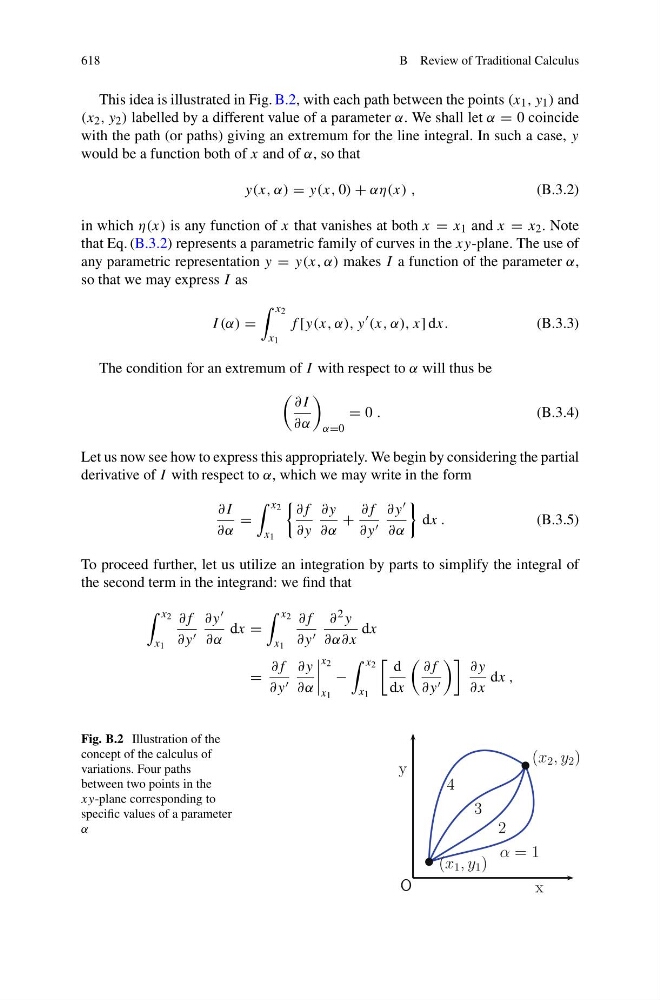
This idea is illustrated in Fig. B.2, with each path between the points (x 1 , y 1 ) and
(x 2 , y 2 ) labelled by a different value of a parameter α. We shall let α = 0 coincide
with the path (or paths) giving an extremum for the line integral. In such a case, y
would be a function both of x and of α, so that
y(x, α) = y(x, 0) + αη(x) ,
(B.3.2)
in which η(x) is any function of x that vanishes at both x = x 1 and x = x 2 . Note
that Eq. (B.3.2) represents a parametric family of curves in the xy-plane. The use of
any parametric representation y = y(x, α) makes I a function of the parameter α,
so that we may express I as
I (α) =
x 2
x 1
f [y(x, α), y
(x, α), x] dx.
(B.3.3)
The condition for an extremum of I with respect to α will thus be
∂I
∂α
α=0
= 0 .
(B.3.4)
Let us now see how to express this appropriately. We begin by considering the partial
derivative of I with respect to α, which we may write in the form
∂I
∂α
=
x 2
x 1
∂f
∂y
∂y
∂α
+
∂f
∂y
∂y
∂α
dx .
(B.3.5)
To proceed further, let us utilize an integration by parts to simplify the integral of
the second term in the integrand: we find that
x 2
x 1
∂f
∂y
∂y
∂α
dx =
x 2
x 1
∂f
∂y
∂ 2 y
∂α∂x
dx
=
∂f
∂y
∂y
∂α
x 2
x 1
−
x 2
x 1
d
dx
∂f
∂y
∂y
∂x
dx ,
Fig. B.2 Illustration of the
concept of the calculus of
variations. Four paths
between two points in the
xy-plane corresponding to
specific values of a parameter
α