

590
A Aspects of Combinatorial Analysis
1
1
or
Configuration 1
Configuration 2
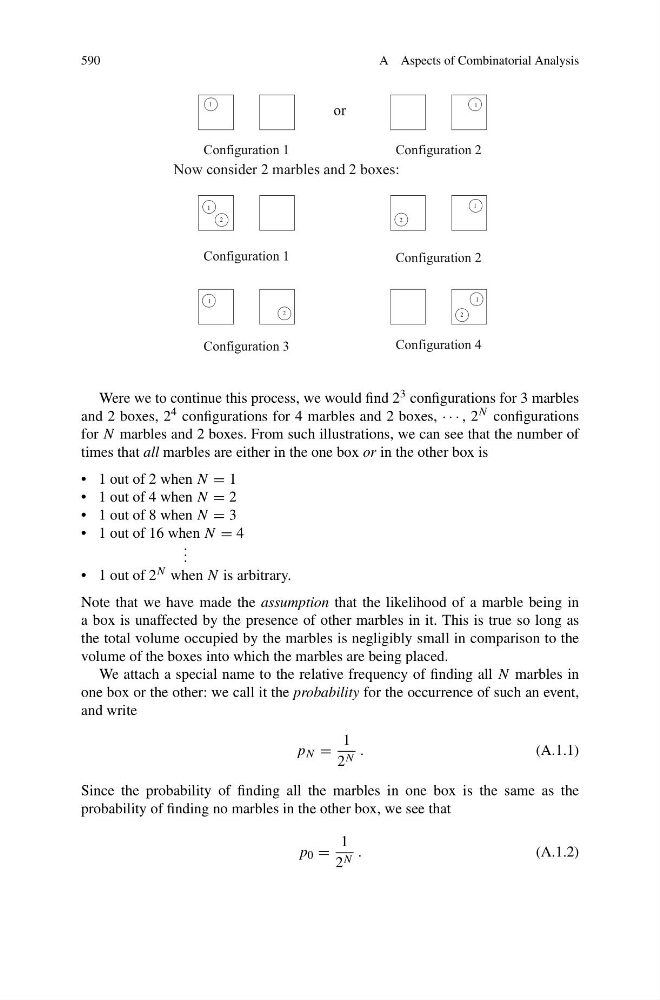
Now consider 2 marbles and 2 boxes:
1
Configuration 3
Configuration 2
Configuration 1
Configuration 4
1
2
2
1
2
2
1
Were we to continue this process, we would find 2 3 configurations for 3 marbles
and 2 boxes, 2 4 configurations for 4 marbles and 2 boxes, · · · , 2 N configurations
for N marbles and 2 boxes. From such illustrations, we can see that the number of
times that all marbles are either in the one box or in the other box is
• 1 out of 2 when N = 1
• 1 out of 4 when N = 2
• 1 out of 8 when N = 3
• 1 out of 16 when N = 4
. . .
• 1 out of 2 N when N is arbitrary.
Note that we have made the assumption that the likelihood of a marble being in
a box is unaffected by the presence of other marbles in it. This is true so long as
the total volume occupied by the marbles is negligibly small in comparison to the
volume of the boxes into which the marbles are being placed.
We attach a special name to the relative frequency of finding all N marbles in
one box or the other: we call it the probability for the occurrence of such an event,
and write
p N =
1
2 N .
(A.1.1)
Since the probability of finding all the marbles in one box is the same as the
probability of finding no marbles in the other box, we see that
p 0 =
1
2 N .
(A.1.2)