

10.8 Problems for This Chapter
587
to treat conduction electrons in these metals as degenerate Fermi gases at room
temperature?
19. By considering that the conduction electrons of Pt and Eu form degenerate
Fermi gases, compute room temperature (300 K) values for the degeneracy
pressures associated with the conduction electrons in these metals, and evaluate
their contributions to the heat capacities (at constant volume) of the two metals.
20. Provide the missing steps to obtain Eq. (10.4.56b) for the magnetic moment
of the conduction electrons at temperature T in a typical metal from
Eq. (10.4.56a).
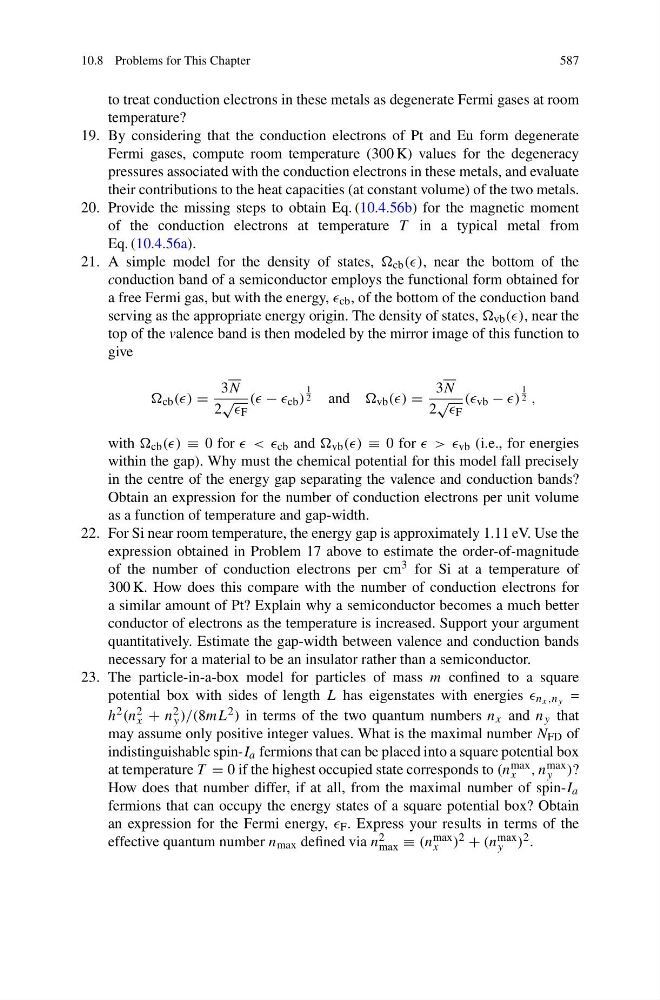
21. A simple model for the density of states, cb ((), near the bottom of the
conduction band of a semiconductor employs the functional form obtained for
a free Fermi gas, but with the energy, cb , of the bottom of the conduction band
serving as the appropriate energy origin. The density of states, vb ((), near the
top of the valence band is then modeled by the mirror image of this function to
give
cb (() =
3N
2
√ F
(( − cb )
1
2
and vb (() =
3N
2
√ F
(( vb − )
1
2 ,
with cb (() ≡ 0 for < < cb and vb (() ≡ 0 for > > vb (i.e., for energies
within the gap). Why must the chemical potential for this model fall precisely
in the centre of the energy gap separating the valence and conduction bands?
Obtain an expression for the number of conduction electrons per unit volume
as a function of temperature and gap-width.
22. For Si near room temperature, the energy gap is approximately 1.11 eV. Use the
expression obtained in Problem 17 above to estimate the order-of-magnitude
of the number of conduction electrons per cm 3 for Si at a temperature of
300 K. How does this compare with the number of conduction electrons for
a similar amount of Pt? Explain why a semiconductor becomes a much better
conductor of electrons as the temperature is increased. Support your argument
quantitatively. Estimate the gap-width between valence and conduction bands
necessary for a material to be an insulator rather than a semiconductor.
23. The particle-in-a-box model for particles of mass m confined to a square
potential box with sides of length L has eigenstates with energies n x ,n y =
h 2 (n 2
x + n 2
y )/(8mL 2 ) in terms of the two quantum numbers n x and n y that
may assume only positive integer values. What is the maximal number N FD of
indistinguishable spin-I a fermions that can be placed into a square potential box
at temperature T = 0 if the highest occupied state corresponds to (n max
x , n max
y )?
How does that number differ, if at all, from the maximal number of spin-I a
fermions that can occupy the energy states of a square potential box? Obtain
an expression for the Fermi energy, F . Express your results in terms of the
effective quantum number n max defined via n 2
max ≡ (n max
x ) 2 + (n max
y ) 2 .