

10.6 Bose–Einstein Statistics
579
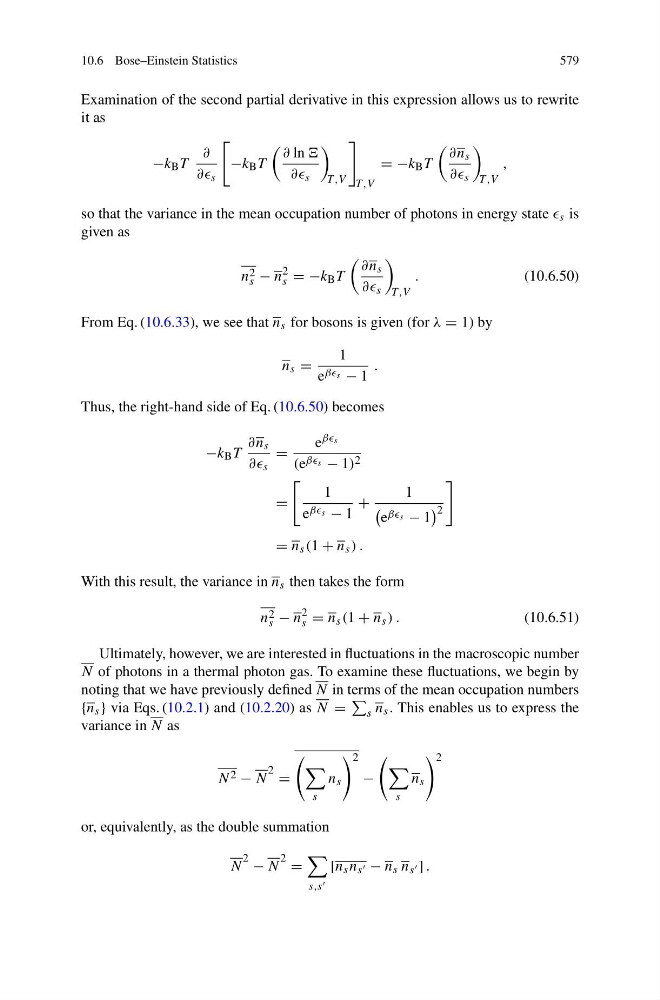
Examination of the second partial derivative in this expression allows us to rewrite
it as
−k B T
∂
∂∂ s
−k B T
∂ ln
∂∂ s
T ,V
T ,V
= −k B T
∂n s
∂∂ s
T ,V
,
so that the variance in the mean occupation number of photons in energy state s is
given as
n 2
s − n
2
s = −k B T
∂n s
∂∂ s
T ,V
.
(10.6.50)
From Eq. (10.6.33), we see that n s for bosons is given (for λ = 1) by
n s =
1
e ββ s − 1
.
Thus, the right-hand side of Eq. (10.6.50) becomes
−k B T
∂n s
∂∂ s
=
e ββ s
(e ββ s − 1) 2
=
1
e ββ s − 1
+
1
e ββ s − 1
2
= n s (1 + n s ) .
With this result, the variance in n s then takes the form
n 2
s − n
2
s = n s (1 + n s ) .
(10.6.51)
Ultimately, however, we are interested in fluctuations in the macroscopic number
N of photons in a thermal photon gas. To examine these fluctuations, we begin by
noting that we have previously defined N in terms of the mean occupation numbers
{n s } via Eqs. (10.2.1) and (10.2.20) as N =
s n s . This enables us to express the
variance in N as
N 2 − N
2 =
s
n s
2
−
s
n s
2
or, equivalently, as the double summation
N
2 − N
2 =
s,s
[n s n s − n s n s ] .