

10.6 Bose–Einstein Statistics
565
10.6.2 The Chemical Potential: Bose Gas
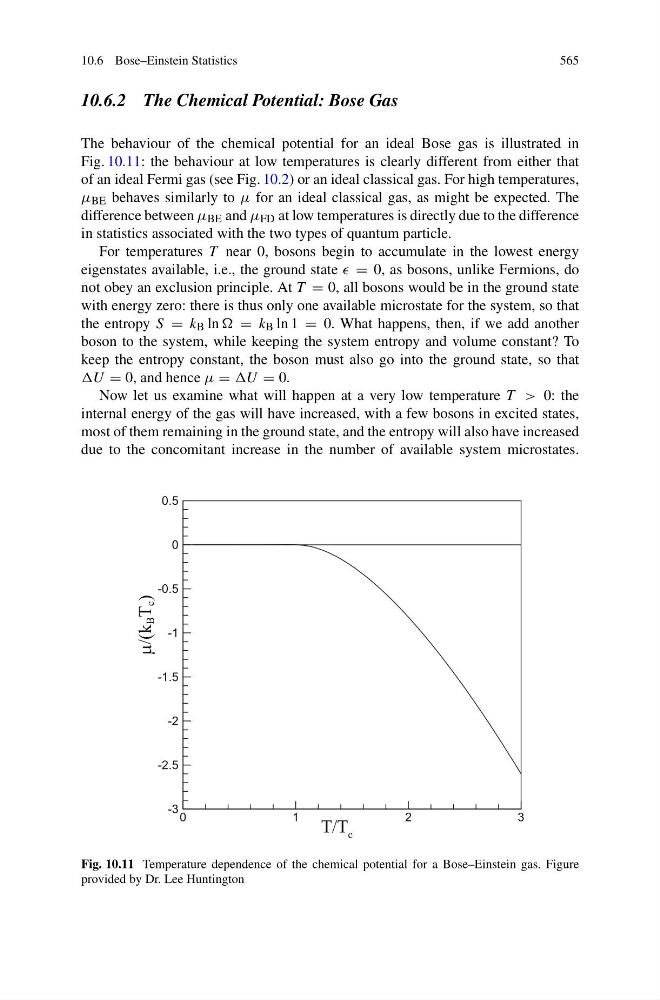
The behaviour of the chemical potential for an ideal Bose gas is illustrated in
Fig. 10.11: the behaviour at low temperatures is clearly different from either that
of an ideal Fermi gas (see Fig. 10.2) or an ideal classical gas. For high temperatures,
μ BE behaves similarly to μ for an ideal classical gas, as might be expected. The
difference between μ BE and μ FD at low temperatures is directly due to the difference
in statistics associated with the two types of quantum particle.
For temperatures T near 0, bosons begin to accumulate in the lowest energy
eigenstates available, i.e., the ground state = 0, as bosons, unlike Fermions, do
not obey an exclusion principle. At T = 0, all bosons would be in the ground state
with energy zero: there is thus only one available microstate for the system, so that
the entropy S = k B ln = k B ln 1 = 0. What happens, then, if we add another
boson to the system, while keeping the system entropy and volume constant? To
keep the entropy constant, the boson must also go into the ground state, so that
U = 0, and hence μ = U = 0.
Now let us examine what will happen at a very low temperature T > 0: the
internal energy of the gas will have increased, with a few bosons in excited states,
most of them remaining in the ground state, and the entropy will also have increased
due to the concomitant increase in the number of available system microstates.
0
1
2
3
-3
-2.5
-2
-1.5
-1
-0.5
0
0.5
T/T c
μ/(k B T
c )
Fig. 10.11 Temperature dependence of the chemical potential for a Bose–Einstein gas. Figure
provided by Dr. Lee Huntington
565
10.6.2 The Chemical Potential: Bose Gas
The behaviour of the chemical potential for an ideal Bose gas is illustrated in
Fig. 10.11: the behaviour at low temperatures is clearly different from either that
of an ideal Fermi gas (see Fig. 10.2) or an ideal classical gas. For high temperatures,
μ BE behaves similarly to μ for an ideal classical gas, as might be expected. The
difference between μ BE and μ FD at low temperatures is directly due to the difference
in statistics associated with the two types of quantum particle.
For temperatures T near 0, bosons begin to accumulate in the lowest energy
eigenstates available, i.e., the ground state = 0, as bosons, unlike Fermions, do
not obey an exclusion principle. At T = 0, all bosons would be in the ground state
with energy zero: there is thus only one available microstate for the system, so that
the entropy S = k B ln = k B ln 1 = 0. What happens, then, if we add another
boson to the system, while keeping the system entropy and volume constant? To
keep the entropy constant, the boson must also go into the ground state, so that
U = 0, and hence μ = U = 0.
Now let us examine what will happen at a very low temperature T > 0: the
internal energy of the gas will have increased, with a few bosons in excited states,
most of them remaining in the ground state, and the entropy will also have increased
due to the concomitant increase in the number of available system microstates.
0
1
2
3
-3
-2.5
-2
-1.5
-1
-0.5
0
0.5
T/T c
μ/(k B T
c )
Fig. 10.11 Temperature dependence of the chemical potential for a Bose–Einstein gas. Figure
provided by Dr. Lee Huntington