

44
2 Macroscopic Thermodynamics
∂P
∂T
V
=
∂S
∂V
T
,
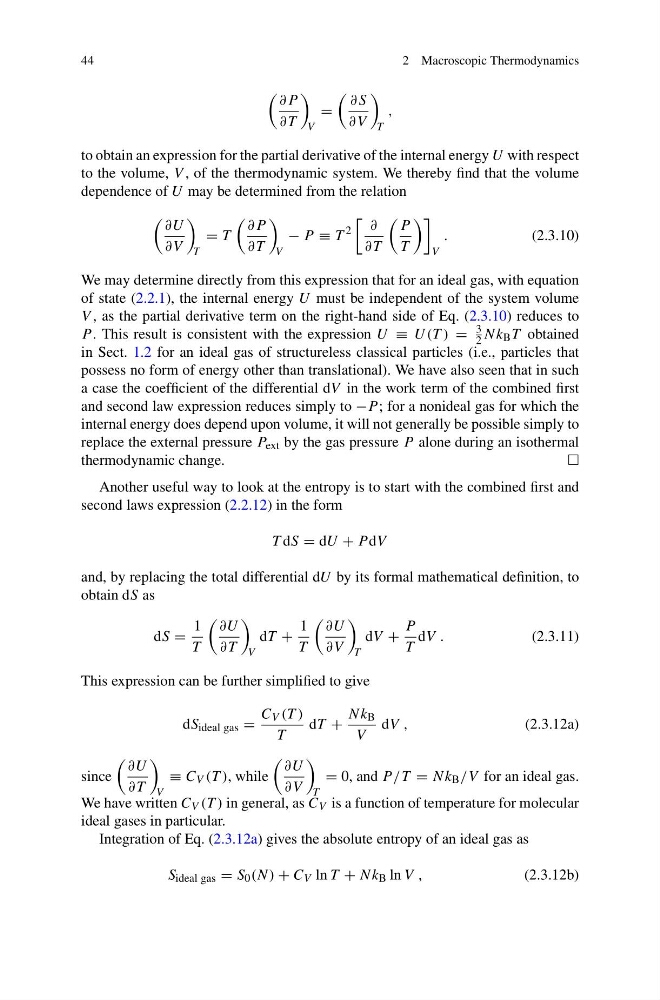
to obtain an expression for the partial derivative of the internal energy U with respect
to the volume, V , of the thermodynamic system. We thereby find that the volume
dependence of U may be determined from the relation
∂U
∂V
T
= T
∂P
∂T
V
− P ≡ T
2
∂
∂T
P
T
V
.
(2.3.10)
We may determine directly from this expression that for an ideal gas, with equation
of state (2.2.1), the internal energy U must be independent of the system volume
V , as the partial derivative term on the right-hand side of Eq. (2.3.10) reduces to
P . This result is consistent with the expression U ≡ U(T ) =
3
2 Nk B T obtained
in Sect. 1.2 for an ideal gas of structureless classical particles (i.e., particles that
possess no form of energy other than translational). We have also seen that in such
a case the coefficient of the differential dV in the work term of the combined first
and second law expression reduces simply to −P ; for a nonideal gas for which the
internal energy does depend upon volume, it will not generally be possible simply to
replace the external pressure P ext by the gas pressure P alone during an isothermal
thermodynamic change.
Another useful way to look at the entropy is to start with the combined first and
second laws expression (2.2.12) in the form
T dS = dU + P dV
and, by replacing the total differential dU by its formal mathematical definition, to
obtain dS as
dS =
1
T
∂U
∂T
V
dT +
1
T
∂U
∂V
T
dV +
P
T
dV .
(2.3.11)
This expression can be further simplified to give
dS ideal gas =
C V (T )
T
dT +
Nk B
V
dV ,
(2.3.12a)
since
∂U
∂T
V
≡ C V (T ), while
∂U
∂V
T
= 0, and P /T = Nk B /V for an ideal gas.
We have written C V (T ) in general, as C V is a function of temperature for molecular
ideal gases in particular.
Integration of Eq. (2.3.12a) gives the absolute entropy of an ideal gas as
S ideal gas = S 0 (N) + C V ln T + Nk B ln V ,
(2.3.12b)
2 Macroscopic Thermodynamics
∂P
∂T
V
=
∂S
∂V
T
,
to obtain an expression for the partial derivative of the internal energy U with respect
to the volume, V , of the thermodynamic system. We thereby find that the volume
dependence of U may be determined from the relation
∂U
∂V
T
= T
∂P
∂T
V
− P ≡ T
2
∂
∂T
P
T
V
.
(2.3.10)
We may determine directly from this expression that for an ideal gas, with equation
of state (2.2.1), the internal energy U must be independent of the system volume
V , as the partial derivative term on the right-hand side of Eq. (2.3.10) reduces to
P . This result is consistent with the expression U ≡ U(T ) =
3
2 Nk B T obtained
in Sect. 1.2 for an ideal gas of structureless classical particles (i.e., particles that
possess no form of energy other than translational). We have also seen that in such
a case the coefficient of the differential dV in the work term of the combined first
and second law expression reduces simply to −P ; for a nonideal gas for which the
internal energy does depend upon volume, it will not generally be possible simply to
replace the external pressure P ext by the gas pressure P alone during an isothermal
thermodynamic change.
Another useful way to look at the entropy is to start with the combined first and
second laws expression (2.2.12) in the form
T dS = dU + P dV
and, by replacing the total differential dU by its formal mathematical definition, to
obtain dS as
dS =
1
T
∂U
∂T
V
dT +
1
T
∂U
∂V
T
dV +
P
T
dV .
(2.3.11)
This expression can be further simplified to give
dS ideal gas =
C V (T )
T
dT +
Nk B
V
dV ,
(2.3.12a)
since
∂U
∂T
V
≡ C V (T ), while
∂U
∂V
T
= 0, and P /T = Nk B /V for an ideal gas.
We have written C V (T ) in general, as C V is a function of temperature for molecular
ideal gases in particular.
Integration of Eq. (2.3.12a) gives the absolute entropy of an ideal gas as
S ideal gas = S 0 (N) + C V ln T + Nk B ln V ,
(2.3.12b)