

560
10 Quantum Statistics
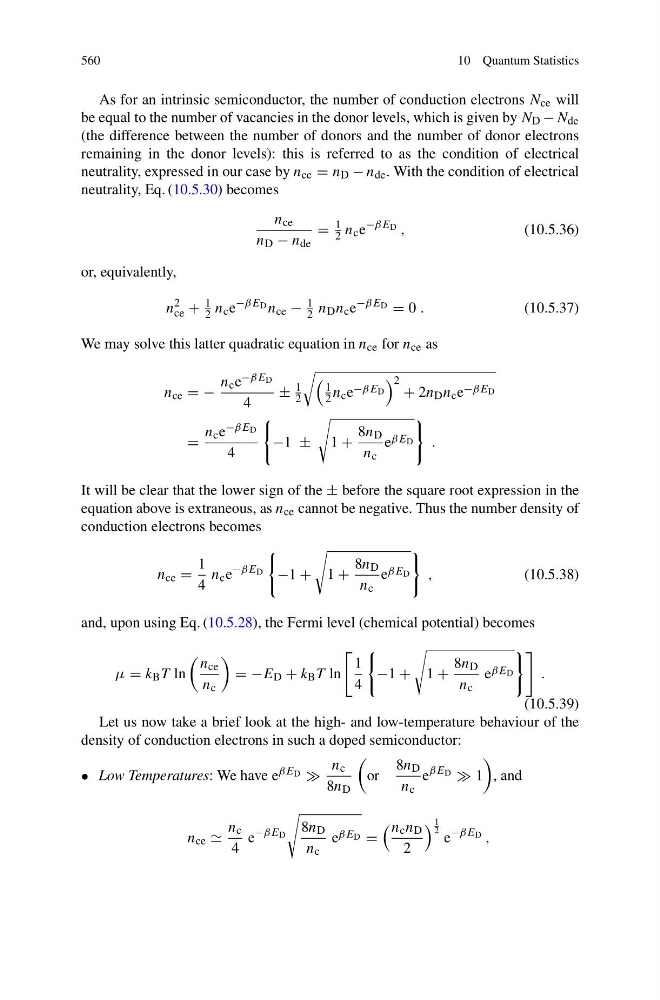
As for an intrinsic semiconductor, the number of conduction electrons N ce will
be equal to the number of vacancies in the donor levels, which is given by N D − N de
(the difference between the number of donors and the number of donor electrons
remaining in the donor levels): this is referred to as the condition of electrical
neutrality, expressed in our case by n ce = n D − n de . With the condition of electrical
neutrality, Eq. (10.5.30) becomes
n ce
n D − n de
=
1
2 n c e
−βE D ,
(10.5.36)
or, equivalently,
n
2
ce +
1
2 n c e
−βE D n ce −
1
2 n D n c e
−βE D = 0 .
(10.5.37)
We may solve this latter quadratic equation in n ce for n ce as
n ce = −
n c e −βE D
4
±
1
2
1
2 n c e −βE D
2 + 2n D n c e −βE D
=
n c e −βE D
4
−1 ±
1 +
8n D
n c
e βE D
.
It will be clear that the lower sign of the ± before the square root expression in the
equation above is extraneous, as n ce cannot be negative. Thus the number density of
conduction electrons becomes
n ce =
1
4
n c e
−βE D
−1 +
1 +
8n D
n c
e βE D
,
(10.5.38)
and, upon using Eq. (10.5.28), the Fermi level (chemical potential) becomes
μ = k B T ln
n ce
n c
= −E D + k B T ln
1
4
−1 +
1 +
8n D
n c
e βE D
.
(10.5.39)
Let us now take a brief look at the high- and low-temperature behaviour of the
density of conduction electrons in such a doped semiconductor:
• Low Temperatures: We have e βE D
n c
8n D
or
8n D
n c
e
βE D 1
, and
n ce
n c
4
e
−βE D
8n D
n c
e βE D =
n c n D
2
1
2 e
−βE D ,
10 Quantum Statistics
As for an intrinsic semiconductor, the number of conduction electrons N ce will
be equal to the number of vacancies in the donor levels, which is given by N D − N de
(the difference between the number of donors and the number of donor electrons
remaining in the donor levels): this is referred to as the condition of electrical
neutrality, expressed in our case by n ce = n D − n de . With the condition of electrical
neutrality, Eq. (10.5.30) becomes
n ce
n D − n de
=
1
2 n c e
−βE D ,
(10.5.36)
or, equivalently,
n
2
ce +
1
2 n c e
−βE D n ce −
1
2 n D n c e
−βE D = 0 .
(10.5.37)
We may solve this latter quadratic equation in n ce for n ce as
n ce = −
n c e −βE D
4
±
1
2
1
2 n c e −βE D
2 + 2n D n c e −βE D
=
n c e −βE D
4
−1 ±
1 +
8n D
n c
e βE D
.
It will be clear that the lower sign of the ± before the square root expression in the
equation above is extraneous, as n ce cannot be negative. Thus the number density of
conduction electrons becomes
n ce =
1
4
n c e
−βE D
−1 +
1 +
8n D
n c
e βE D
,
(10.5.38)
and, upon using Eq. (10.5.28), the Fermi level (chemical potential) becomes
μ = k B T ln
n ce
n c
= −E D + k B T ln
1
4
−1 +
1 +
8n D
n c
e βE D
.
(10.5.39)
Let us now take a brief look at the high- and low-temperature behaviour of the
density of conduction electrons in such a doped semiconductor:
• Low Temperatures: We have e βE D
n c
8n D
or
8n D
n c
e
βE D 1
, and
n ce
n c
4
e
−βE D
8n D
n c
e βE D =
n c n D
2
1
2 e
−βE D ,