

10.4 Fermi–Dirac Statistics
549
the number of continuum translational states for m s = +
1
2 electrons is given by
N
m s = +
1
2
= 0 (V )
∞
−μ 0 B
(( − μ 0 B)
1
2 f (() d ,
(10.4.57b)
and the net magnetic moment is given by
M ce = μ 0
N(m s =−
1
2 ) − N
m s =+
1
2
= μ 0 0 (V )
∞
−μ 0 B
(( + μ 0 B)
1
2 f (() d −
∞
μ 0 B
(( − μ 0 B)
1
2 f (() d
.
(10.4.58)
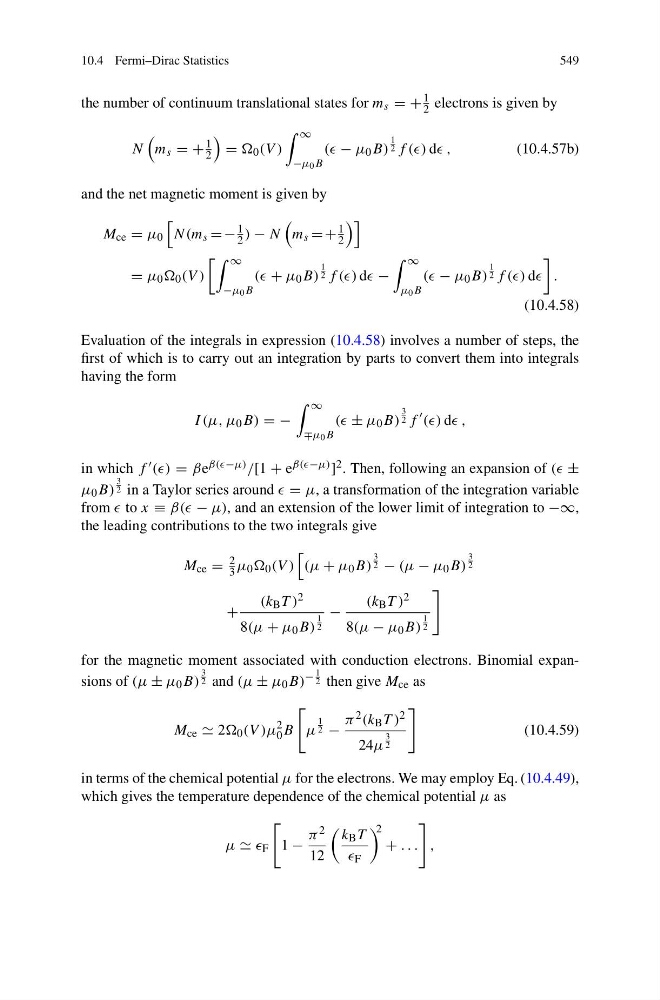
Evaluation of the integrals in expression (10.4.58) involves a number of steps, the
first of which is to carry out an integration by parts to convert them into integrals
having the form
I (μ, μ 0 B) = −
∞
∓μ 0 B
(( ± μ 0 B)
3
2 f
(() d ,
in which f (() = βe β((−μ) /[1 + e β((−μ) ] 2 . Then, following an expansion of (( ±
μ 0 B)
3
2 in a Taylor series around = μ, a transformation of the integration variable
from to x ≡ β(( − μ), and an extension of the lower limit of integration to −∞,
the leading contributions to the two integrals give
M ce =
2
3 μ 0 0 (V )
(μ + μ 0 B)
3
2 − (μ − μ 0 B)
3
2
+
(k B T ) 2
8(μ + μ 0 B)
1
2
−
(k B T ) 2
8(μ − μ 0 B)
1
2
for the magnetic moment associated with conduction electrons. Binomial expansions of (μ ± μ 0 B)
3
2 and (μ ± μ 0 B)
−
1
2 then give M ce as
M ce 2 0 (V )μ
2
0 B
μ
1
2 −
π 2 (k B T ) 2
24μ
3
2
(10.4.59)
in terms of the chemical potential μ for the electrons. We may employ Eq. (10.4.49),
which gives the temperature dependence of the chemical potential μ as
μ F
1 −
π 2
12
k B T
F
2
+ . . .
,
549
the number of continuum translational states for m s = +
1
2 electrons is given by
N
m s = +
1
2
= 0 (V )
∞
−μ 0 B
(( − μ 0 B)
1
2 f (() d ,
(10.4.57b)
and the net magnetic moment is given by
M ce = μ 0
N(m s =−
1
2 ) − N
m s =+
1
2
= μ 0 0 (V )
∞
−μ 0 B
(( + μ 0 B)
1
2 f (() d −
∞
μ 0 B
(( − μ 0 B)
1
2 f (() d
.
(10.4.58)
Evaluation of the integrals in expression (10.4.58) involves a number of steps, the
first of which is to carry out an integration by parts to convert them into integrals
having the form
I (μ, μ 0 B) = −
∞
∓μ 0 B
(( ± μ 0 B)
3
2 f
(() d ,
in which f (() = βe β((−μ) /[1 + e β((−μ) ] 2 . Then, following an expansion of (( ±
μ 0 B)
3
2 in a Taylor series around = μ, a transformation of the integration variable
from to x ≡ β(( − μ), and an extension of the lower limit of integration to −∞,
the leading contributions to the two integrals give
M ce =
2
3 μ 0 0 (V )
(μ + μ 0 B)
3
2 − (μ − μ 0 B)
3
2
+
(k B T ) 2
8(μ + μ 0 B)
1
2
−
(k B T ) 2
8(μ − μ 0 B)
1
2
for the magnetic moment associated with conduction electrons. Binomial expansions of (μ ± μ 0 B)
3
2 and (μ ± μ 0 B)
−
1
2 then give M ce as
M ce 2 0 (V )μ
2
0 B
μ
1
2 −
π 2 (k B T ) 2
24μ
3
2
(10.4.59)
in terms of the chemical potential μ for the electrons. We may employ Eq. (10.4.49),
which gives the temperature dependence of the chemical potential μ as
μ F
1 −
π 2
12
k B T
F
2
+ . . .
,