

538
10 Quantum Statistics
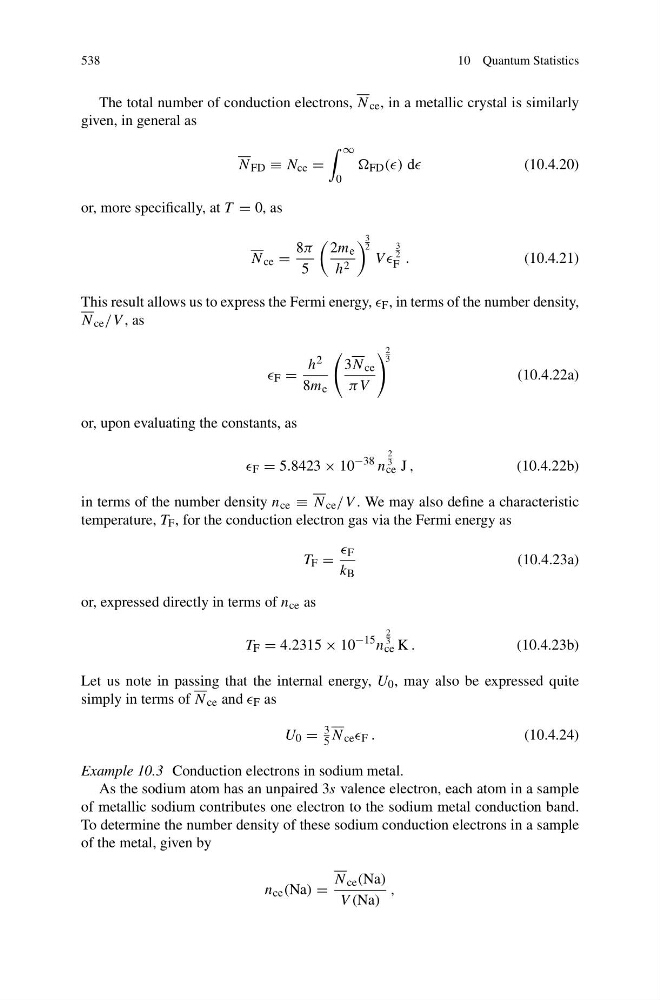
The total number of conduction electrons, N ce , in a metallic crystal is similarly
given, in general as
N FD ≡ N ce =
∞
0
FD (() d
(10.4.20)
or, more specifically, at T = 0, as
N ce =
8π
5
2m e
h 2
3
2
V V
3
2
F .
(10.4.21)
This result allows us to express the Fermi energy, F , in terms of the number density,
N ce /V , as
F =
h 2
8m e
3N ce
πV
2
3
(10.4.22a)
or, upon evaluating the constants, as
F = 5.8423 × 10
−38 n
2
3
ce J ,
(10.4.22b)
in terms of the number density n ce ≡ N ce /V . We may also define a characteristic
temperature, T F , for the conduction electron gas via the Fermi energy as
T F =
F
k B
(10.4.23a)
or, expressed directly in terms of n ce as
T F = 4.2315 × 10
−15 n
2
3
ce K .
(10.4.23b)
Let us note in passing that the internal energy, U 0 , may also be expressed quite
simply in terms of N ce and F as
U 0 =
3
5 N ce F .
(10.4.24)
Example 10.3 Conduction electrons in sodium metal.
As the sodium atom has an unpaired 3s valence electron, each atom in a sample
of metallic sodium contributes one electron to the sodium metal conduction band.
To determine the number density of these sodium conduction electrons in a sample
of the metal, given by
n ce (Na) =
N ce (Na)
V (Na)
,
10 Quantum Statistics
The total number of conduction electrons, N ce , in a metallic crystal is similarly
given, in general as
N FD ≡ N ce =
∞
0
FD (() d
(10.4.20)
or, more specifically, at T = 0, as
N ce =
8π
5
2m e
h 2
3
2
V V
3
2
F .
(10.4.21)
This result allows us to express the Fermi energy, F , in terms of the number density,
N ce /V , as
F =
h 2
8m e
3N ce
πV
2
3
(10.4.22a)
or, upon evaluating the constants, as
F = 5.8423 × 10
−38 n
2
3
ce J ,
(10.4.22b)
in terms of the number density n ce ≡ N ce /V . We may also define a characteristic
temperature, T F , for the conduction electron gas via the Fermi energy as
T F =
F
k B
(10.4.23a)
or, expressed directly in terms of n ce as
T F = 4.2315 × 10
−15 n
2
3
ce K .
(10.4.23b)
Let us note in passing that the internal energy, U 0 , may also be expressed quite
simply in terms of N ce and F as
U 0 =
3
5 N ce F .
(10.4.24)
Example 10.3 Conduction electrons in sodium metal.
As the sodium atom has an unpaired 3s valence electron, each atom in a sample
of metallic sodium contributes one electron to the sodium metal conduction band.
To determine the number density of these sodium conduction electrons in a sample
of the metal, given by
n ce (Na) =
N ce (Na)
V (Na)
,