

10.4 Fermi–Dirac Statistics
535
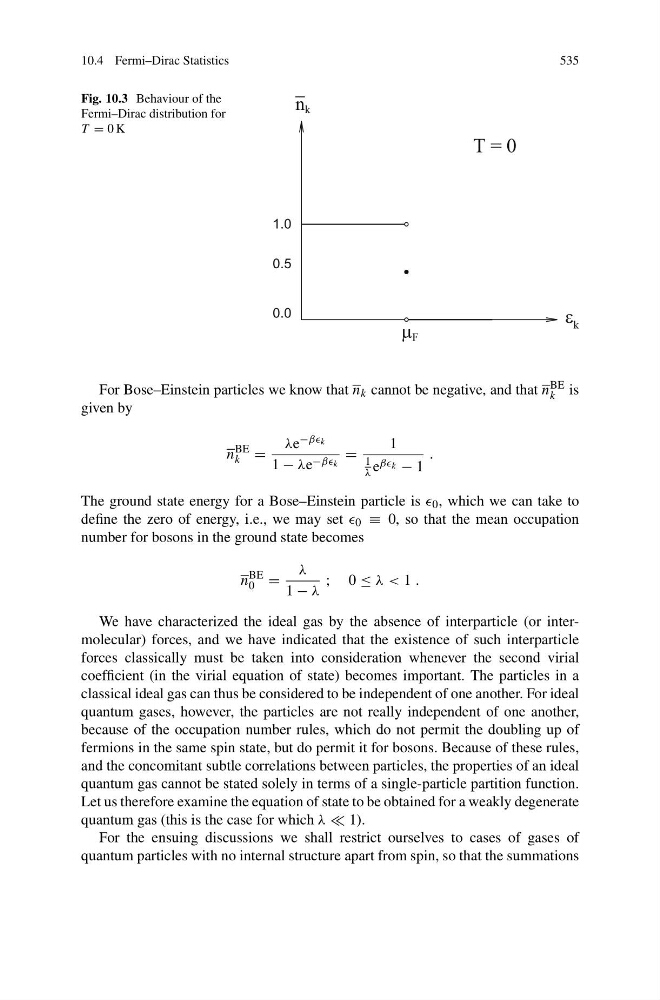
Fig. 10.3 Behaviour of the
Fermi–Dirac distribution for
T = 0 K
n k
ε k
1.0
0.0
0.5
μ F
T = 0
For Bose–Einstein particles we know that n k cannot be negative, and that n
BE
k is
given by
n
BE
k =
λe −ββ k
1 − λe −ββ k
=
1
1
λ e ββ k − 1
.
The ground state energy for a Bose–Einstein particle is 0 , which we can take to
define the zero of energy, i.e., we may set 0 ≡ 0, so that the mean occupation
number for bosons in the ground state becomes
n
BE
0 =
λ
1 − λ
; 0 ≤ λ < 1 .
We have characterized the ideal gas by the absence of interparticle (or intermolecular) forces, and we have indicated that the existence of such interparticle
forces classically must be taken into consideration whenever the second virial
coefficient (in the virial equation of state) becomes important. The particles in a
classical ideal gas can thus be considered to be independent of one another. For ideal
quantum gases, however, the particles are not really independent of one another,
because of the occupation number rules, which do not permit the doubling up of
fermions in the same spin state, but do permit it for bosons. Because of these rules,
and the concomitant subtle correlations between particles, the properties of an ideal
quantum gas cannot be stated solely in terms of a single-particle partition function.
Let us therefore examine the equation of state to be obtained for a weakly degenerate
quantum gas (this is the case for which λ 1).
For the ensuing discussions we shall restrict ourselves to cases of gases of
quantum particles with no internal structure apart from spin, so that the summations
535
Fig. 10.3 Behaviour of the
Fermi–Dirac distribution for
T = 0 K
n k
ε k
1.0
0.0
0.5
μ F
T = 0
For Bose–Einstein particles we know that n k cannot be negative, and that n
BE
k is
given by
n
BE
k =
λe −ββ k
1 − λe −ββ k
=
1
1
λ e ββ k − 1
.
The ground state energy for a Bose–Einstein particle is 0 , which we can take to
define the zero of energy, i.e., we may set 0 ≡ 0, so that the mean occupation
number for bosons in the ground state becomes
n
BE
0 =
λ
1 − λ
; 0 ≤ λ < 1 .
We have characterized the ideal gas by the absence of interparticle (or intermolecular) forces, and we have indicated that the existence of such interparticle
forces classically must be taken into consideration whenever the second virial
coefficient (in the virial equation of state) becomes important. The particles in a
classical ideal gas can thus be considered to be independent of one another. For ideal
quantum gases, however, the particles are not really independent of one another,
because of the occupation number rules, which do not permit the doubling up of
fermions in the same spin state, but do permit it for bosons. Because of these rules,
and the concomitant subtle correlations between particles, the properties of an ideal
quantum gas cannot be stated solely in terms of a single-particle partition function.
Let us therefore examine the equation of state to be obtained for a weakly degenerate
quantum gas (this is the case for which λ 1).
For the ensuing discussions we shall restrict ourselves to cases of gases of
quantum particles with no internal structure apart from spin, so that the summations