

528
10 Quantum Statistics
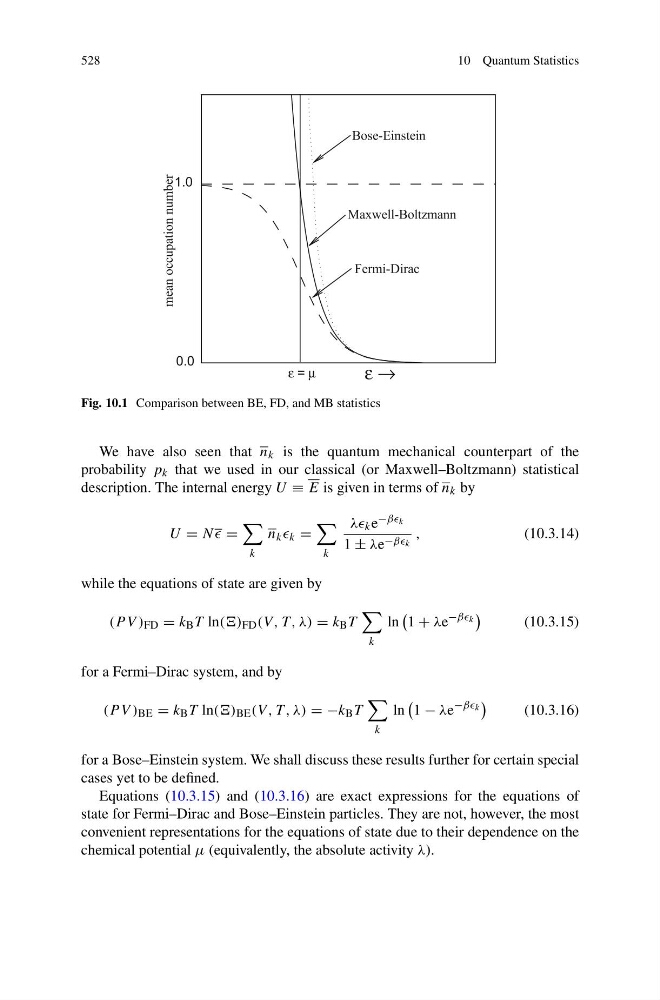
Fig. 10.1 Comparison between BE, FD, and MB statistics
We have also seen that n k is the quantum mechanical counterpart of the
probability p k that we used in our classical (or Maxwell–Boltzmann) statistical
description. The internal energy U ≡ E is given in terms of n k by
U = N =
k
n k k =
k
λλ k e −ββ k
1 ± λe −ββ k
,
(10.3.14)
while the equations of state are given by
(P V ) FD = k B T ln(() FD (V , T , λ) = k B T
k
ln
1 + λe
−ββ k
(10.3.15)
for a Fermi–Dirac system, and by
(P V ) BE = k B T ln(() BE (V , T , λ) = −k B T
k
ln
1 − λe
−ββ k
(10.3.16)
for a Bose–Einstein system. We shall discuss these results further for certain special
cases yet to be defined.
Equations (10.3.15) and (10.3.16) are exact expressions for the equations of
state for Fermi–Dirac and Bose–Einstein particles. They are not, however, the most
convenient representations for the equations of state due to their dependence on the
chemical potential μ (equivalently, the absolute activity λ).
10 Quantum Statistics
Fig. 10.1 Comparison between BE, FD, and MB statistics
We have also seen that n k is the quantum mechanical counterpart of the
probability p k that we used in our classical (or Maxwell–Boltzmann) statistical
description. The internal energy U ≡ E is given in terms of n k by
U = N =
k
n k k =
k
λλ k e −ββ k
1 ± λe −ββ k
,
(10.3.14)
while the equations of state are given by
(P V ) FD = k B T ln(() FD (V , T , λ) = k B T
k
ln
1 + λe
−ββ k
(10.3.15)
for a Fermi–Dirac system, and by
(P V ) BE = k B T ln(() BE (V , T , λ) = −k B T
k
ln
1 − λe
−ββ k
(10.3.16)
for a Bose–Einstein system. We shall discuss these results further for certain special
cases yet to be defined.
Equations (10.3.15) and (10.3.16) are exact expressions for the equations of
state for Fermi–Dirac and Bose–Einstein particles. They are not, however, the most
convenient representations for the equations of state due to their dependence on the
chemical potential μ (equivalently, the absolute activity λ).