

10.3 Connection to Maxwell–Boltzmann Statistics
525
• fixed N/V when ) is small or, equivalently, when T is high: from
Eq. (10.2.22), we thus see that λe −ββ k 1, as for N/V is small.
Thus, n k → 0 may be achieved by taking λ → 0. This result is consistent with our
knowledge that for classical (or Maxwell–Boltzmann) statistics to apply, there must
be many more quantum N-body states than there are particles to occupy them, so
that on average most states are unoccupied.
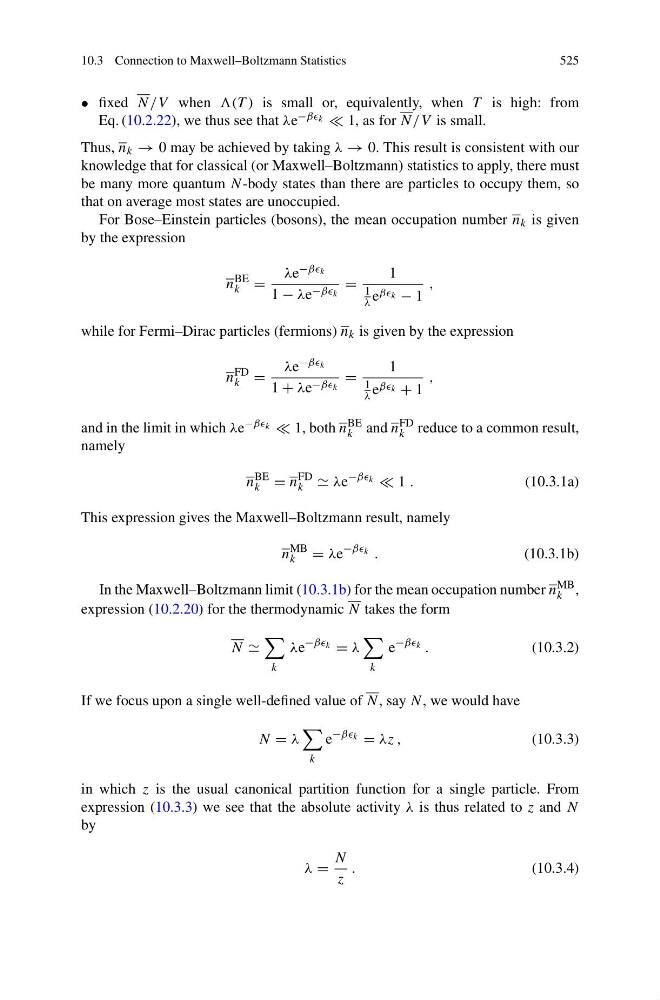
For Bose–Einstein particles (bosons), the mean occupation number n k is given
by the expression
n
BE
k =
λe −ββ k
1 − λe −ββ k
=
1
1
λ e ββ k − 1
,
while for Fermi–Dirac particles (fermions) n k is given by the expression
n
FD
k =
λe −ββ k
1 + λe −ββ k
=
1
1
λ e ββ k + 1
,
and in the limit in which λe −ββ k 1, both n
BE
k and n
FD
k reduce to a common result,
namely
n
BE
k = n
FD
k λe
−ββ k 1 .
(10.3.1a)
This expression gives the Maxwell–Boltzmann result, namely
n
MB
k
= λe
−ββ k .
(10.3.1b)
In the Maxwell–Boltzmann limit (10.3.1b) for the mean occupation number n
MB
k ,
expression (10.2.20) for the thermodynamic N takes the form
N
k
λe
−ββ k = λ
k
e
−ββ k .
(10.3.2)
If we focus upon a single well-defined value of N, say N, we would have
N = λ
k
e
−ββ k = λz ,
(10.3.3)
in which z is the usual canonical partition function for a single particle. From
expression (10.3.3) we see that the absolute activity λ is thus related to z and N
by
λ =
N
z
.
(10.3.4)
525
• fixed N/V when ) is small or, equivalently, when T is high: from
Eq. (10.2.22), we thus see that λe −ββ k 1, as for N/V is small.
Thus, n k → 0 may be achieved by taking λ → 0. This result is consistent with our
knowledge that for classical (or Maxwell–Boltzmann) statistics to apply, there must
be many more quantum N-body states than there are particles to occupy them, so
that on average most states are unoccupied.
For Bose–Einstein particles (bosons), the mean occupation number n k is given
by the expression
n
BE
k =
λe −ββ k
1 − λe −ββ k
=
1
1
λ e ββ k − 1
,
while for Fermi–Dirac particles (fermions) n k is given by the expression
n
FD
k =
λe −ββ k
1 + λe −ββ k
=
1
1
λ e ββ k + 1
,
and in the limit in which λe −ββ k 1, both n
BE
k and n
FD
k reduce to a common result,
namely
n
BE
k = n
FD
k λe
−ββ k 1 .
(10.3.1a)
This expression gives the Maxwell–Boltzmann result, namely
n
MB
k
= λe
−ββ k .
(10.3.1b)
In the Maxwell–Boltzmann limit (10.3.1b) for the mean occupation number n
MB
k ,
expression (10.2.20) for the thermodynamic N takes the form
N
k
λe
−ββ k = λ
k
e
−ββ k .
(10.3.2)
If we focus upon a single well-defined value of N, say N, we would have
N = λ
k
e
−ββ k = λz ,
(10.3.3)
in which z is the usual canonical partition function for a single particle. From
expression (10.3.3) we see that the absolute activity λ is thus related to z and N
by
λ =
N
z
.
(10.3.4)