

10.2 Two Types of Quantum Statistics
523
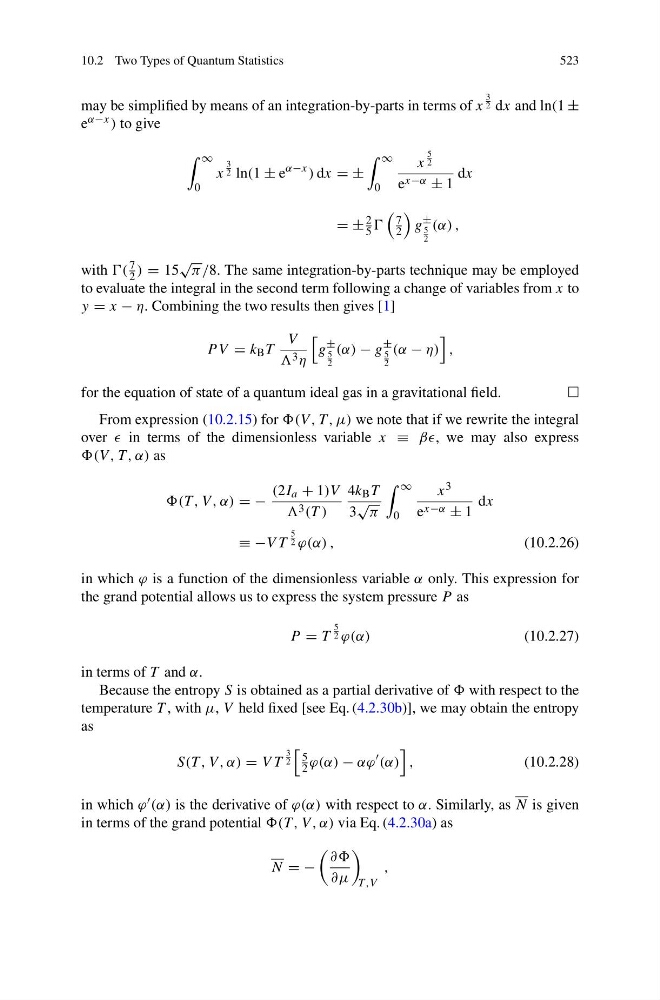
may be simplified by means of an integration-by-parts in terms of x
3
2 dx and ln(1 ±
e α−x ) to give
∞
0
x
3
2 ln(1 ± e
α−x ) dx = ±
∞
0
x
5
2
e x−α ± 1
dx
= ±
2
5
7
2
g
±
5
2
(α) ,
with (
7
2 ) = 15
√
π/8. The same integration-by-parts technique may be employed
to evaluate the integral in the second term following a change of variables from x to
y = x − η. Combining the two results then gives [1]
P V = k B T
V
3 η
g
±
5
2
(α) − g
±
5
2
(α − η)
,
for the equation of state of a quantum ideal gas in a gravitational field.
From expression (10.2.15) for (V , T , μ) we note that if we rewrite the integral
over in terms of the dimensionless variable x ≡ ββ, we may also express
, T , α) as
(T , V , α) = −
(2I a + 1)V
3 (T )
4k B T
3
√
π
∞
0
x 3
e x−α ± 1
dx
≡ −V T
5
2 ϕ(α) ,
(10.2.26)
in which ϕ is a function of the dimensionless variable α only. This expression for
the grand potential allows us to express the system pressure P as
P = T
5
2 ϕ(α)
(10.2.27)
in terms of T and α.
Because the entropy S is obtained as a partial derivative of with respect to the
temperature T , with μ, V held fixed [see Eq. (4.2.30b)], we may obtain the entropy
as
S(T , V , α) = V T
3
2
5
2 ϕ(α) − αϕ
(α)
,
(10.2.28)
in which ϕ (α) is the derivative of ϕ(α) with respect to α. Similarly, as N is given
in terms of the grand potential , V , α) via Eq. (4.2.30a) as
N = −
∂∂
∂μ
T ,V
,
523
may be simplified by means of an integration-by-parts in terms of x
3
2 dx and ln(1 ±
e α−x ) to give
∞
0
x
3
2 ln(1 ± e
α−x ) dx = ±
∞
0
x
5
2
e x−α ± 1
dx
= ±
2
5
7
2
g
±
5
2
(α) ,
with (
7
2 ) = 15
√
π/8. The same integration-by-parts technique may be employed
to evaluate the integral in the second term following a change of variables from x to
y = x − η. Combining the two results then gives [1]
P V = k B T
V
3 η
g
±
5
2
(α) − g
±
5
2
(α − η)
,
for the equation of state of a quantum ideal gas in a gravitational field.
From expression (10.2.15) for (V , T , μ) we note that if we rewrite the integral
over in terms of the dimensionless variable x ≡ ββ, we may also express
, T , α) as
(T , V , α) = −
(2I a + 1)V
3 (T )
4k B T
3
√
π
∞
0
x 3
e x−α ± 1
dx
≡ −V T
5
2 ϕ(α) ,
(10.2.26)
in which ϕ is a function of the dimensionless variable α only. This expression for
the grand potential allows us to express the system pressure P as
P = T
5
2 ϕ(α)
(10.2.27)
in terms of T and α.
Because the entropy S is obtained as a partial derivative of with respect to the
temperature T , with μ, V held fixed [see Eq. (4.2.30b)], we may obtain the entropy
as
S(T , V , α) = V T
3
2
5
2 ϕ(α) − αϕ
(α)
,
(10.2.28)
in which ϕ (α) is the derivative of ϕ(α) with respect to α. Similarly, as N is given
in terms of the grand potential , V , α) via Eq. (4.2.30a) as
N = −
∂∂
∂μ
T ,V
,