

508
9 Chemical Equilibrium
Vibrations having symmetry designations a, e, and f have degeneracies 1, 2, and
3, respectively.
5. Find the values for the equilibrium constant for the dissociation of molecular
bromine at temperatures of 300 K, 500 K, and 1000 K. The dissociation reaction
is
Br 2 (g) 2Br(g) .
The term symbol for ground level molecular bromine is X 1 +
g , its spectroscopic
dissociation energy is D 0 = 1.9707 eV, and ν osc = 323.166 cm −1 , B 0 =
0.08148 cm −1 ; use reduced mass μ = 39.4592 for Br 2 . The ground term for
atomic bromine is X 2 P 3
2
.
6. Calculate values for the equilibrium constant for the formation of 84 Kr 2 Van der
Waals molecules in a sample of krypton gas at temperatures of 200 K, 300 K, and
500 K. The 84 Kr atom has a 1 S 0 ground electronic term, with no low-lying excited
electronic terms. The relevant spectroscopic constants for the 84 Kr 2 molecule
are D 0 = 126.9 cm −1 , ν osc = 23.022 cm −1 , and B 0 = 0.02439 cm −1 ; the
Kr 2 molecule also has no low-lying electronic states. Compare your values for
K eq (T ) calculated for temperatures of 300 K and 500 K for the Kr–Kr 2 system
with corresponding values of K eq (T ) obtained in Problem 5 for the Br–Br 2
system.
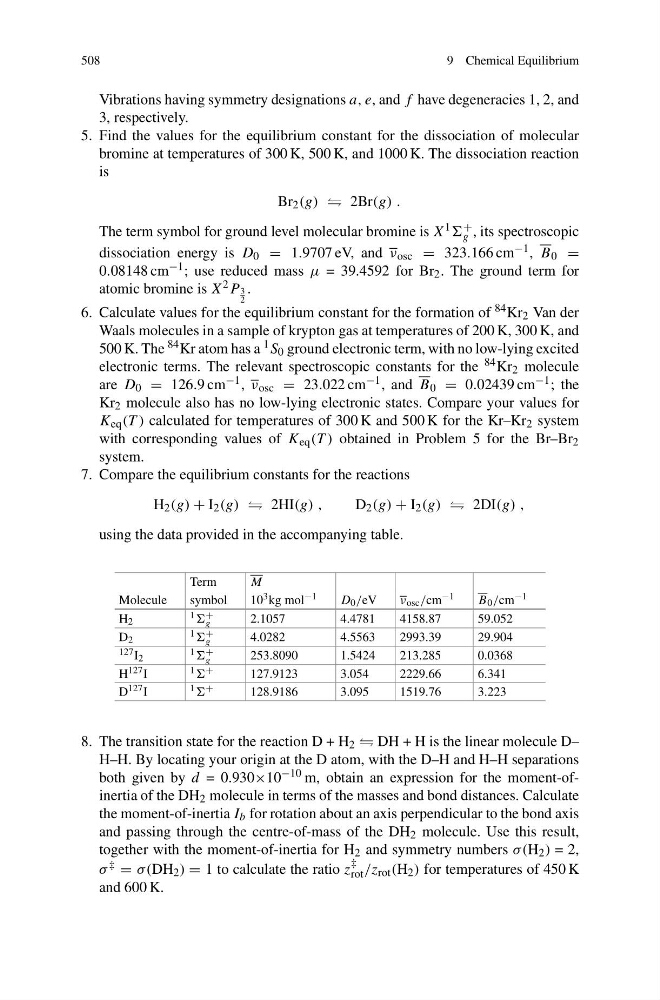
7. Compare the equilibrium constants for the reactions
H 2 (g) + I 2 (g) 2HI(g) ,
D 2 (g) + I 2 (g) 2DI(g) ,
using the data provided in the accompanying table.
Term
M
Molecule
symbol
10 3 kg mol −1
D 0 /eV
ν osc /cm −1
B 0 /cm −1
H 2
1 +
g
2.1057
4.4781
4158.87
59.052
D 2
1 +
g
4.0282
4.5563
2993.39
29.904
127 I 2
1 +
g
253.8090
1.5424
213.285
0.0368
H 127 I
1 +
127.9123
3.054
2229.66
6.341
D 127 I
1 +
128.9186
3.095
1519.76
3.223
8. The transition state for the reaction D + H 2 DH + H is the linear molecule D–
H–H. By locating your origin at the D atom, with the D–H and H–H separations
both given by d = 0.930×10 −10 m, obtain an expression for the moment-ofinertia of the DH 2 molecule in terms of the masses and bond distances. Calculate
the moment-of-inertia I b for rotation about an axis perpendicular to the bond axis
and passing through the centre-of-mass of the DH 2 molecule. Use this result,
together with the moment-of-inertia for H 2 and symmetry numbers σ (H 2 ) = 2,
σ ‡ = σ (DH 2 ) = 1 to calculate the ratio z
‡
rot /z rot (H 2 ) for temperatures of 450 K
and 600 K.
9 Chemical Equilibrium
Vibrations having symmetry designations a, e, and f have degeneracies 1, 2, and
3, respectively.
5. Find the values for the equilibrium constant for the dissociation of molecular
bromine at temperatures of 300 K, 500 K, and 1000 K. The dissociation reaction
is
Br 2 (g) 2Br(g) .
The term symbol for ground level molecular bromine is X 1 +
g , its spectroscopic
dissociation energy is D 0 = 1.9707 eV, and ν osc = 323.166 cm −1 , B 0 =
0.08148 cm −1 ; use reduced mass μ = 39.4592 for Br 2 . The ground term for
atomic bromine is X 2 P 3
2
.
6. Calculate values for the equilibrium constant for the formation of 84 Kr 2 Van der
Waals molecules in a sample of krypton gas at temperatures of 200 K, 300 K, and
500 K. The 84 Kr atom has a 1 S 0 ground electronic term, with no low-lying excited
electronic terms. The relevant spectroscopic constants for the 84 Kr 2 molecule
are D 0 = 126.9 cm −1 , ν osc = 23.022 cm −1 , and B 0 = 0.02439 cm −1 ; the
Kr 2 molecule also has no low-lying electronic states. Compare your values for
K eq (T ) calculated for temperatures of 300 K and 500 K for the Kr–Kr 2 system
with corresponding values of K eq (T ) obtained in Problem 5 for the Br–Br 2
system.
7. Compare the equilibrium constants for the reactions
H 2 (g) + I 2 (g) 2HI(g) ,
D 2 (g) + I 2 (g) 2DI(g) ,
using the data provided in the accompanying table.
Term
M
Molecule
symbol
10 3 kg mol −1
D 0 /eV
ν osc /cm −1
B 0 /cm −1
H 2
1 +
g
2.1057
4.4781
4158.87
59.052
D 2
1 +
g
4.0282
4.5563
2993.39
29.904
127 I 2
1 +
g
253.8090
1.5424
213.285
0.0368
H 127 I
1 +
127.9123
3.054
2229.66
6.341
D 127 I
1 +
128.9186
3.095
1519.76
3.223
8. The transition state for the reaction D + H 2 DH + H is the linear molecule D–
H–H. By locating your origin at the D atom, with the D–H and H–H separations
both given by d = 0.930×10 −10 m, obtain an expression for the moment-ofinertia of the DH 2 molecule in terms of the masses and bond distances. Calculate
the moment-of-inertia I b for rotation about an axis perpendicular to the bond axis
and passing through the centre-of-mass of the DH 2 molecule. Use this result,
together with the moment-of-inertia for H 2 and symmetry numbers σ (H 2 ) = 2,
σ ‡ = σ (DH 2 ) = 1 to calculate the ratio z
‡
rot /z rot (H 2 ) for temperatures of 450 K
and 600 K.