

9.3 Four Extended Examples
497
Thus, for this particular alkali metal, we obtain α as
α = 0.1826
P ◦
P
1
2
T
5
4 e
−2.259×10 4 /T
(9.3.24)
for arbitrary temperature T . At 1500 K and a total gas pressure of 0.01313 bar, for
example, we obtain α(Cs) = 0.0136.
Example 9.4 A simple isotopic exchange reaction.
Isotopic exchange reactions are particularly simple examples of chemical reactions that still illustrate the utility of the statistical mechanical expression for the
equilibrium constant. We shall obtain an expression for the equilibrium constant,
K P (T ), for the isotopic exchange reaction between two homonuclear chlorine
isotopologues, specifically,
35 Cl 2 +
37 Cl 2 2
35 Cl
37 Cl .
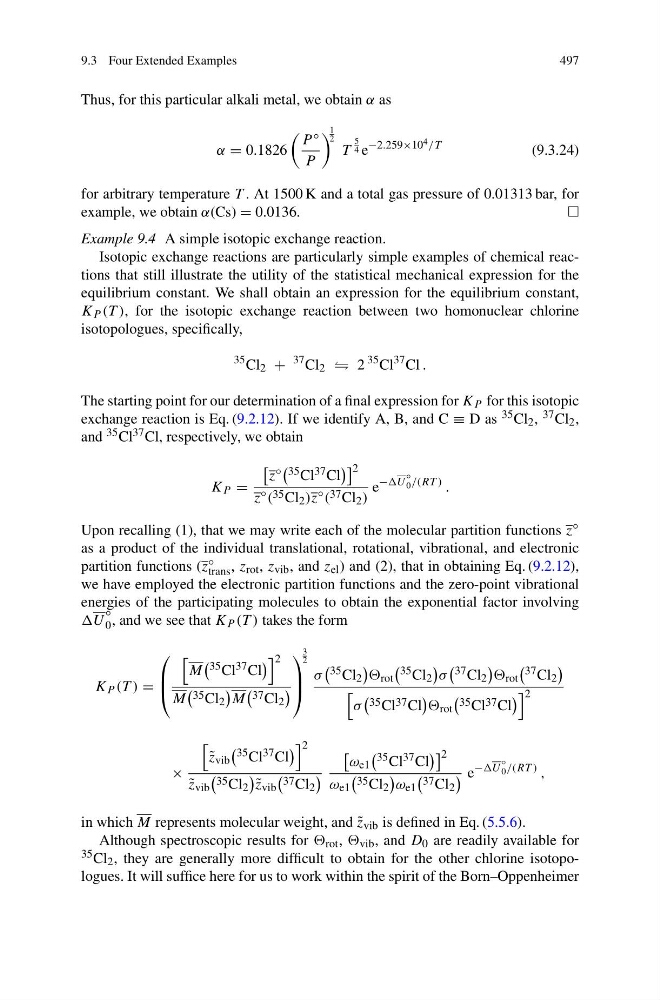
The starting point for our determination of a final expression for K P for this isotopic
exchange reaction is Eq. (9.2.12). If we identify A, B, and C ≡ D as 35 Cl 2 , 37 Cl 2 ,
and 35 Cl 37 Cl, respectively, we obtain
K P =
z
◦
35 Cl 37 Cl
2
z
◦ ( 35 Cl 2 )z
◦ ( 37 Cl 2 )
e
−U
◦
0 /(RT ) .
Upon recalling (1), that we may write each of the molecular partition functions z
◦
as a product of the individual translational, rotational, vibrational, and electronic
partition functions (z
◦
trans , z rot , z vib , and z el ) and (2), that in obtaining Eq. (9.2.12),
we have employed the electronic partition functions and the zero-point vibrational
energies of the participating molecules to obtain the exponential factor involving
U
◦
0 , and we see that K P (T ) takes the form
K P (T ) =
⎛
⎜
⎝
M
35 Cl 37 Cl
2
M
35 Cl 2
M
37 Cl 2
⎞
⎟
⎠
3
2
σ
35 Cl 2
rot
35 Cl 2
σ
37 Cl 2
rot
37 Cl 2
σ
35 Cl 37 Cl
rot
35 Cl 37 Cl
2
×
˜
z vib
35 Cl 37 Cl
2
˜
z vib
35 Cl 2
˜
z vib
37 Cl 2
ω e1
35 Cl 37 Cl
2
ω e1
35 Cl 2
ω e1
37 Cl 2
e
−U
◦
0 /(RT ) ,
in which M represents molecular weight, and ˜
z vib is defined in Eq. (5.5.6).
Although spectroscopic results for rot , vib , and D 0 are readily available for
35 Cl 2 , they are generally more difficult to obtain for the other chlorine isotopologues. It will suffice here for us to work within the spirit of the Born–Oppenheimer
497
Thus, for this particular alkali metal, we obtain α as
α = 0.1826
P ◦
P
1
2
T
5
4 e
−2.259×10 4 /T
(9.3.24)
for arbitrary temperature T . At 1500 K and a total gas pressure of 0.01313 bar, for
example, we obtain α(Cs) = 0.0136.
Example 9.4 A simple isotopic exchange reaction.
Isotopic exchange reactions are particularly simple examples of chemical reactions that still illustrate the utility of the statistical mechanical expression for the
equilibrium constant. We shall obtain an expression for the equilibrium constant,
K P (T ), for the isotopic exchange reaction between two homonuclear chlorine
isotopologues, specifically,
35 Cl 2 +
37 Cl 2 2
35 Cl
37 Cl .
The starting point for our determination of a final expression for K P for this isotopic
exchange reaction is Eq. (9.2.12). If we identify A, B, and C ≡ D as 35 Cl 2 , 37 Cl 2 ,
and 35 Cl 37 Cl, respectively, we obtain
K P =
z
◦
35 Cl 37 Cl
2
z
◦ ( 35 Cl 2 )z
◦ ( 37 Cl 2 )
e
−U
◦
0 /(RT ) .
Upon recalling (1), that we may write each of the molecular partition functions z
◦
as a product of the individual translational, rotational, vibrational, and electronic
partition functions (z
◦
trans , z rot , z vib , and z el ) and (2), that in obtaining Eq. (9.2.12),
we have employed the electronic partition functions and the zero-point vibrational
energies of the participating molecules to obtain the exponential factor involving
U
◦
0 , and we see that K P (T ) takes the form
K P (T ) =
⎛
⎜
⎝
M
35 Cl 37 Cl
2
M
35 Cl 2
M
37 Cl 2
⎞
⎟
⎠
3
2
σ
35 Cl 2
rot
35 Cl 2
σ
37 Cl 2
rot
37 Cl 2
σ
35 Cl 37 Cl
rot
35 Cl 37 Cl
2
×
˜
z vib
35 Cl 37 Cl
2
˜
z vib
35 Cl 2
˜
z vib
37 Cl 2
ω e1
35 Cl 37 Cl
2
ω e1
35 Cl 2
ω e1
37 Cl 2
e
−U
◦
0 /(RT ) ,
in which M represents molecular weight, and ˜
z vib is defined in Eq. (5.5.6).
Although spectroscopic results for rot , vib , and D 0 are readily available for
35 Cl 2 , they are generally more difficult to obtain for the other chlorine isotopologues. It will suffice here for us to work within the spirit of the Born–Oppenheimer