

8.6 Magnetism, II. Ferromagnetism
467
Z N (T ) ≡
2 N
r N =1
e
−βE r N
(8.6.4)
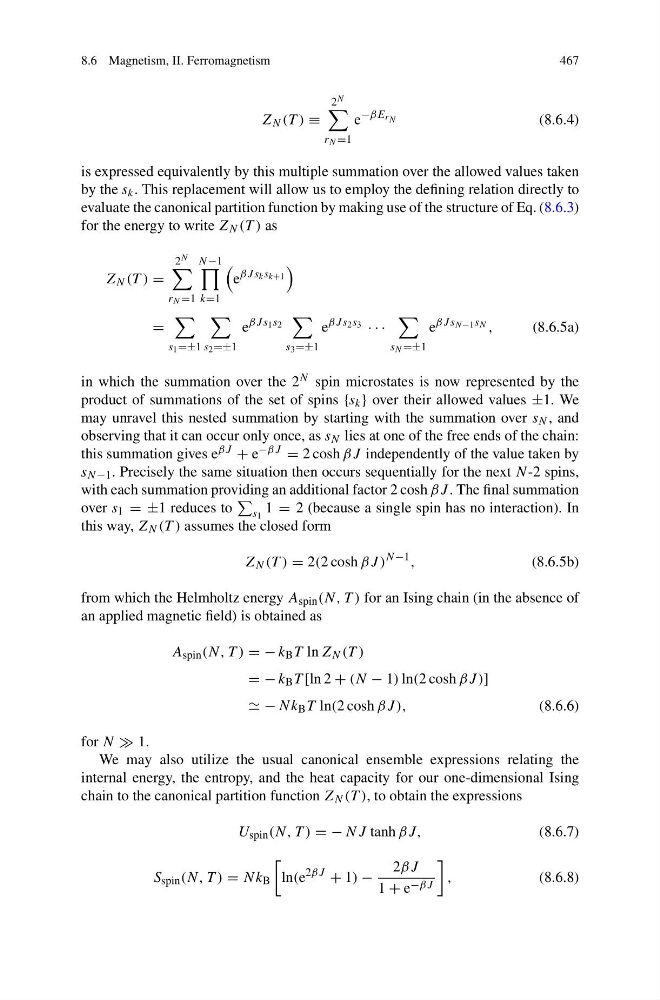
is expressed equivalently by this multiple summation over the allowed values taken
by the s k . This replacement will allow us to employ the defining relation directly to
evaluate the canonical partition function by making use of the structure of Eq. (8.6.3)
for the energy to write Z N (T ) as
Z N (T ) =
2 N
r N =1
N −1
k=1
e
βJ s k s k+1
=
s 1 =±1
s 2 =±1
e
βJ s 1 s 2
s 3 =±1
e
βJ s 2 s 3 · · ·
s N =±1
e
βJ s N−1 s N ,
(8.6.5a)
in which the summation over the 2 N spin microstates is now represented by the
product of summations of the set of spins {s k } over their allowed values ±1. We
may unravel this nested summation by starting with the summation over s N , and
observing that it can occur only once, as s N lies at one of the free ends of the chain:
this summation gives e βJ + e −βJ = 2 cosh βJ independently of the value taken by
s N −1 . Precisely the same situation then occurs sequentially for the next N-2 spins,
with each summation providing an additional factor 2 cosh βJ . The final summation
over s 1 = ±1 reduces to
s 1
1 = 2 (because a single spin has no interaction). In
this way, Z N (T ) assumes the closed form
Z N (T ) = 2(2 cosh βJ )
N −1 ,
(8.6.5b)
from which the Helmholtz energy A spin (N, T ) for an Ising chain (in the absence of
an applied magnetic field) is obtained as
A spin (N, T ) = − k B T ln Z N (T )
= − k B T [ln 2 + (N − 1) ln(2 cosh βJ )]
− Nk B T ln(2 cosh βJ ),
(8.6.6)
for N 1.
We may also utilize the usual canonical ensemble expressions relating the
internal energy, the entropy, and the heat capacity for our one-dimensional Ising
chain to the canonical partition function Z N (T ), to obtain the expressions
U spin (N, T ) = − NJ tanh βJ,
(8.6.7)
S spin (N, T ) = Nk B
ln(e
2βJ
+ 1) −
2βJ
1 + e −βJ
,
(8.6.8)
467
Z N (T ) ≡
2 N
r N =1
e
−βE r N
(8.6.4)
is expressed equivalently by this multiple summation over the allowed values taken
by the s k . This replacement will allow us to employ the defining relation directly to
evaluate the canonical partition function by making use of the structure of Eq. (8.6.3)
for the energy to write Z N (T ) as
Z N (T ) =
2 N
r N =1
N −1
k=1
e
βJ s k s k+1
=
s 1 =±1
s 2 =±1
e
βJ s 1 s 2
s 3 =±1
e
βJ s 2 s 3 · · ·
s N =±1
e
βJ s N−1 s N ,
(8.6.5a)
in which the summation over the 2 N spin microstates is now represented by the
product of summations of the set of spins {s k } over their allowed values ±1. We
may unravel this nested summation by starting with the summation over s N , and
observing that it can occur only once, as s N lies at one of the free ends of the chain:
this summation gives e βJ + e −βJ = 2 cosh βJ independently of the value taken by
s N −1 . Precisely the same situation then occurs sequentially for the next N-2 spins,
with each summation providing an additional factor 2 cosh βJ . The final summation
over s 1 = ±1 reduces to
s 1
1 = 2 (because a single spin has no interaction). In
this way, Z N (T ) assumes the closed form
Z N (T ) = 2(2 cosh βJ )
N −1 ,
(8.6.5b)
from which the Helmholtz energy A spin (N, T ) for an Ising chain (in the absence of
an applied magnetic field) is obtained as
A spin (N, T ) = − k B T ln Z N (T )
= − k B T [ln 2 + (N − 1) ln(2 cosh βJ )]
− Nk B T ln(2 cosh βJ ),
(8.6.6)
for N 1.
We may also utilize the usual canonical ensemble expressions relating the
internal energy, the entropy, and the heat capacity for our one-dimensional Ising
chain to the canonical partition function Z N (T ), to obtain the expressions
U spin (N, T ) = − NJ tanh βJ,
(8.6.7)
S spin (N, T ) = Nk B
ln(e
2βJ
+ 1) −
2βJ
1 + e −βJ
,
(8.6.8)